


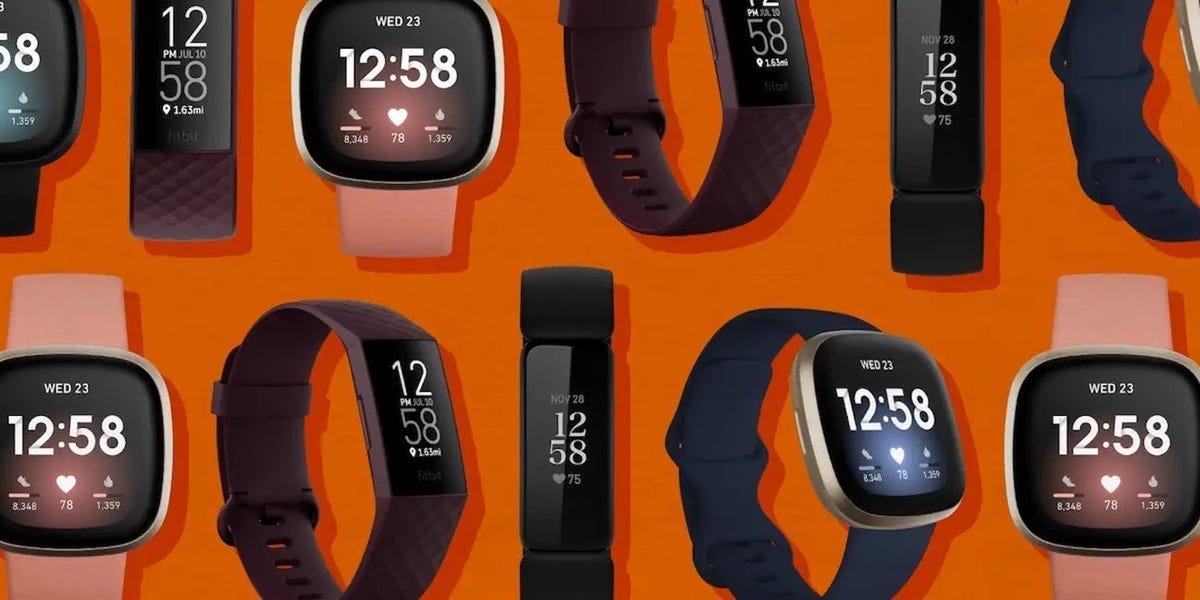
Fitbit is the original fitness tracker. Although the wearable world has been flooded with new brands and categories (ahem, smart rings), the best Fitbit devices remain some of the most dependable, user-friendly, and affordable trackers out there. Whether you’re aiming to up your daily step count, improve your sleep, or train for a half-marathon, there’s a Fitbit that fits your needs and budget.
Fitbit was launched in 2007 and acquired by Google in 2021. The change in ownership hasn’t significantly affected the brand, but Fitbit’s technology has now been integrated into the Google Pixel Watch. Fitbit health and fitness trackers still offer long multi-day battery life, seamless compatibility with both iOS and Android, and access to Fitbit’s well-established app, which stores all your data — years’ worth, for brand loyalists — in one place.
Fitbit offers five models in its current lineup, but there are really only three that we consider the best picks for most people. Our top recommendation is the Fitbit Charge 6. It’s an exceptional fitness tracker offering long battery life, health-monitoring tools, and comprehensive activity data. For a budget-friendly option, we recommend the Fitbit Inspire 3, a worthwhile entry-level wearable with basic health and fitness tools for under $100.
Our top picks for the best Fitbit
Best overall: Fitbit Charge 6 – See at Amazon
Best budget: Fitbit Inspire 3 – See at Amazon
Best midrange: Fitbit Versa 4 – See at Amazon
Honorable mention for Android users: Google Pixel Watch 3 – See at Amazon
Best overall
Fitbit Charge 6
The Charge 6 by Fitbit has a more expansive feature set than the budget-friendly Inspire 3 for fitness, whether you’re an amateur or enthusiast. While it’s a pricier option, it’s still amazing value for such a capable fitness tracker.
Whether you’re looking to increase your daily step count, track your sleep, or train for a race, the Fitbit Charge 6 is the best Fitbit for most people.
The Charge 6 is a kind of “smartwatch-y tracker”: It’s not a smartwatch, but it does have features like Google Maps, Google Wallet, and the ability to display messages on your wrist. That said, its screen is smaller, and its core focus is helping you achieve your health and fitness goals.
Rachael Schultz/Business Insider
It offers the most accurate heart rate tracking of Fitbit’s entire lineup, especially during intense interval workouts. It also features built-in GPS, electrocardiogram (ECG) sensors to assess any heart rhythm irregularities, electrodermal (EDA) sensors to assess stress levels, blood oxygen tracking, and all-day stress tracking (though you’ll need a Fitbit subscription to access the coaching side of how you can improve any of these numbers).
The Charge 6 is compact, lightweight, and water-resistant, making it comfortable to wear while working out, showering, or sleeping. The display doesn’t take up your whole wrist, but it’s large enough to read at a glance. Its battery life stretches up to six days (shorter than the Inspire but longer than the Versa). And while you’ll get text and app notifications, the Charge 6 isn’t trying to replace your phone — it’s a tracker first, smartwatch second.
This is the best choice for people who want a range of health and fitness features without the bulk or distractions of a full smartwatch.
Best budget
Fitbit Inspire 3
The Inspire 3 may be one of Fitbit’s most basic watches, but it still packs a powerful fitness-tracking punch with tons of trackable activities, advanced health features like skin temperature sensing, and a comfortable, lightweight design.
The Fitbit Inspire 3 is a great intro fitness tracker. If you are just getting into a new health or fitness routine and want the basics of a fitness tracker without all the frills — or the triple-digit price tag — we love the Inspire 3. In fact, this is the tracker I got my mom for Christmas when she said she wanted to make sure she was walking enough and sleeping well. It has just enough features to provide value without being overwhelming.
Rachael Schultz/Business Insider
You get a lot for a relatively low price. For $100 or less (it’s often on sale), it provides 24/7 heart rate monitoring, step counting, blood oxygen tracking, and automatic workout detection. In the app, it also offers a stress management score, although this is derived from a combination of metrics such as heart rate, activity levels, and sleep patterns, rather than the more advanced EDA sensors found in the Inspire and Versa. With a premium membership, you also get access to Fitbit’s library of mindfulness and deep breathing sessions. To improve your sleep, the Inspire 3 tracks sleep stages, duration, and heart rate variability, using all of these data points to provide you with a daily sleep score. You’ll also get daily readiness scores and personalized activity reminders on your wrist.
It’s slim, modern-looking (thanks to a bright, colorful AMOLED display), and built for all-day comfort, even while you sleep. It’s also compatible with a range of the best Inspire 3 bands, allowing you to change its look slightly.
It cuts corners with no built-in GPS — you’ll need to carry your phone to track distance — and no smartwatch features like on-wrist messages or music control. But thanks to Fitbit’s robust technology, it still delivers all the aforementioned basics with surprising accuracy.
Read our full Fitbit Inspire 3 review.
Best midrange
Fitbit Versa 4
The Fitbit Versa 4 is a great midrange tracker if you want Fitbit features and usability packed into a design that closely resembles a typical smartwatch.
The Versa 4 is the closest thing Fitbit makes to a traditional smartwatch. It boasts a large AMOLED display, physical button, and the ability to take Bluetooth calls and see notifications at a glance.
Functionally, it shares many similarities with the Charge 6 — including blood oxygen monitoring (SpO2), sleep tracking, stress data, and built-in GPS. However, the Versa 4 features a more traditional smartwatch aesthetic, with its large, square screen and the ability to answer phone calls directly from the wrist.
Rick Stella/Business Insider
Fitbit technically has other smartwatches: The Sense 2, which is basically the Versa with continuous EDA scanning to better alert you to stress patterns in real time for $50 more, and the Pixel Watch 3 and 4, which are arguably more advanced but only compatible with Android and pricier than the Versa 4 (more on that one in a sec).
Still, the Versa 4 delivers on everyday usability: You’ll get four to six days of battery life, a bright screen, and access to Fitbit’s app experience (though a Premium monthly membership is required to get the most out of its offerings). If you want the sleekness and convenience of a smartwatch with most of the usable health and fitness features, all at a midrange price, the Versa 4 is for you.
Honorable mention for Android users
Google Pixel Watch 3
The latest Google Pixel Watch offers robust fitness tracking benefits like Fitbit Morning Brief, advanced running features, and target cardio load. The bezel is still quite thick, but given most apps run on a black background, it’s really not that noticeable, and the rounded glass design makes it one of the best-looking smartwatches money can buy.
Though not technically a Fitbit-branded device, the Google Pixel Watch 3 is powered by Fitbit’s technology, and it’s such a good wearable that it’s worth a mention in this guide. For Android users who want both smart features and Fitbit’s health data, the Pixel Watch 3 is worth the money.
Antonio Villas-Boas/Business Insider
It includes advanced metrics like cardio load, workout fatigue, loss-of-pulse alerts, and a helpful “morning brief” that summarizes your sleep, weather, and calendar at a glance. The integrated microphone and speaker let you take calls, set reminders, and respond to texts, and the built-in workout builder (via the Fitbit app) is a standout tool for training.
You’ll get better app integration and smart features than any Fitbit device, even the Versa. But the tradeoff is battery life — you’ll need to charge it every 24 to 36 hours. It’s also Android-only. Still, if you’re someone who wants your health tracking built into a stylish timepiece, the Pixel Watch 3 is worth the extra spend.
However, buyers should note that a new Pixel Watch 4 is scheduled to launch in October. The new model has a brighter screen that uses a dome shape to provide a larger viewing area. Google says the Pixel Watch 4 will also offer longer battery life, with up to 40 hours of charge. The LTE model will also provide emergency satellite communication. If those features sound interesting, you may want to hold off for the new model, but keep in mind that it costs around $50 to $100 more than the Pixel Watch 3 typically sells for.
How we chose the best Fitbits
Rick Stella/Business Insider
As a health and fitness writer for over a decade, I’ve worn numerous Fitbits across various generations while training for half-marathons, sweating in HIIT classes, and commuting to and from my office job. While I haven’t tested every model on this list, I am intimately familiar with Fitbit’s technology and ecosystem and have researched its current product offerings extensively. When considering which is the best Fitbit for different types of people, I prioritized:
Sensor quality and accuracy (heart rate, GPS, SpO₂, ECG, EDA)Battery life during real-world useDesign, comfort, and durability for everyday and sleepwearCompanion app quality for interpreting health dataPlatform compatibility across Android and iOS
I also considered which models offer the most features without requiring Fitbit Premium — although many models unlock deeper insights with a subscription.
Fitbit FAQs
Shannon Ullman/Business Insider
Are Fitbits worth it?
Fitbit wearables are backed with reliable heart rate technology, well-designed to be compact but readable, and generally well-priced compared to other fitness trackers. Furthermore, the free Fitbit companion app provides significant value to individuals seeking guidance on enhancing their workouts, sleep, and stress management, although the Premium subscription offers even greater benefits.
There are other brands with longer battery life, better GPS tracking, and potentially more robust smartwatch features, but if you want a reliable health and fitness tracker without spending a fortune, Fitbits are definitely worth it.
For other top picks in the wearable tracker space, check out our guides to the best Android smartwatches, best fitness trackers, best smart rings, and best Garmin watches.
What is Fitbit Premium?
Fitbit Premium is the brand’s monthly membership option. You can access the Fitbit app for free to view basic data, including your steps, sleep score, period tracking, activity tracking, and the Daily Readiness Score. However, for $10/month, Fitbit Premium provides access to more in-depth health and fitness features, including nutrition insights, advanced sleep tracking (e.g., insights into your sleep stages), and access to the workout and mindfulness libraries to help reduce stress. It also offers guided meditations, exclusive video workouts, in-depth goal setting, various unique challenges, and other health insights such as blood oxygen level readings, heart rate variability, and breathing rate.
You don’t need a Fitbit Premium subscription to use a Fitbit, but it does help elevate the base experience on any wearable in its lineup.
Is the Fitbit app getting a new AI coach?
During its August Pixel product launch, Google announced plans to bring a new AI-powered personal health coach to the Fitbit app. The new feature is part of a larger redesign of the entire app, and it will be available as a preview to Fitbit Premium subscribers this fall. You can sign up to gain access to the preview via the Google website.
The Fitbit personal health coach is built using Google’s Gemini AI. The company says it will create fitness plans tailored to your specific goals, featuring training routines, sleep insights, and wellness suggestions. The AI coach will learn more about your needs by tracking your fitness data and your ongoing conversations within the app.
Is a Fitbit better than an Apple Watch?
The best Apple Watch models are more powerful and full-featured than Fitbits, but if you don’t need access to a suite of apps, then a Fitbit will suffice. Both options offer deep tracking capabilities for activities such as running, cycling, and weightlifting, and each comes standard with a user-friendly interface.
Though the Apple Watch now offers a deep well of fitness and activity tracking capability, it still leans more heavily toward being a smartwatch (similar to Fitbit’s Versa line, though arguably better). So, if you’re after basic fitness tracking without the frills, something like Fitbit’s Charge 6 would be more your speed.
Will a Fitbit work with an iPhone or Apple Health?
Fitbits are compatible with any iPhone running iOS 16.4 or later, which is the minimum requirement for the Fitbit app. You can learn more about compatibility on the Fitbit website.
While a Fitbit can’t directly sync to the Apple Health app, it is possible to use third-party apps like Strava as a go-between to transfer data indirectly from a Fitbit to the Apple Health app.
What’s the battery life like on a Fitbit?
The latest Fitbit models offer battery life ranging from four to 10 days, with an average of around six days. In our experience, the Sense 2 lasts an average of six days on one charge, while the Inspire 3 lasts up to 10 days, for instance.
While top Garmin watches generally have a longer battery life, most Fitbits last long enough that you won’t have to worry about charging them every night.
How accurate are Fitbits for tracking steps, heart rate, and sleep?
Fitbits are very accurate for tracking steps, heart rate, and sleep quality. Because it’s one of the original tracking brands, Fitbit has been refining its technology for nearly 20 years. While it is outperformed by Garmin in on-wrist GPS tracking capabilities (e.g., the exact mileage of your morning run), pretty much every fitness tracker is equally reliable in step count and heart rate these days.
Which Fitbit is best for beginners
The best Fitbit for beginners is the Inspire 3. It offers all the basics you’ll want to kick-start your health journey — step count, sleep quality, automatic workout detection — without any of the superfluous data to overcomplicate things, and all for $100 or less. If you pay for a Fitbit Premium membership, you’ll also score coaching on how to improve your workouts or stress levels.
Will there be new Fitbit models?
Based on comments the company made in 2024, Google does not plan to release new Fitbit Versa or Sense models. However, new Charge and Inspire models are a possibility, though nothing concrete has been announced.
