


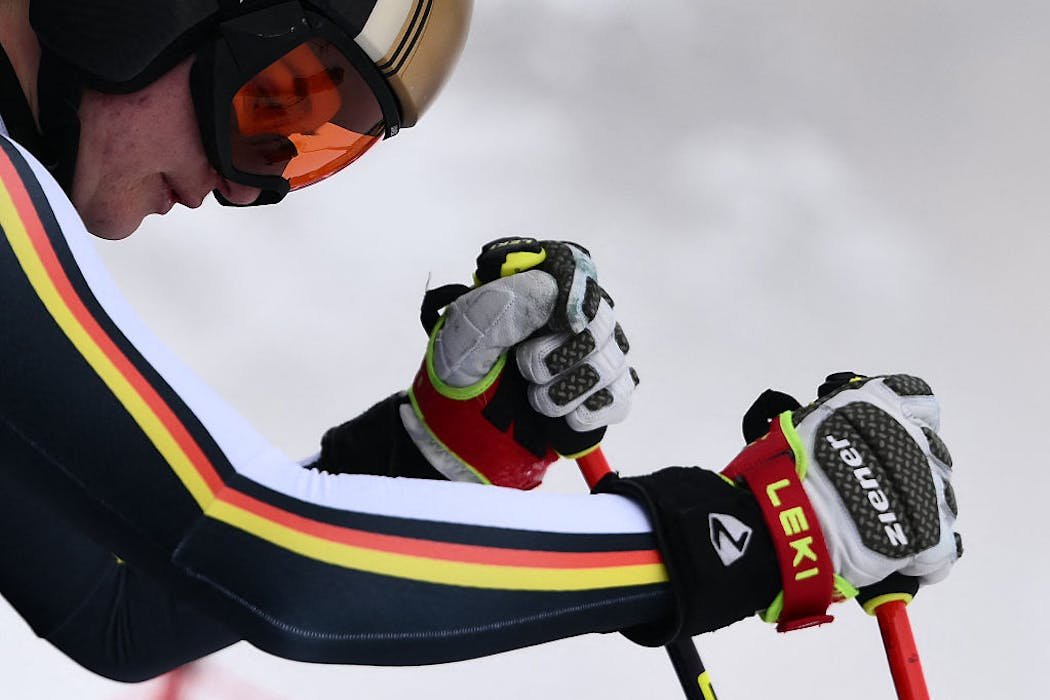
At the Winter Olympics, skiers, bobsledders, speedskaters and many other athletes all have to master one critical moment: when to start. That split second is paramount during competition because when everyone is strong and skilled, a moment of hesitation can separate gold from silver. A competitor who hesitates too much will be left behind – but moving too early will get them disqualified.
Though the circumstances are less intense, this paradox of hesitation applies to daily life. Waiting for the right moment to cross the street, or pausing before deciding whether to answer a call from a number you don’t recognize, are daily examples of hesitation. Importantly, some psychiatric conditions such as obsessive-compulsive disorder are characterized by impulsivity, or a lack of hesitation, while excessive hesitation is a crippling consequence of several anxiety disorders.
As a neuroscientist, I have been working to uncover how the brain decides when to act and when to wait. Recent research from my team and me helps explain why this split-second pause happens, offering insight not only into elite athletic performance, but also how people make everyday decisions when the potential outcome isn’t clear.
We found that the key to hesitation is a response to uncertainty. This could be where a dropped hockey puck will land, when a race starts, or placing your order at a new restaurant.

Hesitation and the brain
To understand how the brain controls hesitation, my colleagues and I designed a simple decision-making task in mice.
The task required the mouse’s brain to interpret signals that were predictably good, predictably bad or – most importantly – uncertain, meaning somewhere in between. Different auditory tones indicated whether a drop of sugar water would soon be delivered, not delivered, or had a 50/50 chance of delivery.
How the mice behaved would not affect the outcome. Nevertheless, mice would still wait longer before licking to see whether a reward had been given in the uncertain scenario. Just like in people, unpredictable situations led to delays in response. This hesitation was not the result of vacillating between options in indecision, but an active and regulated brain process to pause before acting due to environmental uncertainty.
When we examined neural activity associated with the onset of licking, we identified a specific group of neurons that became active only when outcomes were unclear. Those neurons effectively controlled whether the brain should commit to an action or pause to gather more information. The degree to which these neurons were active could predict whether mice would hesitate before making a decision.
To confirm that these neurons played a role in controlling hesitation, we used a technique called optogenetics to briefly turn these brain cells on or off. When we activated the neurons, mice hesitated more. When we silenced them, that hesitation faded and their responses were quicker by several hundred milliseconds, in line with their reactions to predictable situations.
Daily life, disease and downhill racing
Our findings suggest that, rather than a weakness to overcome, hesitation appears to be a fundamental brain feature that helps people and animals navigate an uncertain world and avoid costly mistakes.
Our study also provides insights into the balance of action and inaction in health and disease. The hesitation neurons are located in the basal ganglia, the same part of the brain affected in Parkinson’s disease, OCD and addiction. While researchers must still determine how much overlap or interaction there is between the cells involved in hesitation and those affected in psychiatric disorders, their overlap in circuitry points to possible targets for treatment.
Our next step is to understand how cells controlling hesitation interact with drugs treating ADHD and OCD, conditions where patients can respond impulsively during volatile or uncertain situations.
We also aim to identify which brain areas provide these cells with information about uncertainty – the environmental signal so critical to hesitation. While researchers have found that several parts of an area of the brain called the prefrontal cortex encode uncertainty, it’s unclear how the brain actually makes use of this information, where the rubber meets the road.
Hesitation is not a flaw – it’s a critical feature for navigating an unpredictable world. Whether you’re a figure skater waiting for the perfect moment to launch your jump or just going about your day, the circuitry behind hesitation plays an important role in figuring out the timing to get the action right.
This article is republished from The Conversation, a nonprofit, independent news organization bringing you facts and trustworthy analysis to help you make sense of our complex world. It was written by: Eric Yttri, Carnegie Mellon University
Read more:
Eric Yttri receives funding from the National Institute of Health and the Binational Science Foundation.
