


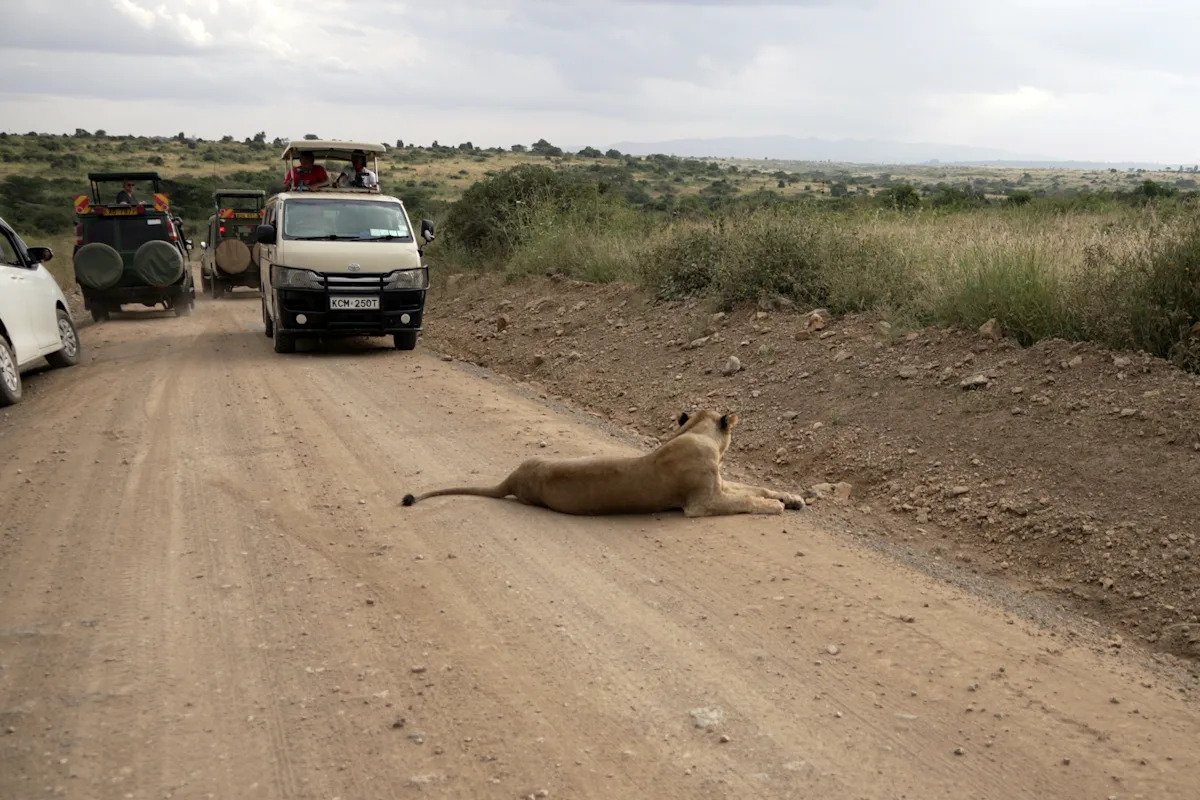
KAJIADO, Kenya (AP) — This year, less than a kilometer from where I live, a girl named Peace Mwende was killed by a lion. The news hit me hard: She was 14, the same age as my youngest daughter, and the lioness responsible may have been one of the animals we see in our neighborhood almost weekly.
Our children are growing up in a part of Nairobi where lions roam free. We see them while taking our kids to school. We’ve lost pets and livestock. Neighborhood WhatsApp groups share warnings when big cats come close — and feature CCTV footage of lions hunting family pets.
It’s a conservation headache for the Kenya Wildlife Service (KWS), which is tasked with keeping people who share space with wildlife safe, while protecting the wildlife as well — especially endangered species. KWS estimates that “just over 2,000” lions remain in Kenya.
“During the rainy season, tall grass and shifting herbivore patterns make it difficult for carnivores to hunt,” KWS wrote on a reel of a Nairobi lion cub rescue posted to its social media in July. The cub in the video had been seen starving in the park, causing a public outcry. KWS added it was “conducting a feeding intervention, providing meat daily to the pride residing in the park to help them regain their strength and resume natural hunting.”
Nairobi National Park, bordering the city to the north, has long relied on vast southern grazing lands for its wildlife to migrate to other protected areas. With those areas fast turning into residential and industrial developments, Kenya’s State Department for Wildlife announced a nearly $5 billion plan to create a migratory corridor between Nairobi and conservancies to the south. There are also nongovernment initiatives that pay landowners bordering Nairobi National Park a small annual fee to keep their properties unfenced for wildlife.
But will it be enough?
Avoid sudden movements
What’s missing is greater awareness on how to behave around predators, especially among increasingly urban communities who are coming into contact with them.
My children never learned this in school. Their closest encounter with a lion was in 2020, when we took advantage of a post-COVID bookings slump to show them the Maasai Mara National Reserve. An incredibly knowledgeable local guide led us through the southern reserve in a completely open safari vehicle, surrounded by surging wildebeest.
On one outing, our guide stopped the car for a passing trio of hunting lionesses. The first strode by, ignoring us. The second looked as if she was going to pass behind the car, but was distracted by the glint of a seatbelt buckle, which my daughter was absentmindedly playing with. The lioness stopped, turned to stare, then wandered up to us. Stretching her head up towards my child, she sniffed the buckle before taking it between her teeth. My daughter sat stiff, perhaps ten inches from the lioness’s head, which suddenly seemed impossibly huge.
“Keep still,” the guide murmured under his breath. “Don’t move. Don’t make a sound.”
Her curiosity satisfied, the lioness ducked under the car and moved on.
That day, we learned a lesson in predator behavior during a holiday experience very few Kenyans can afford. It may have recently saved my wife’s life when she encountered a lioness in our garden. Checking to see what our dog was barking at, she spotted a lioness under a bush less than 10 yards away. Only its head was visible.
“No sudden movements,” she mumbled to herself, remembering our guide. “Don’t make a sound.” She walked slowly and silently backwards to the house, until she was close enough to the front door to break into a run and tell us all what had happened.
A different kind of front line
I’ve covered conflicts in Iraq, Afghanistan, Sierra Leone, Gaza and Syria, receiving regular hostile environment training to keep me as safe as possible. I chose to make my home in nature.
But here, I find myself on a different kind of front line.
In December 2019, a man named Simon Kipkirui went out to Tuala, a small settlement across the river from us. He decided, against friends’ advice, to walk home at night. He never made it. He lived in our compound; he had helped to build our house and to plant many of the trees that now form the indigenous forest that surrounds our home.
I called his brother, and a group went out to retrace his steps. Nothing. Two more days passed before his brother, Daniel Rono, discovered a bag of maize flour lying in a patch of wilderness between our home and Tuala. He investigated.
“I reached for the maize flour and saw Simon’s head. It was separated from his body. I reached for the head and saw a hand, then a leg inside a gumboot,” Daniel remembers. Horrified, he called me. As we started on the grisly task of trying to find Simon’s remains, we were pushed back by a warning growl. It was a male lion, still guarding the kill.
At this point, Simon had been missing for 2 1/2 days. No one knows whether the lion that was with him by the time we found him was responsible for his death. Lions who kill humans – the notorious man-eaters – are shot to avoid recurrence, and KWS claim to have shot the lioness that killed Peace Mwende the night of that attack.
Although human-wildlife conflict has existed for as long as humans have, predator attacks are likely to rise as space for Kenya’s lions shrinks and their hunting opportunities diminish. This can only spell doom for Nairobi’s world-famous national park, which some already want to see turned into housing developments.
I mourn Simon like the friends and colleagues who died on assignment in Sierra Leone and Afghanistan. Every lion sighting also still fills me with joy and wonder, in spite of the horrors of that day in 2019. I hope solutions can be found to keep both people and lion populations safe, and that this remarkable wilderness that makes Nairobi such a unique capital city survives for the joy and wonder of many others.
___
Khaled Kazziha, assistant news director for The Associated Press in Nairobi, has covered Africa since 1998.
