


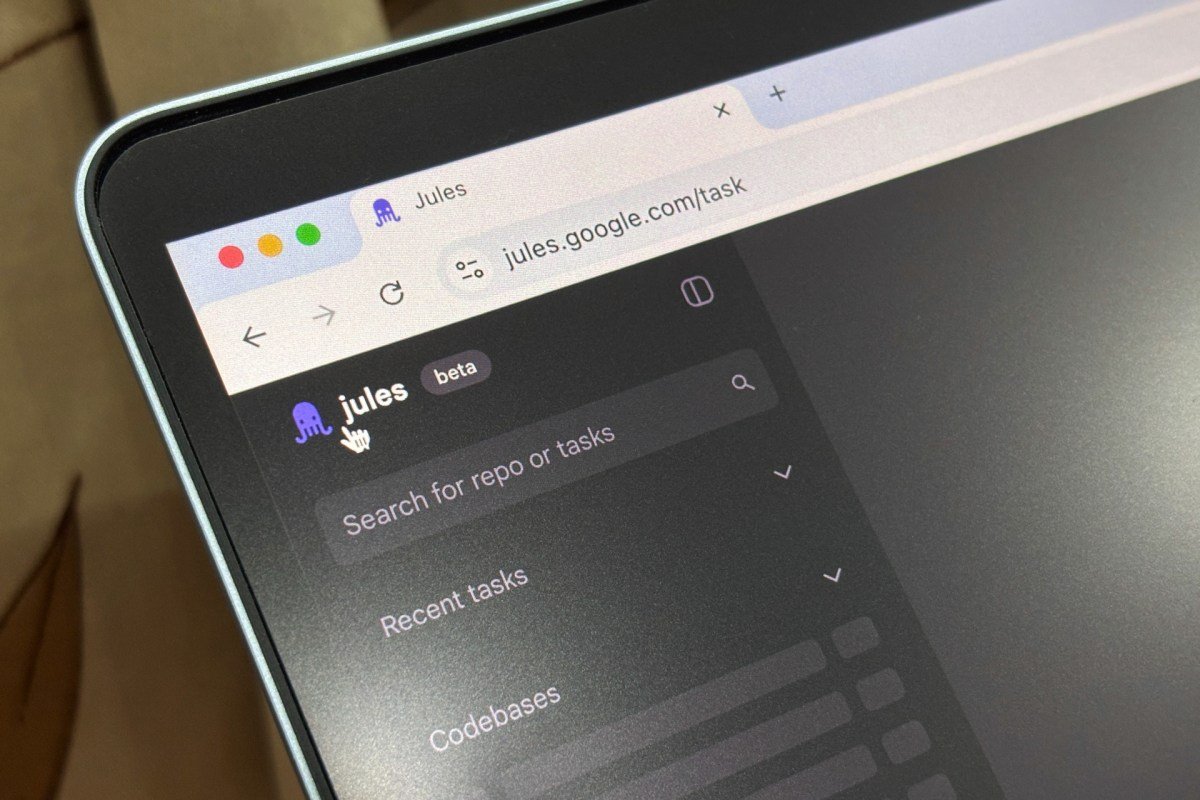
Google on Wednesday launched its AI coding agent, Jules, out of beta, just over two months after its public preview debut in May.
Powered by Gemini 2.5 Pro, Jules is an asynchronous, agent-based coding tool that integrates with GitHub, clones codebases into Google Cloud virtual machines, and uses AI to fix or update code while developers focus on other tasks.
Google initially announced Jules as a Google Labs project in December and made it available to beta testers through a public preview at its I/O developer conference.
Kathy Korevec, director of product at Google Labs, told TechCrunch that the tool’s improved stability drove the decision to take it out of beta after receiving hundreds of UI and quality updates during its beta phase.
“The trajectory of where we’re going gives us a lot of confidence that Jules is around and going to be around for the long haul,” she said.
With the wider rollout, Google introduced structured pricing tiers for Jules, starting with an “introductory access” free plan capped at 15 individual daily tasks and three concurrent ones, down from the 60-task limit during beta. Jules’ paid tiers are part of the Google AI Pro and Ultra plans, which are priced at $19.99 and $124.99 a month, and offer subscribers 5× and 20× higher limits, respectively.
Korevec noted that Jules’ packaging and pricing are based on “real usage” insights gathered over the past couple of months.
“The 60-task cap helped us study how developers use Jules and gave us the information we needed to design the new packaging,” she said. “The 15/day is designed to give people a sense of whether Jules will work for them on real project tasks.”
Google also updated Jules’ privacy policy to be more explicit about how it trains AI. If a repository is public, its data may be used for training, but if it is private, Korevec said that no data is sent.
“We got a little bit of feedback from users that it [the privacy policy] wasn’t as clear as we thought it was, and so most of it is just responding to that. We didn’t change anything about what we’re doing on the training side, but we changed the language,” Korevec said.
During the beta, Google said that thousands of developers tackled tens of thousands of tasks, resulting in over 140,000 code improvements shared publicly. Initial feedback led the Google Labs team to add new capabilities, including reusing previous setups for faster task execution, integrating with GitHub issues, and supporting multimodal input.

The two primary users of Jules so far are the AI enthusiasts and professional developers, Korevec said.
By running asynchronously in a virtual machine, Jules stands apart from top AI coding tools like Cursor, Windsurf, and Lovable, which all work synchronously and require users to watch the output after each prompt.
“Jules operates like an extra set of hands … you can basically kick off tasks to it, and then you could close your computer and walk away from it if you want and then come back hours later. Jules would have those tasks done for you, versus if you were doing that with a local agent or using a synchronous agent, you would be bound to that session,” Korevec explained.
This week, Jules received a deeper integration with GitHub to open pull requests automatically — just like it could open branches — and a feature called Environment Snapshots to save dependencies and install scripts as a snapshot for faster, more consistent task execution.
From vibe coding to mobile use, beta trials informed Jules’ development
Since entering public beta, Jules has logged 2.28 million visits worldwide, 45% of them from mobile devices, per data from market intelligence provider SimilarWeb, reviewed by TechCrunch. India was the top market for traffic, followed by the U.S. and Vietnam.
Google did not share specifics on Jules’ user base and its top geographies.
Korevec told TechCrunch that during the beta, the team observed that many people used Jules from traditional vibe-coding tools to either fix bugs that might have been implemented or extend the vibe-coded project to make it more production-ready.
Originally, Jules required users to have an existing codebase. But Google soon realized many potential users — like those trying other AI tools — might want to explore it without one. Korevec said the company quickly enabled Jules to work even with an empty repository. That helped increase its scope and usage.
Google Labs’ team also noticed an increasing number of users accessing Jules through their mobile devices. Although the tool does not have a dedicated mobile app, Korevec said users were accessing it through its web app.
“Since it’s a big use case that we’re seeing emerging, we’re absolutely exploring what the features are that people need on mobile a lot more,” she noted.
Alongside beta testers, Korevec stated that Google already uses Jules to help develop some projects internally, and there is now a “big push” to use the tool on “a lot more projects” at the company.
