


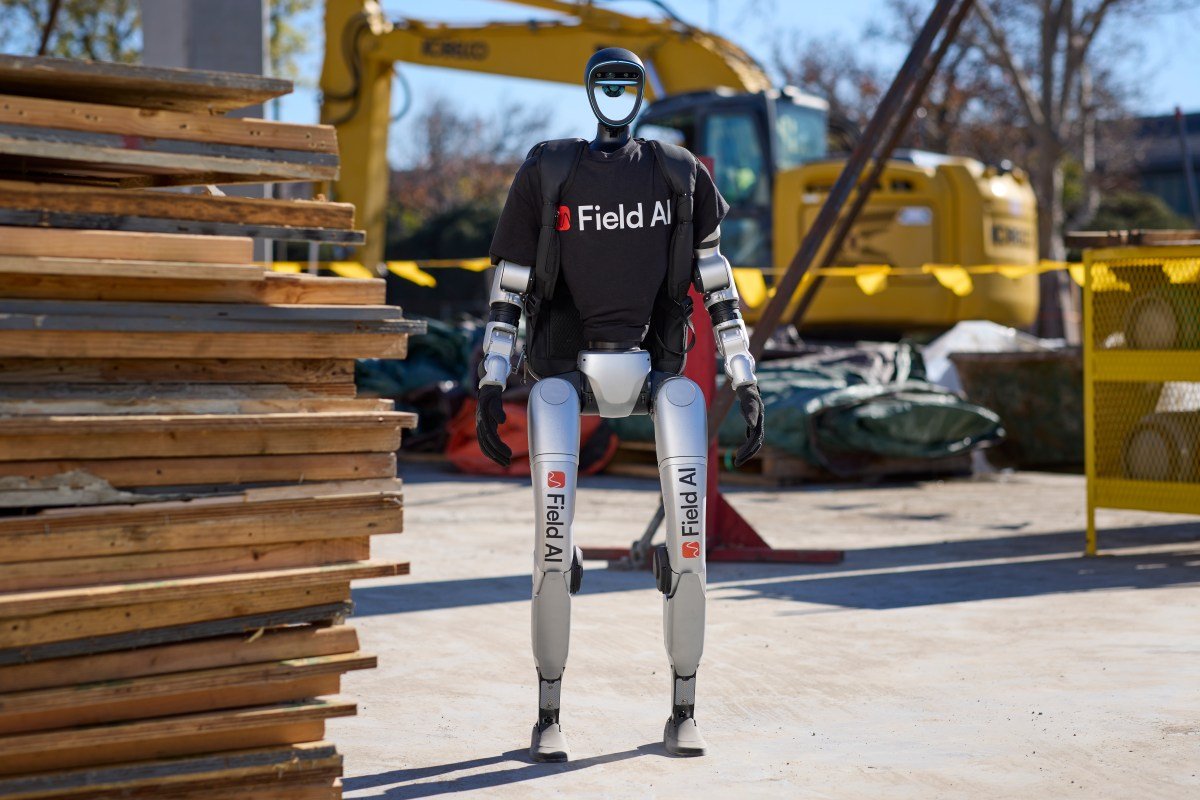
FieldAI, an Irvine, California-based robotics startup, has raised $405 million across multiple previously undisclosed rounds to develop what it calls “foundational embodied AI models” — essentially robot brains designed to help everything from humanoids to quadrupeds to self-driving cars adapt to new environments.
The company announced the funding Wednesday; the most recent round raised $314 million in August and was co-led by Bezos Expedition, Prysm and Temasek. FieldAI’s other backers include Khosla Ventures, Intel Capital, and Canaan Partners, among others.
Unlike traditional AI that processes text or images, embodied AI refers to AI that controls physical robots moving through real-world environments. FieldAI builds “Field Foundation Models” which are general-purpose embodied AI models rooted in physics. This approach gives robots the ability to quickly learn and adapt to new environments while being conscious of risk, FieldAI founder and CEO Ali Agha told TechCrunch in an interview.
“The mission is to build a single robot brain that can generalize across different robot types and a diverse set of environments,” Agha said. “To get there, you need to manage risk and safety as you go to these new environments. And that has been a fundamental gap in robotics, that traditional models and traditional approaches were never designed to manage that risk and safety.”
Agha said the key to getting robots to be able to safely learn in new environments is to add a layer of physics into these AI models. This addition gives robots a second set of information to pull from to make decisions — especially in a new environment — as opposed to just reacting to whatever a model says to do next as traditional LLMs do.
He added that while a small amount of AI hallucination isn’t detrimental in certain circumstances, it can be for robots working in dangerous environments or alongside people.
“Suddenly you start to have that sense of, how much I know, and if I don’t know something, or if I’m making a decision, how confident I am in it,” Agha said. “Once [the] network starts getting access to that, it starts making much safer decisions. Not just this spits out that, ‘Hey, here’s the next sort of an action,’ but it tells you how confident it is, and you as a customer can define this risk threshold, and robot will be reactive to that.”
Techcrunch event
San Francisco
|
October 27-29, 2025
Agha has been working on this idea for decades across various roles at places ranging from NASA to Massachusetts Institute of Technology (MIT). He decided to launch FieldAI when he achieved a technological breakthrough that allowed one robot brain to work across different types of robots performing both the same and individual actions.
Since launching the company in 2023, FieldAI has secured contracts across industries including construction, energy, and urban delivery. The company declined to disclose any customers by name.
The funding will support research and development while helping the company ramp up production to deploy its models to its customers and to further expand its reach abroad.
Agha compares FieldAI’s approach to human evolution. “You evolve to be able to do various different tasks in different environments, and you have the ability to rapidly learn, [and] we believe that is a necessity in robotics. Yes, definitely you can optimize for one specific use case, but that is not the market we are going after.”
We’re always looking to evolve, and by providing some insight into your perspective and feedback into TechCrunch and our coverage and events, you can help us! Fill out this survey to let us know how we’re doing and get the chance to win a prize in return!
