


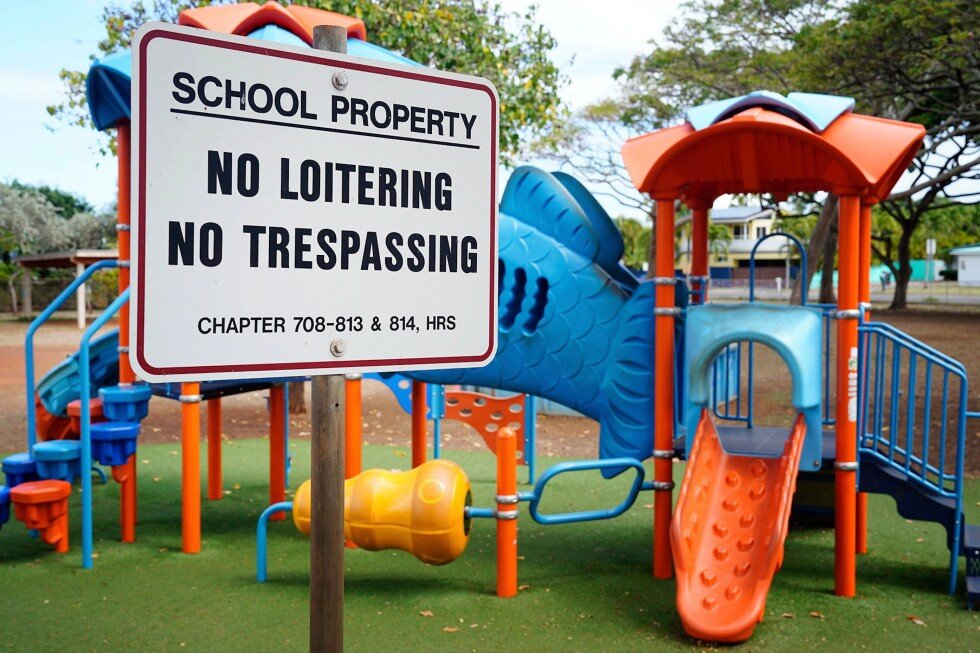
Parents, lawmakers and county leaders across Hawaiʻi have made a recurring request to the education department in recent years: open up school playgrounds and fields for the public when classes aren’t in session.
The ask seemed to be gaining traction at the start of this year, with lawmakers introducing multiple proposals to require the Department of Education to make recreational facilities available to communities. Halfway through the session, however, the Legislature is moving in the opposite direction with a bill to crack down on school trespassing that may also criminalize parents.
Under Senate Bill 2611, families who set foot on school grounds on weekends or holidays could face criminal trespassing charges without even receiving a warning from police or school administrators. Consequences could include up to a year in jail and $2,000 in fines. The bill passed through the Senate and is now awaiting a hearing in the House.
Not all after-hours visitors intend to vandalize school campuses, said parent Maya Childress. School playgrounds can be a weekend gathering place for families, especially in communities without city parks in walking distance.
“People are just trying to get their kids out of the house and into a safe and controlled environment,” Childress said. “It’s just making it more difficult.”
Some school districts on the mainland have gone the other way, opening up their campuses for more public use. For example, in the San Diego Unified School District, people can use many school fields and playgrounds on the weekends as well as in the afternoons. In exchange, the city helps upkeep the campuses.
But two bills to expand the public’s weekend access to Hawaiʻi schools died in the House and Senate Education Committees last month. Rep. Trish La Chica, who authored one of them, said she’s determined to find a compromise that allows families to use campus facilities for recreation, while still addressing schools’ concerns about liability and safety.
“The perception is that there’s nothing we can do to promote recreation and physical activity,” La Chica said. “I feel like we should be willing to work through the logistics of that to grant more access to our community.”
Changing Families’ Behavior?
In recent legislative hearings, principals have raised concerns about worsening vandalism, homelessness and unsanitary conditions on their campuses. Property damage and trash left on campuses put an additional burden on teachers and custodians, and principals say schools need to hold trespassers accountable for damaging school spaces on the weekends.
“Every Monday morning, my staff is forced to deal with a staggering array of vandalism and biohazards before students can safely step onto campus,” Kaimukī High School Principal Lorelei Aiwohi said in written testimony to the Legislature.
Under the current law, individuals can be charged for trespassing on campuses on the weekends or holidays, but they need to have first received a warning from administrators or law enforcement. No warning is required to charge people trespassing on school campuses at night, between 10 p.m. and 5 a.m.
DOE doesn’t track the number of calls to the police regarding trespassing after school hours, Communications Director Nanea Ching said.
If passed, Superintendent Keith Hayashi said in his written testimony, Senate Bill 2611 could protect against harassment and violence against school employees — a growing problem that gained statewide attention after a parent assaulted a high school athletic director last year.
Eliminating the warning requirement for trespassers could help schools more effectively address aggressive or unsafe behavior on campus, said Kāneʻohe Elementary Principal Derek Minakami.
While schools may have cameras and alarm systems installed on campus, Minakami said they don’t always have the 24/7 security needed to catch intruders and call the police. In some cases, he noted, things don’t have to go that far because written warnings to families and community members about trespassing on campus have been enough to deter unwanted behavior.
At Holomua Elementary in ʻEwa Beach, Principal Christopher Bonilla said he’s hopeful that changing the state trespassing law will discourage the public from entering school campuses on the weekends. If the bill passes, he said, schools and lawmakers would need to clearly communicate the change to their communities to impact people’s behavior.
“If the public is more aware of this, they’ll think twice,” he said.
But Childress said she’s skeptical that changing the trespassing law will deter families from visiting school playgrounds on the weekends, especially in communities with limited alternatives. Families are drawn to local elementary schools that can offer safe spaces for their kids to play and socialize, she said, and are willing to chance a rare encounter with the police.
“People are going to still go. They’re going to chance it,” Childress said, adding that she has actually never been approached by police or school administrators when taking her three children to play at ʻAikahi Elementary’s playground on the weekends.
Limited Outdoor Options
Some lawmakers and county leaders have argued that the solution to improving campus safety and community well-being is more public access to schools, not less.
House Bill 1786 proposed a four-year pilot program that would have required schools to make their outdoor facilities available for public use on the weekends without fees or permitting applications. It required schools to post signs notifying visitors that the DOE is not responsible for injuries that occur on the weekends.
While DOE already has a process for vetting public requests to use their campuses, the approval process can be inconsistent across schools, the bill said, citing past reporting on the issue. Community members also need to have insurance and pay hourly fees covering the costs of utilities, custodial staff and facility rentals.
“The current system for granting access is highly principal-driven, discretionary, and inconsistent across campuses,” the bill said. The measure died in the House Education Committee.
Hourly rentals can range from $2 for an unlit parking lot to more than $230 for a large, air-conditioned auditorium. Renting a school playfield costs $5 an hour, according to the DOE.
Opening up campuses to the public for free would remove the bureaucracy communities currently face when trying to access schools, La Chica said, adding that city parks are often overcrowded with sports leagues’ practices and games.
But Minakami said the application process for facilities ensures that outside activities aren’t overlapping with school events while helping schools hold people accountable if they damage facilities or bring tobacco or alcohol on campus.
DOE leaders raised similar concerns in their testimony against that bill, arguing that allowing public use of playgrounds and fields could lead to costly repairs. Schools have faced significant damage to their campuses, including vandalism at ʻAikahi Elementary’s playground in 2021 and a fire intentionally set at Nānāikapono Elementary’s playground in 2023.
“That’s like managing a park,” said Deputy Superintendent Jesse Souki in a recent legislative hearing about the bill. “That’s a huge amount of energy and resources.”
La Chica said opening campuses to the public could in fact encourage community members to take better care of campuses.
“There’s always going to be risk attached to it, but if we open spaces for families, for youth, for neighbors to use responsibly, I feel like we see the opposite of vandalism,” she said. “When the community feels that a space belongs to them, they take care of it.”
More than 20 years ago, state leaders advocated for a similar change — and found a solution at Farrington High School.
A pilot program in 2005 allowed the City and County of Honolulu to run free exercise programs on Farrington High School’s campus several times a week, inviting students and community members to take free classes such as volleyball, hula and aerobics.
Under the agreement between the city and DOE, the Kalihi campus was open for community activities after school as well as Saturday mornings. The city provided staff to run the classes, while the school offered the recreational space at no charge. During the pilot, the school did not report any cases of vandalism, Department of Health Administrator Lola Irvin said in a recent legislative hearing.
Researchers at the University of Hawaiʻi labeled the program a success, with more than 80% of participants reporting they found a safe space to exercise during the pilot and increased their physical activity. But the initiative was short-lived after funding for the city’s exercise classes ran out.
The Honolulu parks department and DOE have not entered any similar partnerships since the Farrington pilot, although city leaders have pushed for more cooperation between the agencies in recent years. Earlier this year, lawmakers introduced resolutions on behalf of the Hawaiʻi State Association of Counties asking DOE to open its outdoor campus facilities to the public when classes aren’t in session.
Those resolutions have not yet been scheduled for hearings in the House or Senate.
Childress, a mom of three, remains skeptical that state and county agencies will be able to come to an agreement in the near future.
“If they could get some kind of agreement on paper and expand access to playgrounds on weekends or off school hours, that would be amazing,” she said. “Then we wouldn’t have to jump a fence.”
___
Civil Beat’s education reporting is supported by a grant from Chamberlin Family Philanthropy.
___
This story was originally published by Honolulu Civil Beat and distributed through a partnership with The Associated Press.
