


What do puzzles, gymnastics, writing and using maps all have in common?
They all rely on people’s ability to visualize objects as they spin, flip or turn in space, without physically moving them. This is a spatial skill that developmental psychologists call mental rotation.
Whether a person is navigating a new city or doing a cartwheel, they must use mental rotation skills to move shapes or objects in their mind and make sense of where their bodies are going and what surrounds them.
When children play with puzzles, building blocks or pattern games, they are also practicing mental rotation.
Over time, these skills support learning in math, science and reading. This can look like visualizing pulley systems in physics or seeing the differences between similar-looking letters such as b and d, which young children often confuse.
Strong mental rotation skills also lay the foundation for doing well in school and developing interest in careers in science, technology, engineering and math.
Most preschool-age children are not yet learning to read – but it turns out they are still using some of these same spatial reasoning skills as they think about the world around them.
We are scholars of, developmental science and were curious to find out how children as young as 3 years old mentally rotate objects.
While there is research on the age at which children can mentally rotate objects, less is understood about how children are solving mental rotation problems. We found in our research, conducted from 2022 to 2023, that young children are using the same problem-solving strategies as adults when they solve a mental rotation task.
Children think visually, just like adults
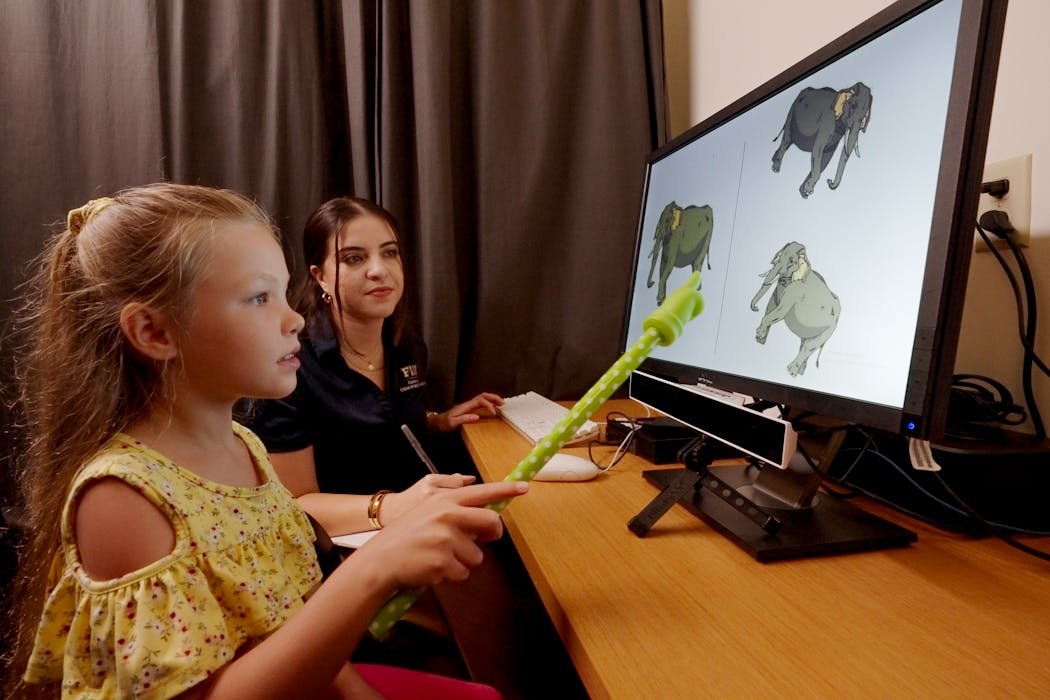
We used eye-tracking technology to understand how a sample of 148 children, all between 3 and 7 years old, solved different mental rotation problems. Eye-trackers use harmless infrared light to capture eye movements. This technology lets us observe how children solve these problems in real time.
As part of our study, we showed each child a large picture of items such as a fire truck, as well as two smaller pictures of the same truck, one placed above the other and positioned slightly differently.
Children were asked to say which small picture on the right matched the large one on the left. In this example, the correct answer is the top picture, because that top fire truck can be rotated to match the large fire truck. The bottom fire truck was a mirrored image, and no matter how much you rotate it, it will never match the large fire truck.

Children looked at pictures of fire trucks as part of a research study to assess how they manipulated the object in their heads. Karinna Rodriguez
While the children thought about their response, the eye-tracker, mounted right below the computer screen, recorded their eye movements.
By looking at where and for how long children looked at each image, we figured out what kind of strategy they were using.
Some children focused on fewer parts of the object and spent less time studying its details. This suggests they used a holistic strategy, meaning they took in the whole image at once, instead of breaking it into pieces. These children mentally rotated the entire object to solve the task.
Other children focused on parts of the object and spent more time studying its details. This suggests they broke the image down into pieces instead of visualizing the image as a whole, known as a piecemeal strategy. Our findings support prior work showing that children generally use these two visual approaches to solve mental rotation problems.
This study helped us learn where children look while solving puzzles and identify how they solve these problems – without ever having to ask the child, who might be too young to explain, about their process.
Children were more likely to turn the whole image instead of breaking it down into pieces, a pattern of problem solving adults typically also use. This means that even very young children are already thinking about how objects move and turn in space in ways that are more advanced than expected.

Supporting children’s visual skills
Knowing how young children mentally rotate objects may help researchers, teachers and parents understand why some children struggle with learning to read.
Children who break an image down into pieces, instead of visualizing it as a whole, to solve mental rotation problems may be the very same children who struggle with discriminating similar-looking letters such as p and q and may later be diagnosed with dyslexia.
Parents can play an important role in building their child’s mental rotation skills. Parents can help children by offering them opportunities to practice rotating real objects with toys such as three-dimensional puzzles or building blocks. Tangrams – flat, colorful puzzles that come in different shapes – can be used to practice breaking down shapes of animals into pieces. Parents can encourage their child to look for shapes that match parts of the animal or object they are building.
Nov. 8 is International STEM Day, a celebration of all things science, technology, engineering and mathematics.
Research like ours provides valuable guidance for designing early STEM activities and educational tools. By directly observing children’s problem solving in real time, we can develop better ways for educators and toy makers to support strong spatial thinking from an early age. To celebrate, we encourage people to engage in activities that test their spatial skills, such as ditching the GPS for the day or playing a game of Tetris.
Mental rotation is a powerful skill that helps us understand and interact with the surrounding physical world. From solving puzzles to reading maps, mental rotation plays a role in many everyday activities. Building mental rotation abilities can improve children’s performance in subjects such as reading, math and science and may inspire future careers in STEM fields.
This article is republished from The Conversation, a nonprofit, independent news organization bringing you facts and trustworthy analysis to help you make sense of our complex world. It was written by: Shannon Pruden, Florida International University and Karinna Rodriguez, Florida International University
Read more:
Shannon Pruden receives funding from National Institutes of Child Health and Human Development and National Science Foundation.
Karinna Rodriguez does not work for, consult, own shares in or receive funding from any company or organization that would benefit from this article, and has disclosed no relevant affiliations beyond their academic appointment.
