


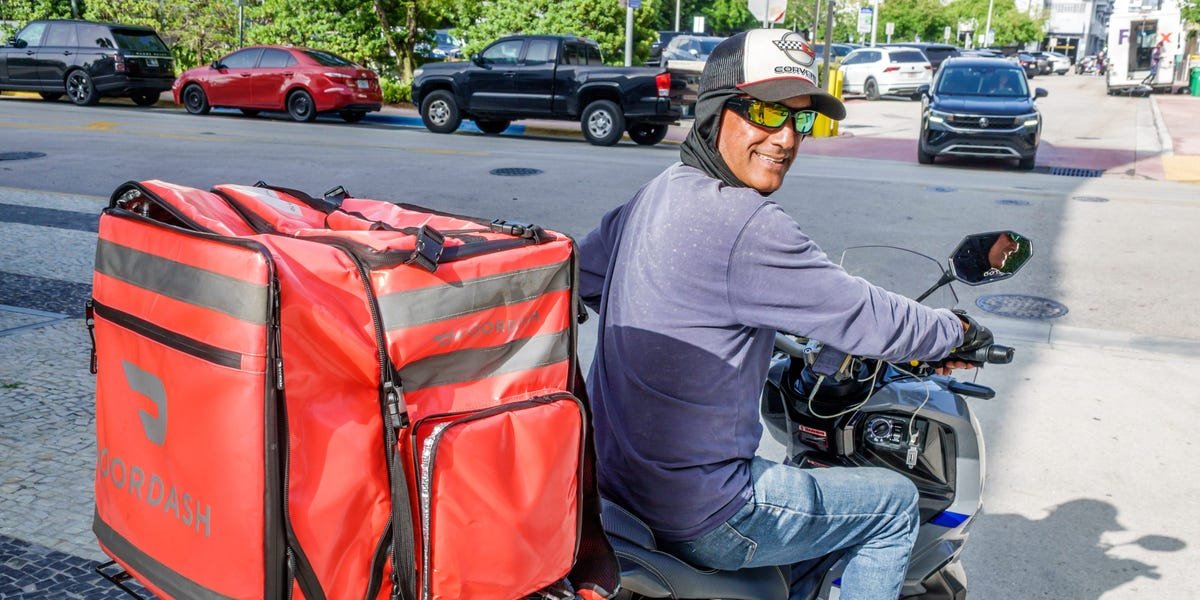
DoorDash CEO Tony Xu says that his company’s grocery offering has a key advantage over Amazon: choice.
Amazon is doubling down on grocery delivery, especially perishables like produce and ice cream. The retail and tech giant said last month that it’s expanding same- and next-day grocery delivery to more parts of the US this year, adding to the thousands of towns and cities it already serves — news that sent shares of Instacart and DoorDash tumbling at the time.
DoorDash, though, has something that shoppers want and that Amazon isn’t replicating, Xu said on the company’s fourth-quarter earnings call on Wednesday.
Unlike Amazon, which owns Whole Foods and several of its own food brands, DoorDash works with existing grocery chains. The delivery service has struck deals in recent years. Last year, it expanded its partnership with Kroger and signed new deals with regional chains, including Schnucks in the Midwest.
Few customers complete all their grocery shopping at a single chain, Xu said. Many stop at multiple stores each week, especially to find specific fresh groceries, such as produce, meat, and seafood.
“Consumers prefer choice,” Xu said on the call, adding that he expects there to “continue to be very strong interest in the DoorDash product” as a result.
DoorDash is also expanding its services for retailers, such as fulfillment through its DashMarts, convenience store-sized retail spaces designed for picking and delivering orders.
Xu said DoorDash is “doing that for every single grocer so that they have the capability to compete against companies like Amazon.”
DoorDash shares rose as much as 14% in after-market trading on Wednesday, despite disappointing fourth-quarter earnings and guidance for 2026. The company’s stock took its biggest one-day hit in November after it unveiled plans to spend hundreds of millions of dollars on tech improvements.
While DoorDash has become known for restaurant deliveries, its gig workers are increasingly making grocery deliveries — many of which make more financial sense for DoorDash.
Xu said DoorDash has attracted more big grocery orders from customers, not just small fill-in trips. That matters in the grocery industry, where grocers tend to make more money when customers buy a wider range of goods.
“People use us for both the quick runs as well as the stock-up use cases,” he said.
Ravi Inukonda, DoorDash’s CFO, said on the call that DoorDash’s retail and grocery business expects to “be unit-economic positive” in the second half of 2026.
Have a tip? Contact this reporter at abitter@businessinsider.com or via encrypted messaging app Signal at 808-854-4501. Use a personal email address, a nonwork WiFi network, and a nonwork device; here’s our guide to sharing information securely.
