


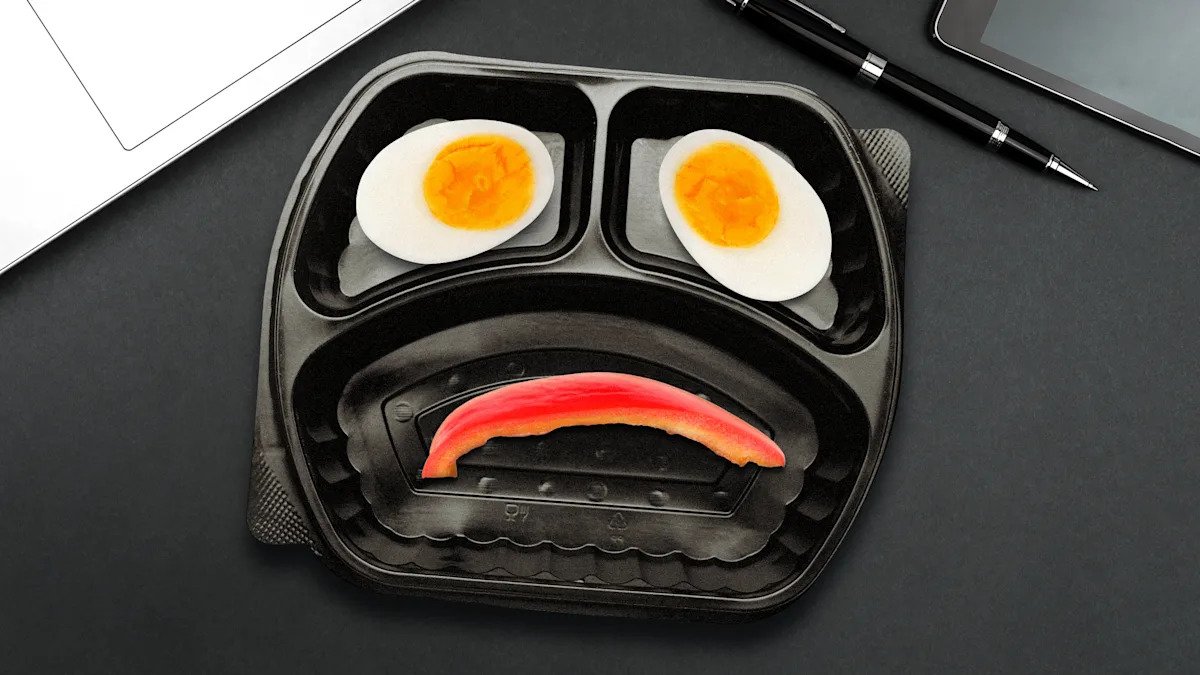
When I think of the term “lunch hour,” I picture Jon Hamm as Don Draper in Mad Men, schmoozing with clients over prime rib and several martinis, even though that’s certainly not what my work lunch looks like. The endless array of fast and fast-casual food joints available in the U.S. suggests that it’s not the way most Americans are spending their midday meals either. (There’s even a “sad desk lunch” hashtag that went viral a few years ago.)
It makes me wonder: Does anyone take a real lunch break anymore? To find out, Yahoo/YouGov polled 1,676 U.S. adults between Sept. 25 and Sept. 29 about their lunchtime habits. I also spoke to an expert who literally wrote the book on lunch, along with several people about their own lunch habits.
The data says: Most people lunch alone, at their desks
According to our polling, three-quarters of Americans who are employed by someone else do get a lunch break. About half of those people have paid lunch breaks, while half take lunch unpaid. In either case, the most common way that they spend their break is eating at their desk (50%). Just shy of 30% of workers go out for lunch on their own.
During lunchtime, nearly half (44%) just eat, taking a break from screens and tasks to focus on their food. But 38% spend this time scrolling on their phones.
When did we all start eating lunch alone?
Ria, a 28-year-old who works in corporate administration, used to eat her company-mandated, hourlong lunch in the cafeteria at her Texas office building, she tells Yahoo. But these days, she brings her own lunch from home since it’s usually more affordable, healthier and convenient. She prefers to spend her lunch break working out in the company’s gym, and then she eats her lunch at her desk while she works (or steps outside if it’s a nice day). Ria says that working through lunch is “more of a personal preference when I get into a groove or a lot of tasks come through that are easier to do then.” She’d love to meet up with a friend for lunch but says it’s just too hard to coordinate schedules.
That seems to be the case for most people. Only 12% of respondents to our poll said they go out to lunch with others during the week. And, in reality, social lunches away from the office were only the cultural norm for a brief period and for a relatively small share of workers, Megan Elias, a professor of food and cultural history at Boston University and author of Lunch, tells Yahoo.
The modern lunch is really a product of the industrial revolution. Factories became the largest employers in the U.S. beginning in the late 19th century and peaking in 1979. Since then, “we’ve internalized what industrialization created, which is this timed day: The bell rings for morning, for lunch, for when it’s time to come back from lunch and when the day is over,” says Elias.
With these industrial companies came the administrative workers to support the businesses and, eventually, offices. By the 20th century, “lunch places” emerged: cafés and diners for people to stop into for lunch, while higher-end restaurants cropped up to serve the executives. During this mid-19th-century era, lunch counters, where “people were sitting elbow-to-elbow” with one another, were important to the Civil Rights Movement,” notes Elias. But they were short-lived, she adds.
The 1980s and 1990s brought more and more office jobs, as well as recession fears that have left a lasting mark. “There’s this anxiety that if I’m seen not working, I’m not taken seriously,” Elias says. Factories are no longer the biggest industry in the U.S., but the idea of a timed lunch hour remained. “If you’re on the clock, it’s regulated,” says Elias. “Somebody knows how long you took for lunch, and it [feels] surveilled.”
Since the pandemic, the return-to-office movement has only renewed the perception that companies want to keep a close eye on their employees, leaving many workers feeling the pressure to appear productive — even while they eat.
Ria at times feels some of that pressure at work. “At the office, when [other employees and managers] see you, they don’t always know if you’re on lunch,” she says. Occasionally, when she needs a real break from the office and other people, Ria will eat in her car, where she can watch something on her iPad and relax a bit.
What we lose when we stop having social lunches
For one, it’s healthier to have a break from work and take your time while eating, rather than rushing through lunch. healthier to stop and eat slowly. Though it may sound counterintuitive, research suggests that taking breaks at work can boost productivity (and well-being). According to Elias, stepping away from your desk and sharing a meal is also good for your sense of connection to others. “When you’re enjoying something, even if it’s just a grilled cheese, in the company of other people enjoying things, it’s a kind of affirmation of your humanity,” she says. Eating together is a form of “community building in little ways,” Elias says, adding that it serves as a reminder that “we have something in common.”
In his 20s, Tony Nguyen, known as Desk.Breaks on social media, often went out to eat with entire groups of colleagues. He loved the group Slack chat and Excel spreadsheet they kept to rate and choose their next lunch spot. Now, at 38, he has changed jobs and roles, and his work has become hybrid. He eats alone at his desk more than he used to. “I wouldn’t prefer eating at my desk — I don’t think it’s a healthy thing to do,” Nguyen tells Yahoo. But with the hybrid schedule and internal changes in his company, group lunches aren’t really part of the work culture anymore. Plus, “I’ve had lunch besties leave or be made redundant,” he says.
Nguyen, who is in the office three days a week, typically eats at his desk on one of those days. The other two days, he picks up lunch with a colleague and they eat together in their office’s cafeteria. As much as he likes dining with colleagues, Nguyen notes that it can be awkward to eat in the cafeteria if not many people are in the office. And, he adds, people’s social skills got rusty during the pandemic. “Sometimes we’re struggling to socialize again; it’s like we have to relearn [to do it] a little bit, and it can feel slightly forced,” says Nguyen.
That — and the constant availability of smartphones — may be why so many people are spending their lunchtimes scrolling. “People were sort of socialized to loneliness during the pandemic,” says Elias. “Now, instead of getting out of the office with their bodies, [people] ‘get out’ with their phones. Scrolling is still an escape, but it’s not physical.” Whether you eat with your colleagues in a cafeteria or grab a sandwich and some solo time outside, Elias says that stepping away from your desk for an actual lunch break is better for your mind and body. “We all have this little piece of time that should be ours,” she adds, “and we keep giving it back.”
