


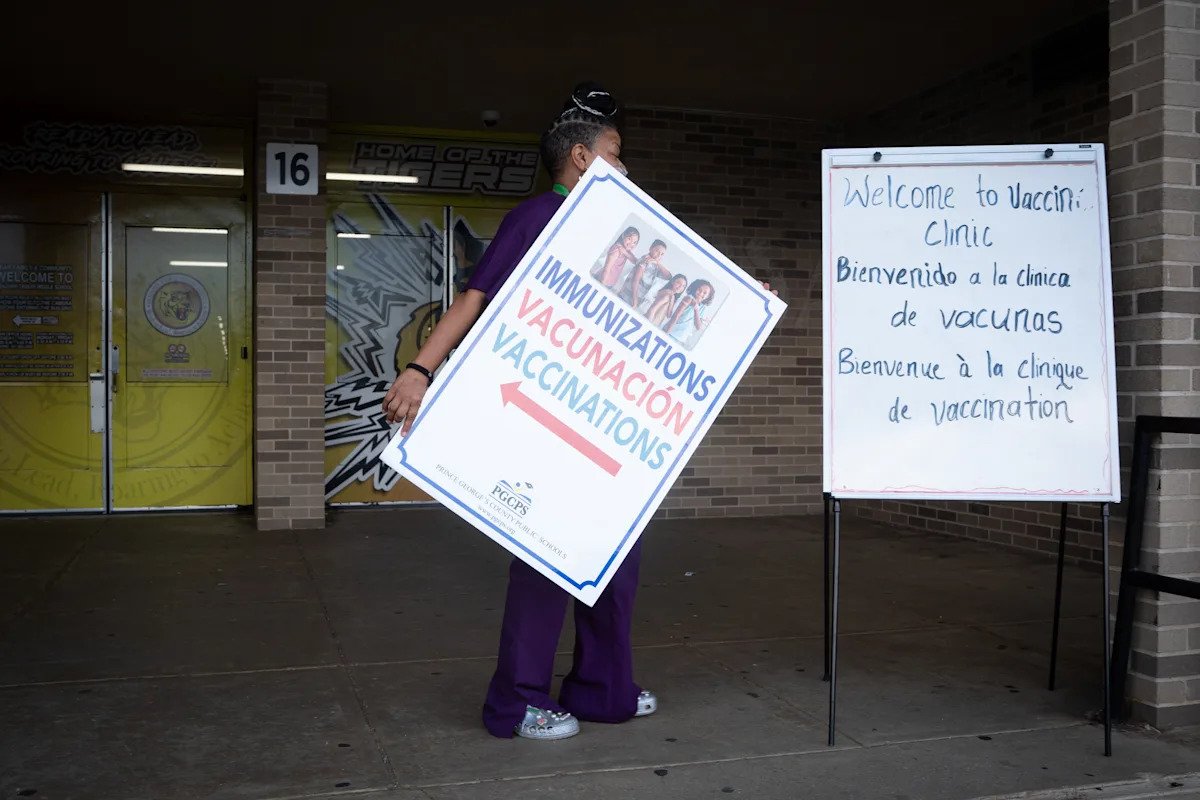
As vaccine hesitancy increases around the country, some parents are choosing to delay routine shots for their children rather than skip them altogether. But that’s a perilous decision that could jeopardize the health of infants, weaken protection against debilitating diseases and lead to outbreaks, medical experts say.
Childhood vaccination rates are backsliding across the country, a trend professionals widely attribute to misinformation about the safety of shots. Those fears have been amplified by Health and Human Services Secretary Robert F. Kennedy and President Donald Trump, who this week encouraged parents to break up childhood vaccinations into multiple doctors visits and postpone some altogether.
Subscribe to The Post Most newsletter for the most important and interesting stories from The Washington Post.
Trump criticized the current federal recommendation schedule as a “disgrace” that overwhelms young children with shots and leads to lasting harm.
“Overstating the risk of vaccines sows distrust overall,” said Ari Brown, a pediatrician in Austin. “It is very easy to scare people, and very difficult to un-scare them.”
Scientific data show that getting several vaccines at once is safe, according to the Centers for Disease Control and Prevention. Combination vaccines have been used in the United States since the mid-1940s. Ignoring the long-standing federally recommended vaccine schedule for infants can have severe and lasting consequences if ignored, according to public health professionals and advocates, who say Trump’s health advice is dangerous and not grounded in science.
Here’s what medical specialists say about delaying or postponing childhood vaccines:
– – –
What is the recommended immunization schedule?
The childhood immunization schedule is a federal recommendation for all the shots kids need as they grow and develop. It’s a carefully crafted timeline that considers when certain vaccines can best protect a child from debilitating diseases.
Babies and young children are often given several shots at the same time to reduce the amount of visits to the doctor. That process is designed to protect them as quickly as possible, and also save parents time, money and reduce trauma on the child. Some vaccines – like the one for measles, mumps and rubella (MMR) – are given as a combination to reduce the number of shots administered during a single visit.
The CDC currently recommends parents vaccinate their child before the age of 2 against more than a dozen infectious diseases, including measles, chicken pox, hepatitis B, tetanus, whooping cough and polio. A Washington Post-KFF poll conducted this summer found that 1 in 6 parents have delayed or skipped some vaccines for their children, excluding for coronavirus or flu, and about a quarter of parents (26 percent) said the CDC recommends “too many” childhood vaccines.
Trump’s remarks – the latest in his administration’s embrace of anti-vaccine rhetoric – come as immunization rates fall across the country and measles cases rise to their highest in over 30 years. Public health experts worry vaccination rates will decline even further under the current administration, as the president and health secretary use their platform to amplify misinformation.
In August, the Department of Health and Human Services revived a long-defunct task force that was initially created in 1986 as part of broader legislation to address childhood vaccine safety. According to HHS, the task force will make recommendations focused on developing and refining childhood vaccines that result in “fewer and less serious adverse reactions,” among other things. The task force will send its first report for Congress within two years.
– – –
What happens if I delay shots for myself, or children?
Delaying a shot outside the recommended schedule leaves children vulnerable to diseases when they are most at risk of getting ill, developing serious complications – or dying – if they contract it. That’s because their bodies and organs are still developing, and their immune systems aren’t yet equipped to handle certain infections.
“There is a lot of work that goes into figuring out what the optimal scheduling timing is and when we should vaccinate,” said James Campbell, a pediatric infectious-disease specialist at the University of Maryland Children’s Hospital and School of Medicine. “If you’re making up your own schedule, you don’t have backing from the data.”
If an infant catches a vaccine-preventable disease like pertussis, commonly known as whooping cough, they have a much higher risk of severe acute disease, hospitalization or death, Campbell said. Others, like hepatitis B, leave a higher risk of developing health complications later in life. That means the risk of complications are higher than the risk of serious vaccine side effects, which are extremely rare.
The vaccine for human papillomavirus is recommended for children at ages 11 or 12, typically before they’re exposed to the virus through sexual activity. It’s also an age when they are most likely to generate the most amount of antibodies. The HPV vaccine has the potential to prevent more than 90 percent of cancers caused by the virus, according to the CDC.
– – –
Do multiple vaccines at once overwhelm the immune system?
No. Vaccines don’t overwhelm the immune system, but instead help it recognize and fight specific diseases, according to medical experts.
Vaccines contain antigens – or tiny parts of viruses or bacteria – that spark an immune response when introduced into the body. The amount of antigens in a vaccine is much lower than what the child would experience if exposed to the disease itself, so the shots do not induce serious illness.
Brown, the pediatrician in Texas, said that while the majority of parents choose to vaccinate their children, those rates are dropping. According to the CDC, 92.5 percent of kindergartners received their MMR vaccines last school year, with lower rates in some parts of the country. More than 95 percent of a community needs to be vaccinated against measles to achieve herd immunity.
“That is really scary and troublesome,” said Brown, the pediatrician in Texas. “As vaccination rates go down, you will start to see these diseases return.”
Related Content
What researchers suspect may be fueling cancer among millennials
Comedian spots man in cardiac arrest during show, finishes set at hospital
Jimmy Kimmel advocates for free speech, slams FCC chair in late-night return
