


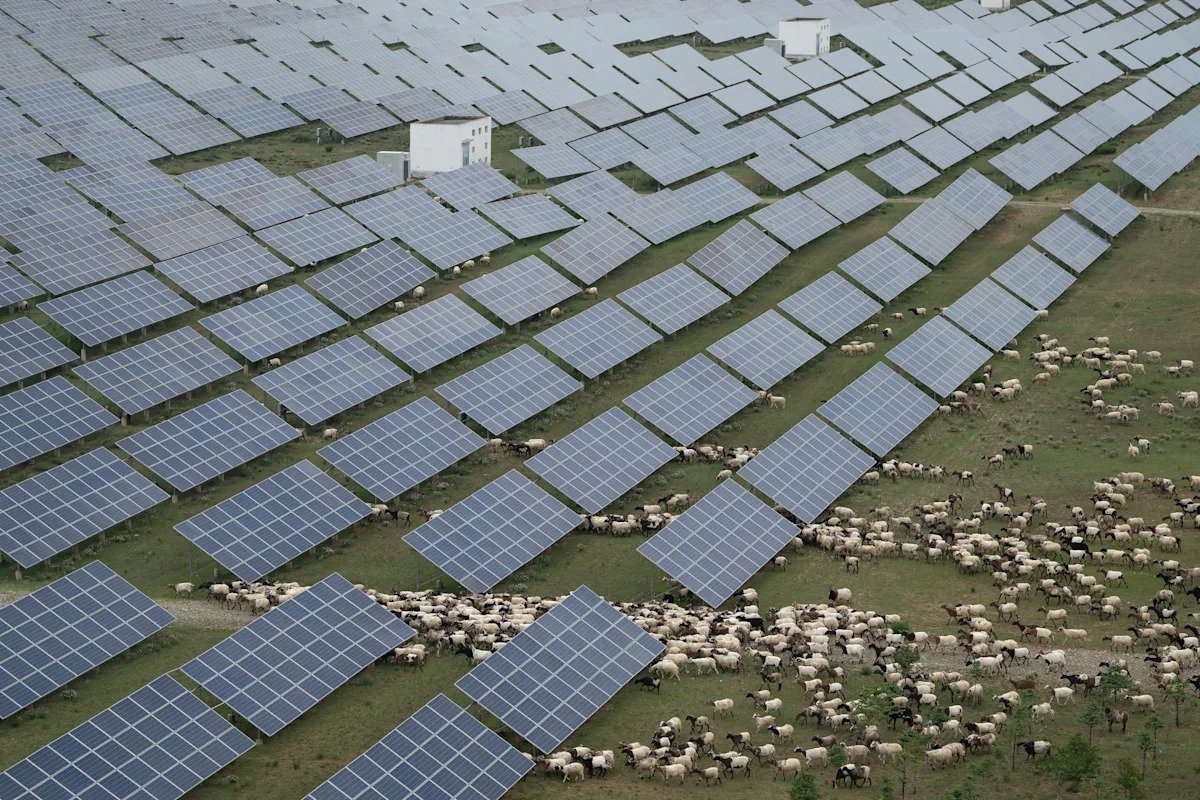
TALATAN, China (AP) — High on the Tibetan plateau, Chinese government officials last month showed off what they say will be the world’s largest solar farm when completed — 610 square kilometers (235 square miles), the size of the American city of Chicago.
China has been installing solar panels at a blistering pace, far faster than anywhere else in the world, and the investment is starting to pay off. A study released Thursday found that the country’s carbon emissions edged down 1% in the first six months of the year compared to a year earlier, extending a trend that began in March 2024.
The good news is China’s carbon emissions may have peaked well ahead of a government target of doing so before 2030. But China, the world’s biggest emitter of greenhouse gases, will need to bring them down much more sharply to play its part in slowing global climate change.
For China to reach its declared goal of carbon neutrality by 2060, emissions would need to fall 3% on average over the next 35 years, said Lauri Myllyvirta, the Finland-based author of the study and lead analyst at the Centre for Research on Energy and Clean Air.
“China needs to get to that 3% territory as soon as possible,” he said.
China’s emissions have fallen even as it uses more electricity
China’s emissions have fallen before during economic slowdowns. What’s different this time is electricity demand is growing — up 3.7% in the first half of this year — but the increase in power from solar, wind and nuclear has easily outpaced that, according to Myllyvirta, who analyzes the most recent data in a study published on the U.K.-based Carbon Brief website.
“We’re talking really for the first time about a structural declining trend in China’s emissions,” he said.
China installed 212 gigawatts of solar capacity in the first six months of the year, more than America’s entire capacity of 178 gigawatts as of the end of 2024, the study said. Electricity from solar has overtaken hydropower in China and is poised to surpass wind this year to become the country’s largest source of clean energy. Some 51 gigawatts of wind power was added from January to June.
Li Shuo, the director of the China Climate Hub at the Asia Society Policy Institute in Washington, described the plateauing of China’s carbon emissions as a turning point in the effort to combat climate change.
“This is a moment of global significance, offering a rare glimmer of hope in an otherwise bleak climate landscape,” he wrote in an email response. It also shows that a country can cut emissions while still growing economically, he said.
But Li cautioned that China’s heavy reliance on coal remains a serious threat to progress on climate and said the economy needs to shift to less resource-intensive sectors. “There’s still a long road ahead,” he said.
One solar farm can power 5 million households
A seemingly endless expanse of solar panels stretches toward the horizon on the Tibetan plateau. White two-story buildings rise above them at regular intervals. Sheep graze on the scrubby vegetation that grows under them.
Solar panels have been installed on about two-thirds of the land. When completed, it will have more than 7 million panels and be capable of generating enough power for 5 million households.
Like many of China’s solar and wind farms, it was built in the relatively sparsely populated west. A major challenge is getting electricity to the population centers and factories in China’s east.
“The distribution of green energy resources is perfectly misaligned with the current industrial distribution of our country,” Zhang Jinming, the vice governor of Qinghai province, told journalists on a government-organized tour.
Part of the solution is building transmission lines traversing the country. One connects Qinghai to Henan province. Two more are planned, including one to Guangdong province in the southeast, almost at the opposite corner of the country.
Making full use of the power is hindered by the relatively inflexible way that China’s electricity grid is managed, tailored to the steady output of coal plants rather than more variable and less predictable wind and solar, Myllyvirta said.
“This is an issue that the policymakers have recognized and are trying to manage, but it does require big changes to the way coal-fired power plants operate and big changes to the way the transmission network operates,” he said. “So it’s no small task.”
___
Moritsugu reported from Beijing. Associated Press video producer Wayne Zhang contributed.
___
The Associated Press’ climate and environmental coverage receives financial support from multiple private foundations. AP is solely responsible for all content. Find AP’s standards for working with philanthropies, a list of supporters and funded coverage areas at AP.org.
