


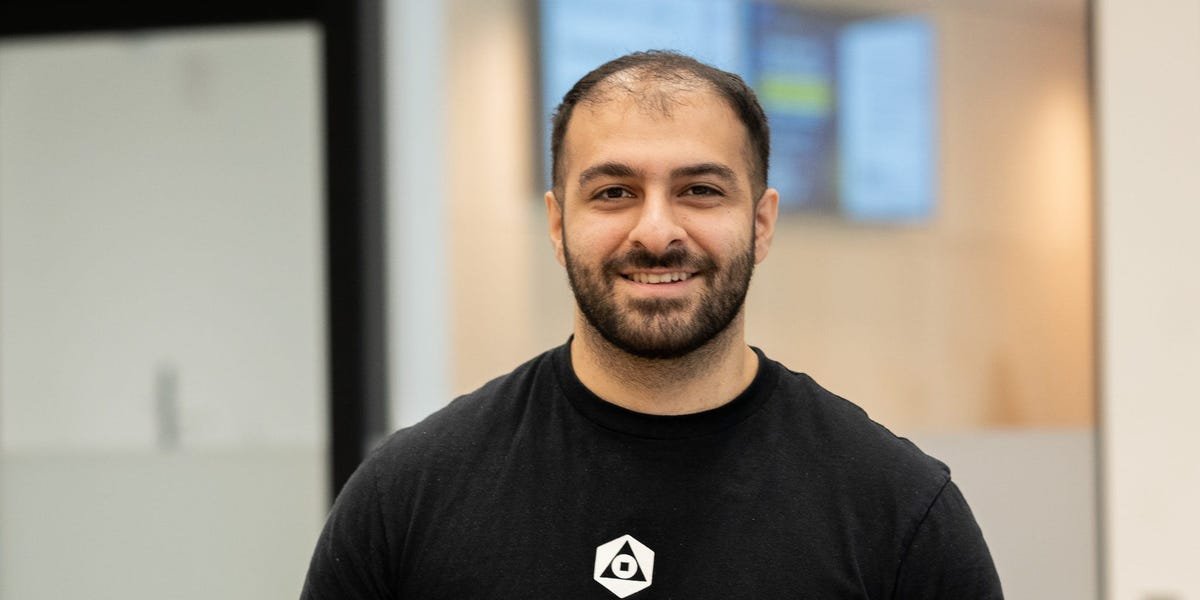
This as-told-to essay is based on a conversation with Hassan Ismail, the 24-year-old cofounder of Yellowcake, who lives in Toronto. It’s been edited for length and clarity.
In 2021, there was a government bid in Canada for some military hardware. My cofounder and I officially founded West Tek Defense Corporation in August 2022. We were doing smart rifles for the military.
It was complicated. (At one point, we were literally balancing redox equations for propellant in the ammo.) The physics background we both had helped a lot; essentially, everything we saw was something we’d encountered in a class or during personal research.
We spent about three years on the entire process. Ultimately, we found out it wasn’t going to work — mostly because of regulation.
We spoke to the head of the civilian side of procurement for the bid, and we were flat-out told something like: “There’s no reason for us to consider you. We don’t even care.” For us to even find the contact for who was running the bid, it was a bunch of dead links. We had to go pester extremely high officials to get us the appropriate contact.
To be able to produce firearms in America, you need an FFL. You go through a pretty standard process: apply, background check, reason.
In Canada, the equivalent of an FFL is a BFL. We weren’t able to get a BFL until we had a contract. We had to convince some type of agency, as two kids, to buy an idea. Almost all of them at first would be receptive: “Sure, can we see this thing?” We’d have to awkwardly explain to them: “Well, you have to order them before I can even produce them, because of government regulation.”
Justifiably, most of them were like, “Nope.”
We took this terrible 3D-printed demo to the law enforcement in Northwest Ontario. It was falling apart. I could tell they pitied us.
It was regulatory law after regulatory law. After a while, we did finally get our BFL.
It turns out, if you want to subcontract this — which you will if you’re a startup, because the startup doesn’t have millions to start some manufacturing project — whoever you subcontract to needs their own BFL.
It really seemed that it was tailored against any kind of startup or disruptor to come in and break the status quo.
The final nail in the coffin was that a lot of manufacturing businesses are going under here. Every time we’d reach out to a company, they’d either say they don’t have the budget to help us, or they would and then would call us back later and say something to the effect of, “We’re going bankrupt.”
By then, we had met with a lot of Canadian investors. They basically told us: “This is not going to happen.” Canadian investors just don’t have risk appetite.
Investors would say: Until you guys lock in these contracts, this $1 billion government bid, we’re not going to touch it. These guys were looking for fourth- or fifth-time founders who already had multi-hundred-million-dollar exits.
One of our angels, who was the first money in, is on the board of a Big Tech company. He wrote us a $50,000 angel check. We’d pitch investors on that — and Canadian investors wouldn’t care.
American investors were interested, but the issue was that they were interested in American defense, not really Canadian defense. They also had a lot of compliance issues with investing in foreign defense.
We ended up shuttering that. We still have the patents. The tech is still ready to go.
Hassan Ismail
We got into the University of Waterloo’s accelerator and started a new SaaS startup.
This startup is a Delaware C Corp. American investors — who rightfully want to invest in American companies, because it’s what they’re familiar with — are far more friendly and open-minded.
Many Canadian investors have very hostile agreement conditions. One investor wanted to do CA$100,00 at a $3-5 million valuation. For reference, we ended up raising our round at $1.6 million at a $10 million post-money capitalization in America. They were offering less than a fraction. It’s brutal.
Everyone in our cap table is American, or Canadian expats living in America. None of our investors are actually living in Canada.
We’d like to move the business to New York. We think it is going to be the next tech hub. Clay CEO Kareem Amin is a McGill grad. He’s Canadian. He also lets us co-work in his office in Chelsea.
YC initially deciding not to invest in Canadian corporations is totally justifiable. There are a lot of Canadian founders in YC. What that’s telling them is: Canadians aren’t even confidant in building Canadian companies. They’re all moving to America anyway.
I understand their decision to reverse it. The backlash was coming from a place of political climate and ignorance. A lot of people were seeing it as YC sticking the middle finger to Canada.
Everyone that we know, as well as Canadian YC founders that we know and love, have all said the same thing: This is a stupid debacle.
We all understand why YC did it.
