


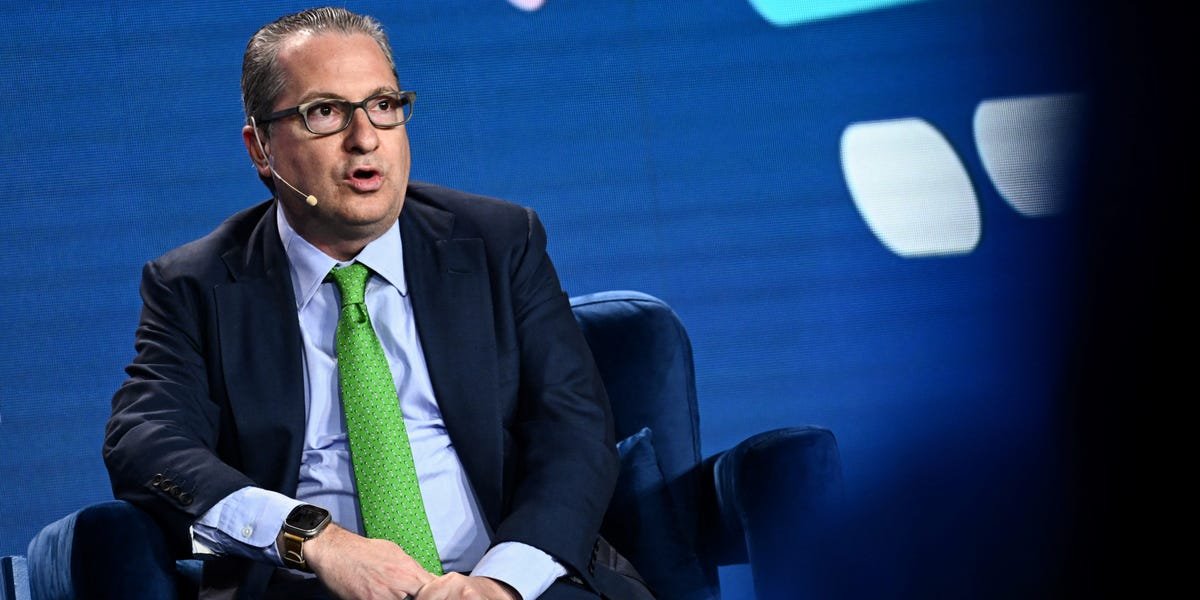
The race to dominate artificial intelligence has turned into an expensive competition that traps Big Tech companies into “a little bit of a prisoner’s dilemma,” a top hedge-fund executive said.
“You have to invest in it because your peers are investing in it, and so if you’re left behind, you’re not going to have the stronger competitive position to it,” said Tony Yoseloff, the chief investment officer at hedge fund Davidson Kempner Capital Management, which manages about $37 billion. He spoke on the Goldman Sachs “Exchanges” podcast published on Friday.
He said that spending dynamic doesn’t just affect Silicon Valley. Because a small number of mega-cap tech stocks dominate the US equity market, their behavior now influences nearly every investor.
‘AI wobble’ risk
Yoseloff isn’t dismissing AI as hype. Instead, he frames it within the long pattern of technological change.
He pointed out that it took about 10 years from when personal computers became popularized in the United States in the 1980s to see productivity gains in the workplace. And it took about five or six years from the mass marketing of the internet to see similar gains.
If history repeats, the economic benefits of today’s AI boom could still be years away. But he said the markets are acting as if the payoff is imminent.
“So the way I like to think about it is: Is there going to be an AI wobble at some point? Are investors going to be concerned about how those CapEx dollars are being invested?” he said.
Yoseloff noted that the enormous AI spending is being driven by some of the healthiest companies in the world, which can afford to reinvest their cash flow. But public markets may not be as patient.
Related stories

Business Insider tells the innovative stories you want to know
Business Insider tells the innovative stories you want to know
“What happens when the market starts to challenge the assumptions of just what the returns are going to be on this?” he asked. “How patient is the market going to be on those returns?”
Yoseloff compared the current moment to earlier “dot-com” and “nifty fifty” eras of extreme market concentration and enthusiasm for breakthrough technologies and growth stocks.
While those trends were based on real innovations, it took investors some 15 years to get their money back.
Yoseloff’s comments came amid a broader debate about whether massive investments in AI are sending the stock markets into a bubble.
Some leaders, including OpenAI CEO Sam Altman, have cautioned about overexcitement in AI — even as they acknowledge the technology’s game-changing potential.
“Are we in a phase where investors as a whole are overexcited about AI? My opinion is yes,” Altman told reporters in August, adding that it’s also the “most important thing” to happen in a long time.
In late October, Microsoft cofounder Bill Gates likened the current environment to the late-90s internet bubble and cautioned that “there are a ton of these investments that will be dead ends.”
