


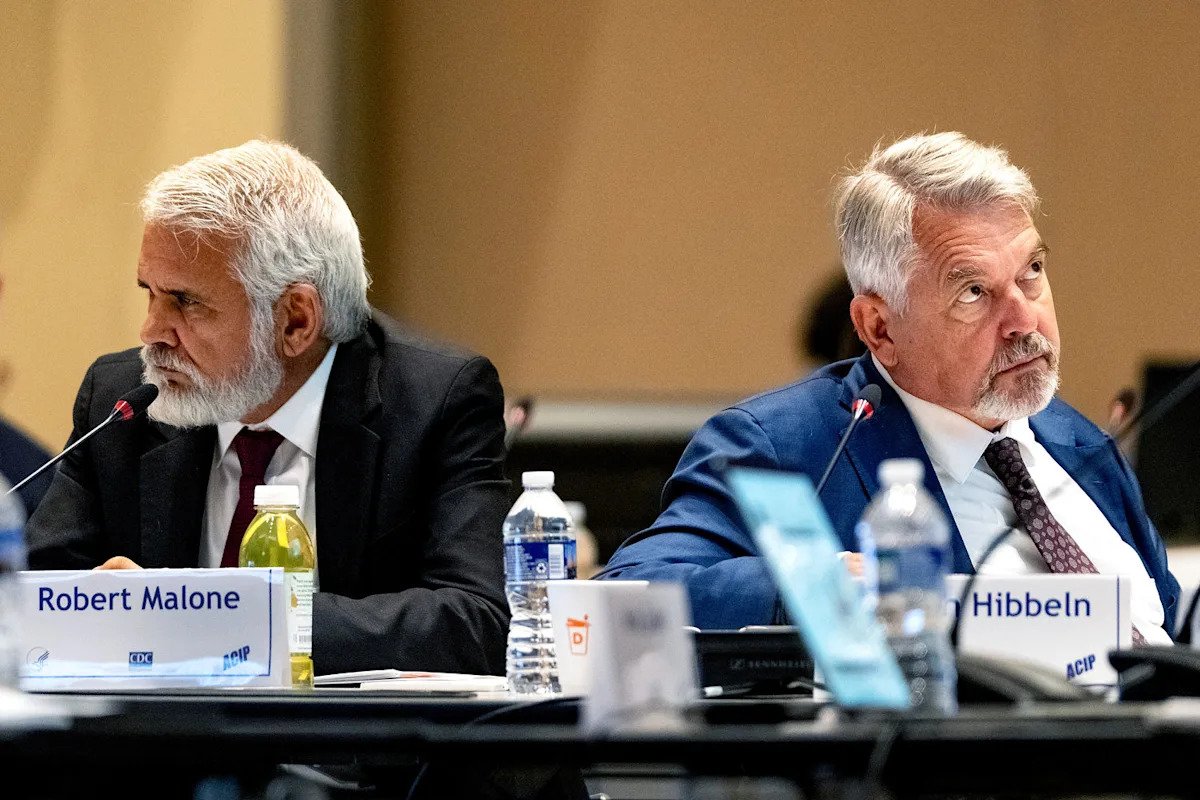
A longtime anti-vaccine activist gave a presentation at the Centers for Disease Control and Prevention’s vaccine advisory committee meeting Thursday about an issue that has long been considered settled science.
It was perhaps the clearest sign of how meetings of the panel, called the Advisory Committee on Immunization Practices, have already changed drastically under Health and Human Services Secretary Robert F. Kennedy Jr., who recently fired all 17 members of the panel and replaced them with his own appointees.
The presenter, nurse practitioner Lyn Redwood, is the president emerita of Children’s Health Defense, the anti-vaccine group founded by Kennedy. Her presentation focused on thimerosal, a mercury-based preservative that had previously been used in some vaccines. Since 2001, however, nearly all vaccines made in the United States contain no thimerosal or only trace amounts. The exceptions are multi-dose flu shot vials, though most flu shots now come in single-dose packaging that doesn’t contain the preservative.
Anti-vaccine activists have long claimed that thimerosal is linked to autism, but the link has been widely debunked. Redwood referred to “neurodevelopmental disorders” rather than autism in her presentation, but after the presentation she asserted links between thimerosal and brain inflammation, which she called “one of the hallmarks that we see in autism.”
A background briefing document that was available on the CDC’s website Tuesday said a summary of studies found “no association between prenatal exposure to thimerosal-containing vaccinations and autism spectrum disorder in children.” The document was taken down Wednesday without explanation. An ACIP member, Dr. Robert Malone, said Thursday at the meeting that, based on his understanding, “that article was not authorized by the office of the secretary and has been removed.”
Dr. David Higgins, a pediatrician and preventive medicine specialist at the University of Colorado Anschutz Medical Campus, decried the document’s removal.
“Decades of evidence were ignored or even hidden,” said Higgins, who wasn’t a part of the meeting. “That’s not being transparent. That’s not scientific integrity.”
After the presentation, the committee voted 5-1 to recommend that children, adults and pregnant women get single-dose thimerosal-free flu vaccines. One member, Vicky Pebsworth, abstained.
Before ACIP recommendations are implemented, the CDC director must sign off on them. However, there is no director, as the nominee for the position, Susan Monarez, awaits confirmation by the Senate. In the absence of a director, Kennedy has the authority to adopt the ACIP’s recommendations. ACIP recommendations don’t mean the multi-dose vials are banned; for that to happen, the Food and Drug Administration would need to revoke approval.
Thimerosal-free flu shots account for the majority of the doses given in the United States. Just 4% to 5% of flu vaccines used during the 2024-25 season were multi-dose, thimerosal-containing vaccines, Tracey Beth Høeg, a special adviser to the FDA commissioner, said during the meeting.
Dr. Cody Meissner, a pediatrician, was the lone dissenting vote.
“The risk from influenza is so much greater than the nonexistent, as far as we know, risk from thimerosal,” Meissner said of his vote. “I would hate for a person not to receive the influenza vaccine because the only available preparation contains thimerosal. I find that very hard to justify.”
Meissner had initially followed up Redwood’s presentation by saying he wasn’t sure how to respond to it. “This is an old issue that has been addressed in the past,” he said.
Multiple infectious disease experts said on a media call Thursday after the ACIP meeting that multi-dose vaccines can be useful for vaccinating large groups such as workers. The decision not to recommend thimerosal-containing vaccines could also dissuade other countries — where multi-dose vials are more common — from using them, thereby reducing vaccine access, they added.

The two-day meeting was the first time the reshaped advisory committee had convened. (Elijah Nouvelage / Getty Images)
Dr. Sean O’Leary, the American Academy of Pediatrics’ liaison to ACIP, called Redwood’s presentation “unprecedented.”
“That was a highly biased presentation full of cherry-picked data and junk science,” O’Leary said. “The vast majority of it wasn’t actually relevant to thimerosal in vaccines.”
O’Leary told reporters in a call Thursday that the AAP chose not to participate in the meeting, which it usually does. “This meeting showcased an ACIP that has drifted so far from its long-standing focus on science, evidence and public health. When that focus returns, we will, too,” he said.
Higgins, the Colorado pediatrician who wasnot part of the meeting, said, “It’s outrageous that a decision as consequential as this would be decided based on a single presentation from someone who arguably is not an expert in the field.”
Redwood’s presentation also triggered a slew of responses from representatives of major medical organizations participating in the meeting, who questioned the veracity of the data that was presented and asked to see credible scientific evidence.
“Will there be an actual CDC presentation done by staff scientists, physicians and those who are subject matter experts with accurate, peer-reviewed scientific data,?” Dr. Jason Goldman, the American College of Physicians’ liaison to ACIP, asked the committee, “or will we have lay person presentations only?”
Committee Chair Martin Kulldorff, a biostatistician who has criticized pandemic lockdowns and Covid vaccines, scolded those representatives for their pushback.
“I think it’s inappropriate to dismiss a presentation just because the person does not have a Ph.D. or an M.D.,” he said. “There are a lot of knowledgeable people who we would like to hear from, and we want to hear from a variety of viewpoints. And I think today’s discussion is a very good example that we have received input from a variety of people on this topic.”
In a separate vote, the committee reaffirmed the existing recommendation that people ages 6 months and older should get annual flu shots, with six votes in favor. Pebsworth again chose to abstain.
Votes in favor of RSV drug
Earlier Thursday, the committee voted on whether to recommend an RSV drug for infants younger than 8 months. Five members voted in favor and two voted against, providing the majority needed for the recommendation to pass.
The drug up for a vote Thursday, clesrovimab, is a monoclonal antibody injection that can prevent lower respiratory disease in infants during or before their first RSV season, which typically starts in the fall and peaks in the winter. RSV, or respiratory syncytial virus, leads to up to 300 deaths a year among those younger than 5 in the United States. A dramatic spike in severe RSV overwhelmed children’s hospitals in late 2022.
The FDA approved clesrovimab this month. A similar drug, nirsevimab, has also been approved for infants and some young children since 2023. A vaccine for pregnant women that also protects newborns is approved, as well.
Meissner, who was part of the committee’s work group on RSV, fielded questions from fellow members about the trial data and the disease itself. He explained how newborns’ tiny airways put them at higher risk for severe illness. That risk, he said, falls in their second year of life, when the airways are larger. The work group determined that the drug was effective at preventing severe RSV in young infants and had a favorable safety profile.
“These are truly remarkable products. They are safe, and they’re effective,” Meissner said. “The FDA has spent an enormous amount of time looking at safety and efficacy.”
Even so, two members of the group, Pebsworth and Retsef Levi, questioned the drug’s safety and voted not to recommend it.
This article was originally published on NBCNews.com
