


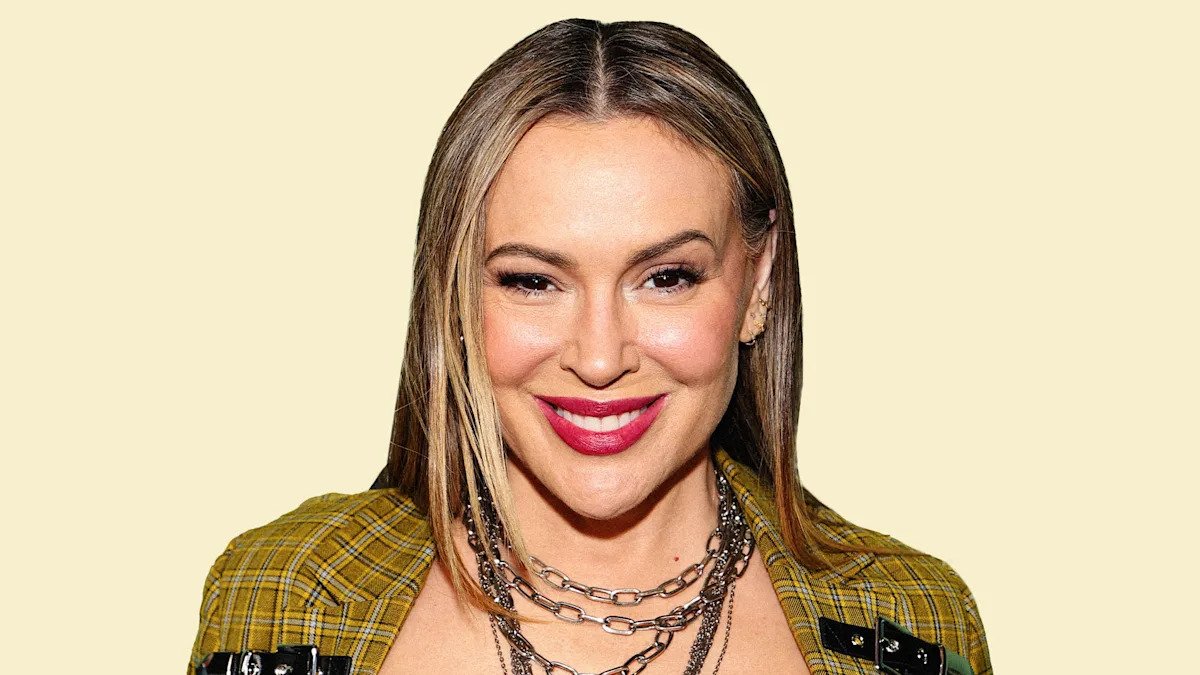
In a culture that still struggles to let women age out loud, Alyssa Milano is choosing transparency over perfection. She’s removed her breast implants. A little Botox or filler? Sure, if that’s what feels right. She’s candid about cosmetic procedures and equally honest about the disorientation that comes with seeing your face and body profoundly change for the first time.
“This is the first time I’m aging,” she tells me for Yahoo’s Unapologetically series. “Let me figure it out.”
At age 53, Milano has been famous for the better part of four decades. In an industry that prioritizes youth and perfection, she’s lived through enough eras to know how quickly women are expected to adapt — and how rarely they’re given space to just be.
“Gain weight, you’re slammed. Take [GLP-1] medication, you’re slammed,” the actress continues. “The internet makes it easy to speak behind someone’s back while speaking directly to them.”
That constant scrutiny, Milano says, is exactly why she’s using her platform now, not just to talk openly about beauty standards, but to name the physical and emotional realities women are so often expected to endure quietly. It’s what led her to be an executive producer for Balance: A Perimenopause Journey, a new docuseries that pulls back the curtain on one of the most common — and least discussed — transitions in a woman’s life. It’s available now on all streaming platforms.
“If you search for perimenopause symptoms, I had every single one. Frozen shoulder. Brain fog. Mustache. Decrease in libido. Exhaustion. Inflammation,” Milano says, adding that for years, many of those changes went unnamed or were dismissed entirely.
Below, Milano talks about navigating perimenopause, aging in the public eye and what it means to finally let go of expectations — and versions of herself — that no longer fit.
How much did you actually know about perimenopause and what was the biggest misconception you had going in?
I knew quite a bit because I had been through it. I had my daughter when I was 41, so I really think that what all the experts and ob-gyns told me was postpartum depression was actually perimenopause. I think my anxiety got bad around 38. Even though we didn’t do any blood work to see if I was in perimenopause, I bet that was around that time.
There are certain things you’re made aware of, and certain things you’re absolutely convinced won’t happen to you. You hear, “Oh, you’re going to forget things,” and that’s basically it. That was my entire knowledge of this major life change.
Every other phase of a woman’s life — puberty, pregnancy, postpartum — has a narrative. But perimenopause and menopause — people whisper about it in the dark. We’re so uneducated, not just as women, but within the medical community.
The narrative has been, “We have to fix this.” First of all, there’s no rolling back time. It’s not about fixing women. It’s about listening and taking seriously what’s happening in our bodies seriously.
I cannot believe the number of doctors who told me, “Maybe spend more time with yourself. Go for a hike. Do a girls’ night. It sounds like you’re overwhelmed.” I was overwhelmed, emotionally, because I kept having to repeat my symptoms.
Can you talk more about the emotional toll this life change took on you?
Every part of my body, down to the bone, hurt. When you think about what’s happening — losing estrogen, the dominant hormone our bodies are based on — it makes sense that it feels almost violent.
But what people don’t talk about is that once you’re past perimenopause, it’s a dream. Everything balances out. You’re not dealing with the highs and lows of a cycle. The drops in hormones, the acne, the emotional roller coaster — all of that goes away.
Most perimenopause content focuses on “getting women back to normal.” Honestly, I’ve never felt more normal than when perimenopause was over, and I was in menopause.
I don’t even want to go back to the person I was then: insecure, moody, volatile. I feel so even now. I feel grounded in my power.
You’ve spent so much of your life in public, yet perimenopause is incredibly personal. How did you experience that contrast?
It really made me reflect on how every other phase of a woman’s life is treated as public and discussable except this one. The silence wasn’t accidental. It was structural. And women are realizing that it isn’t sustainable anymore, at any age.
Women are not allowed to age and change publicly in the same way men are. Where do you still see the biggest double standard?
You can’t ever do anything right. If you get Botox, you get slammed. If you get filler, you get slammed. If you don’t, you get slammed for aging.
Men don’t go through that at all. When men go gray, it’s, “Look at that distinguished gentleman.” When women go gray, it’s “She needs to get her roots done.”
But I do think women entering perimenopause now are the first generation with platforms, public voices, economic stability, creative authority and less willingness to disappear quietly. That’s powerful.
On your birthday, you shared a no-filter, no-makeup selfie and were candid about what was and wasn’t part of that image. What does that transparency mean to you in a culture still negotiating how honest we’re allowed to be about aging and beauty?
If you choose to get Botox every once in a while and get fillers, being honest about it is probably important for the younger generations, so they don’t think that everybody ages without wrinkles. That’s just not conceivable.
Keeping it quiet — we’re not fooling anybody. Someone can google my age. It’s not like people don’t know how old I am. So to me, it’s more about what I personally need.
I just said this to my husband the other day, because he was like, “I don’t want you to get Botox or filler anymore.’” If I’m looking in the mirror and I don’t recognize myself — and I think this is true for women — if the outside doesn’t match how you feel on the inside, there’s an instinct to try to recognize yourself.
Obviously, I don’t want to be shooting poison into my forehead. I just had my breast implants removed, too. But let me get there on my own. Let me figure out what’s available, what’s not, what makes me feel good and what doesn’t.
It’s been a few months since you removed your implants. With some distance, how does that decision feel?
Physically, my neck doesn’t hurt as much. My back doesn’t hurt. I can sit up straight. I can breathe. When I had implants, every deep breath felt like something was sitting on my rib cage. I feel so much better. Maybe it’s psychosomatic.
For me, my implants were tied to a version of myself that was sexualized in my 20s. I felt like I needed big boobs to keep working, to have longevity, to fit an image.
Removing them felt like it didn’t matter anymore.
That sexualization came with a lot of heartache — sexual assaults, all of it. Letting go of that felt incredibly important. I did it because they felt heavy and inflammatory, but the emotional release was just as significant.
What has this decade allowed you to leave behind? What are you still discovering about yourself in your 50s?
This transition forced me to renegotiate with myself. Women in their 50s are often labeled unstable, but it’s not instability. It’s a loss of tolerance.
That’s the power of it. You’re able to be who you are without ulterior motives. It’s not about sex, procreation or hormone cycles anymore. It’s about sitting in your power and realizing who you would’ve been all along.
I don’t ever want to go back.
This interview has been edited for length and clarity.
