


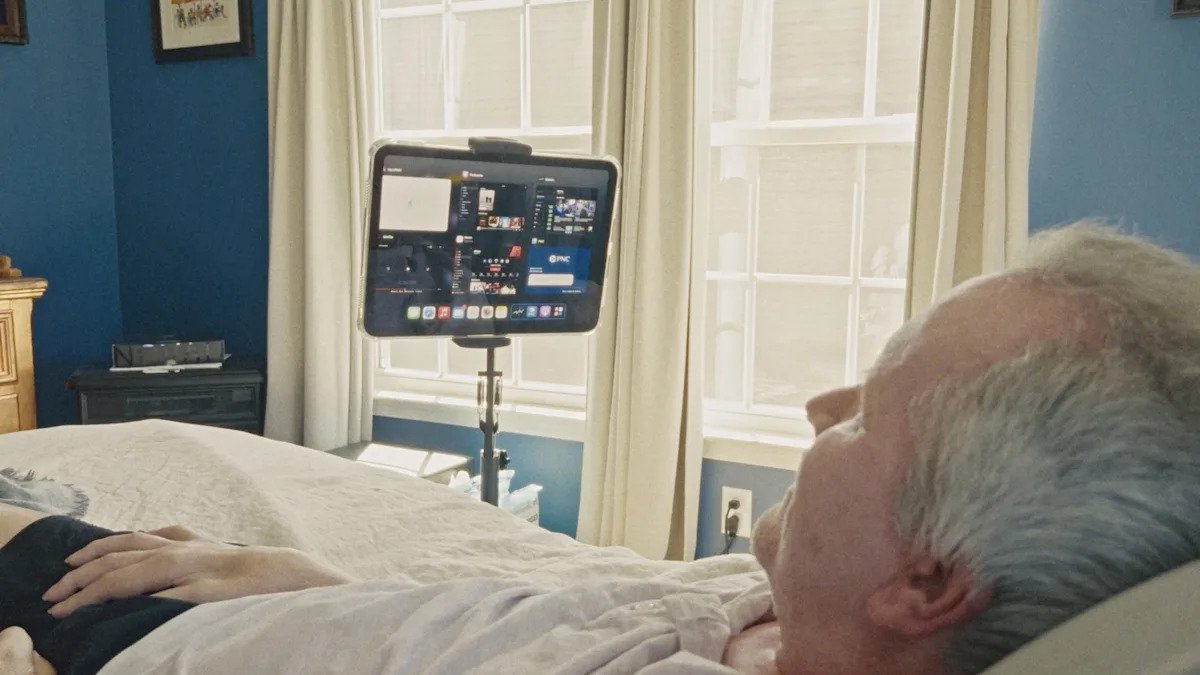
A patient with amyotrophic lateral sclerosis (ALS) has become the first person in the world to control an iPad entirely by thought, according to neurotech company Synchron.
This means Mark Jackson, 65, from western Pennsylvania, can control the product without using his hands or voice commands. Instead, an implantable brain-computer interface (BCI) translates his thoughts into actions.
Jackson was diagnosed with ALS in 2021. Over time, he said he developed paralysis in both of his arms along with some weakness in his neck.
Years ago, this may have meant a loss of independence due to the lack of motor function. Now, Jackson said he is able to watch TV shows, listen to audiobooks, use social media and send text messages to his children.
MORE: ALS took a young mother’s voice away. AI helped her regain it
“One of the most challenging things for me, and I’m sure for others in similar situations, is losing the ability to do things for yourself, and losing the ability to simply move my arm to swipe on a phone,” Jackson told ABC News.
“This gives you the ability to have a way to still be able to do that, even though, yeah, I can’t move my arms anymore, but I can still do things for myself without having someone else do them for me,” he continued.
How do BCIs work?
BCIs are sensors implanted in the brain. They translate brain signals into actions outside of the body.
There are many types of BCIs. Neuralink, a company founded by Elon Musk, developed a BCI that is a small chip inserted directly into the brain tissue and through brain surgery.
The BCI that Jackson is using was developed by the company Synchron, which involves a device implanted into one of the veins within the brain in a minimally invasive procedure.

Synchron – PHOTO: Mark Jackson, 65, from Pennsylvania has become the first person to control an iPad via thought, using a brain computer interface (BCI).
Dr. Leah Croll, a neurologist at Maimonides Hospital, in Brooklyn, New York, who is not involved in Jackson’s care, told ABC News that research into BCIs is not new but that artificial intelligence (AI) has helped it grow rapidly.
“This is an idea that’s really been around since the ’90s, but I think we’re seeing headlines about BCI research coming up more and more frequently because AI has really accelerated the pace of research in this world, and there’s a lot of using AI in terms of creating algorithms that allow us to translate brain signals into actions,” she told ABC News. “I can’t understate enough — it’s absolutely everything to give somebody back some function.”
Giving back independence
On its website, Synchron says it “aims to restore the control of a touchscreen for patients with limited hand mobility using only their thoughts.”
Jackson has been working with Synchron since 2023 and previously used a BCI to help him control an Apple Vision Pro.
Dr. Tom Oxley, founder and CEO of Synchron, said this version of the BCI is using a new HID, or Human Interface Device.
“The BCI HID profile is interesting because, up until this point, we’ve had to trick the computer into thinking a signal was coming from a mouse or a keyboard, and so it takes the signal in with all of the assumptions that come with presuming that it’s a mouse or a keyboard, and so that you know that comes with a range of restrictions,” he told ABC News.
“What’s going to be incredible about this new technology is the BCI profile is going to become a sandbox,” he continued. “One of the really interesting differences is that there is a two-way communication so the computer can detect the strength, the fidelity, of the brain signal, and in real time, present back information about, ‘Well, you’re looking over here. You’re thinking over here. You want to click that. You want to move there, ‘and the feedback will look quite different.”
MORE: FDA approves new drug for rare form of ALS
Jackson said the HID had made it easier and quicker to click into and use different apps compared to an earlier version of the BCI.
This allows Jackson to be able to access Netflix to watch a TV show or movie or keep up with friends on Facebook or Instagram.
“For me to sit down and play around with a computer, it’s just not something I was ever really that interested in, but this has been an amazing experience for me,” Jackson said. “I had no idea that I would be involved in something as groundbreaking.”
Unanswered questions
While BCIs can help patients regain a sense of independence, there are still many unanswered questions about the technology.
Croll said it’s unclear what possible long-term consequences are from someone using a BCI or if there is any damage it can cause the brain.
“There’s legal and ethical conundrums that we really have to start attacking, because this is coming at us very quickly,” she said. “One major concern is that if something is implanted into the brain and using your data to perform its functions, that means, by definition, that it’s collecting your private data from your brain. How do we protect someone’s privacy who’s entitled to that data? How long does it get stored? How can it be used?”
Croll said stories of individual patients using the technology are great but she is curious to see clinical trial data, and what BCIs look like when rolled out to many people at a time.

Synchron – PHOTO: A BCI is a sensor Implanted into the brain that translates brain signals into actions outside of the body. Jackson can watch TV shows, visit social media and send messages without the use of his hands or voice commands.
Oxley said the FDA has very strict requirements when trying to seek approval for medical devices like BCIs, which typically requires an early feasibility study, a pivotal trial to prove safety and effectiveness, and post-market monitoring.
“We’ve completed a feasibility [trial], and we’re now starting to prepare for the pivotal trial,” Oxley said. “The FDA have a guidance document that outlines all of the ways that they want the companies to be very careful on risk for users. So, is it safe? What is the procedure to put it in? How long does the device last? What’s the maintenance requirements? How does it work? In what use case does it work? Which software can it work with? What activities will it help you with?”
It will likely take several years for completion of the pivotal study and intended market approval, he added.
Jackson said he would like to see some improvement in the scrolling function of future BCIs, but he hopes his success gives hope to others in similar situations.
“The participation in all of this for me was not always necessarily about what’s in it for me, but more what we can do to further the technology advances that we have to make it better in the future,” Jackson said. “It’s really about being part of something bigger than myself. … I wake up every day and I have two choices. I can choose to wallow in self-pity and feel bad for myself, or I can choose to take the positive side, make the best of every single day and take one day at a time.”
A representative for Apple did not immediately return ABC News’ request for comment.
