


AMSTERDAM (AP) — Megan Worthy still recalls singing in a choir in the Australian capital, Canberra, as she was growing up.
Now, as a rare form of early-onset dementia chips away at her vision and other brain functions, the 58-year-old is transported back to her musical youth as she and her daughter, Bronte, sing together with other people with neurological conditions in an Amsterdam concert hall, the Concertgebouw.
“It’s pretty brutal,” Worthy said of her rare neurological condition. “I’m starting to lose everything, you know, and this is really rewarding and seeing all these people, yeah, it did make me have a lot of memories.”
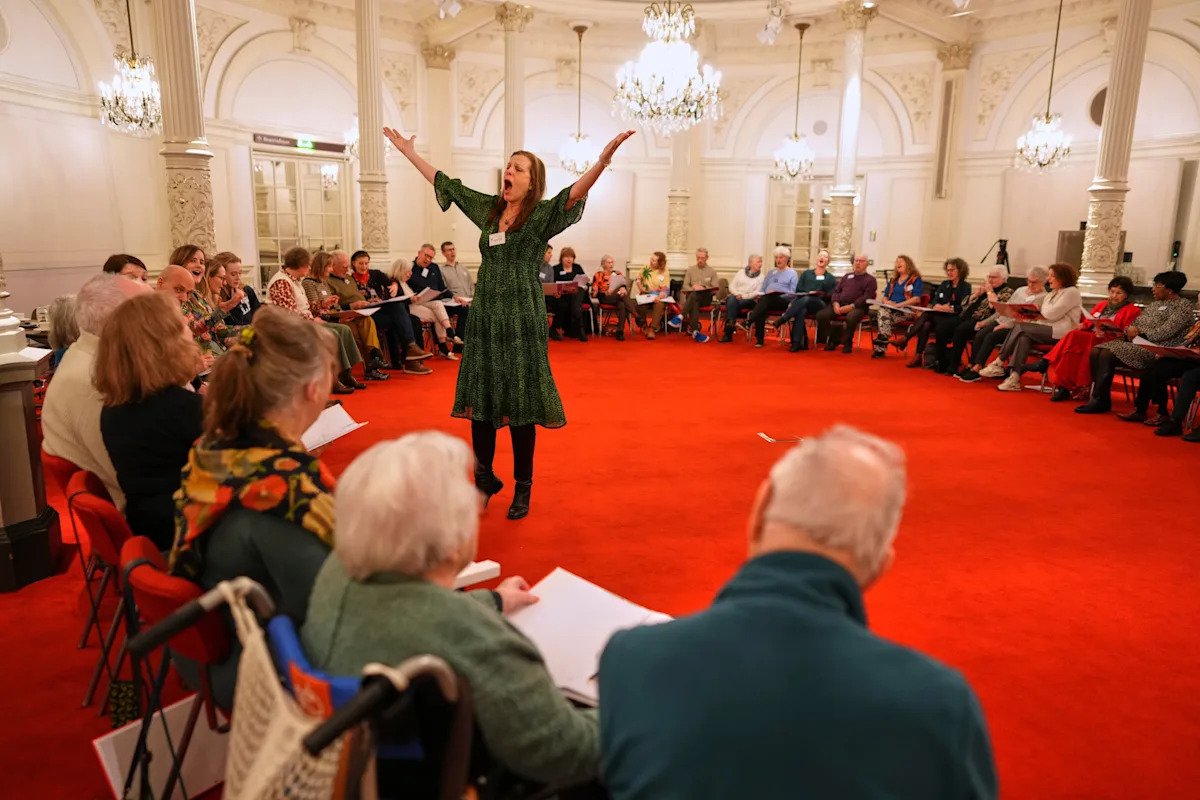
She was taking part in a so-called “singing circle” run by opera singer Maartje de Lint at the landmark concert venue for seniors with what she calls “vulnerable brains,” many of whom have a form of dementia or Parkinson’s disease.
Millions of people have some form of dementia, a progressive loss of memory, reasoning, language skills and other cognitive functions. People can experience changes in personality, emotional control, even visual perception. Alzheimer’s is the most widely recognized type, but there are many others, with their own symptoms and underlying biology. Small strokes, for example, can impair blood flow to the brain and trigger what’s called vascular dementia.
The singers in Amsterdam, who each pay 20 euros ($23.50) to attend, are arranged with their carers in a circle of chairs under a ceiling hung with 14 crystal chandeliers in the venue’s ornate Mirror Hall.
“We always say, music is like vitamins,” said Selien Kneppers, 78, who once managed a Dutch boogie woogie and blues band and now regularly attends the singing circle.
Roving around the middle, often dropping to one knee and reaching out her hands to connect with a singer, is De Lint. She and other singers in her organization crisscross the Netherlands and Europe, leading singing workshops.
Singing, De Lint says, is a way of keeping the brain active and bringing family members and their loved ones closer together.
“So we give people perspective,” she says before one of her singing sessions in Amsterdam. “It’s like actually a training for the brain, for the body, to get more resilient and understand the perspective that you still have.”
The hour-long session clearly has an emotional effect on the singers and their carers. Helpers regularly hand out paper tissues for people to dab away tears. One man tenderly reached out a hand to touch the face of the woman next to him as they sang songs ranging from Elvis Presley’s “Love Me Tender” to Frank Sinatra’s “Fly Me to the Moon” and “Amazing Grace.”
Neurobiologist Brankele Frank, who is not connected to De Lint’s project, agrees that singing can be beneficial to people with dementia or Alzheimer’s or other kinds of neurodegenerative diseases.
Music “speaks to brain areas that haven’t really been degenerated yet,” she told The Associated Press. “So, for example, their verbal skills often are compromised, but music speaks to parts of the brain that don’t necessarily need verbal skills. And so it taps into their emotion, their sense of self, their identity.”
Scientists are studying the potential benefits of music for people with dementia, traumatic brain injuries, Parkinson’s disease and stroke. Music lights up multiple regions of the brain, strengthening neural connections between areas that govern language, memories, emotions and movement.
Megan’s daughter, Bronte Henfling, said that even getting her mother to a new environment that was not a medical appointment to discuss her posterior cortical atrophy felt good.
“Just hearing everyone come together and sing … it reminds us that we’re all human and there’s a humanity out there which is really pleasing and nice to be a part of,” she said.
