


When you lift weights, walk up a steep hill or ride a bike, your body is continuously sending sensory signals to your brain. These signals paint a picture of the physical sensation of what you’re doing. Your brain then takes these signals and filters them through your past experience, goals, expectations and current emotional state.
It turns out that the way your brain uses all that context to interpret this sensory information significantly influences whether you perceive something physically strenuous, such as a bike ride, as difficult and threatening or as rewarding and pleasant.
Many people who are new to exercise often quit because they interpret physical discomfort as a warning sign instead of a challenge that can be overcome. But in recent years, scientists have shown that by changing your emotional state, you can also change how you interpret physical sensations.
We are two neuroscientists who study how the brain and body respond to stress and how those reactions shape perception. Research has shown that small, well-timed challenges can help the body and mind grow more resilient, while too much stress, or stress at the wrong time, can slow recovery and sap motivation.
In a recent experiment, we wanted to see whether it is possible, in a sense, to recalibrate how the brain interprets difficult tasks using a tiny, safe dose of physical discomfort. We found that physical stress in manageable doses – in this case, dunking your hand in ice-cold water – can make a later effort feel more doable, particularly for people who are not yet accustomed to strenuous exercise.

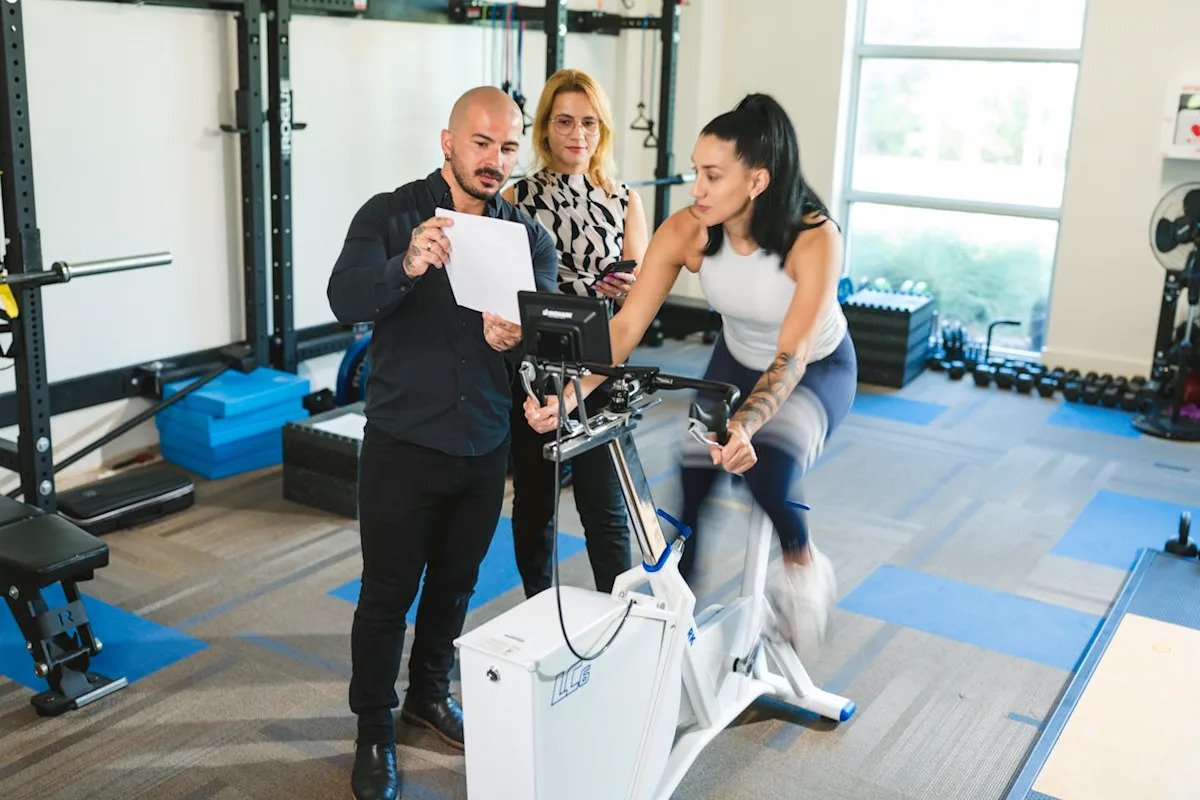
Authors Marcelo Bigliassi and Dayanne S. Antonio monitor psychophysiological and psychological data while a participant performs a cycling exercise on a stationary ergometer. Margi Rentis
Cold first, bike second
In order to evaluate the concept of stress calibration, we assembled a group of 31 adult volunteers with limited prior engagement in physical activity. Our physical fitness task involved volunteers riding a stationary bike for six minutes, with the effort increasing in short stages from easy to tough.
On one visit, before getting on the bike, participants put one hand into a bucket of ice-cold water and kept it there for as long as they could – between one and three minutes. We hypothesized this physical stress would trigger a slight change in how their brains would interpret physical sensations and change their ability to tolerate physical discomfort; this was the recalibration step.
On the other visit they just got on the bike without doing a cold-water hand dunk. To help control for variables, we mixed up the order so that some people did the cold-water dunk on the first day and others did it on the second.
While riding the test bike, participants reported on a number of variables using rating scales, including how much pain they felt, how pleasant or unpleasant the effort seemed, how much energy they had, and whether they felt in control or overwhelmed. These measures allowed us to track how the volunteers were experiencing the exercise at different levels of intensity, both with and without the cold-water hand dunk.
What we found

When we first saw the results, we were amazed by how much a short stress induction could affect people’s perceptual responses during exercise. During the hardest two minutes of the cycling task, the participants who had lasted longer in the cold-water dunk actually reported less pain and more pleasure. Additionally, the participants who said they had a high tolerance for pain experienced a slightly greater sense of dominance compared to other participants as the biking intensity peaked.
We believe three effects may help explain why our participants felt the toughest minutes on the bike were less painful and more enjoyable after the cold-water challenge.
The first effect is similar to a quick biological reset. Ice water jolts the nervous system. In response, the brain switches on its built-in pain-dimming system and sends “turn it down” signals down the spinal cord. For a short window, incoming pain messages are muted, so discomfort feels less intense, helping participants tolerate more pain during cycling right after the hand dunk.
The second effect is a short stress surge. When the body feels stress, your heart rate and blood pressure jump, stress chemicals rise, and the brain may turn pain down for a moment. That bump can make the first minutes of exercise feel less abrupt, almost as if you did a quick psychological warmup. As the surge fades, your system settles, allowing you to find your rhythm without the start feeling so shocking.
The third mechanism works through the brain’s interpretation of the sensations. Getting through the short burst of discomfort from the ice dunk seemed to give participants an instant sense of “I can handle this” and a feeling of accomplishment. We think this boost recalibrates how their brains interpret stress and discomfort.
From lab insight to everyday training
At its core, this study shows that how your brain perceives physical sensations is adjustable. A short, well-timed challenge, such as an ice-cold hand dunk, can act as a calibration mechanism, tilting the toughest moments of exercise away from pain and toward enjoyment.
You don’t need an ice bucket to apply this principle to your life. The challenge could be a short uphill push before a longer run, a quick set of jump squats before starting a workout, or a short jog before a more challenging activity. These brief contrasts can prime the body and mind so the main effort feels less like a threat and more like progress. The key is to keep the challenge short, safe and within your limits, especially on days when life is already stressful.
This finding fascinates us because it shows that neither your brain nor your body is just a passive passenger during effort. They constantly recalibrate what “hard” feels like. The effect of overcoming one small challenge can ripple forward, making the next challenge feel more doable and even rewarding.
Over time, those small wins become reference points, proof that effort leads to recovery and growth. Layered into everyday training, they turn workouts into opportunities to practice composure, restore a sense of control and build lasting resilience.
This article is republished from The Conversation, a nonprofit, independent news organization bringing you facts and trustworthy analysis to help you make sense of our complex world. It was written by: Marcelo Bigliassi, Florida International University and Dayanne S. Antonio, Florida International University
Read more:
Marcelo Bigliassi is an Assistant Professor of Psychophysiology and Neuroscience at Florida International University. He receives funding from the National Institutes of Health (NIH), serves on the advisory board of the Antifragile Academy, and works as the Chief Scientist at NeuroMotor Training and NeuroSmart.
Dayanne Antonio is a Ph.D. student at Florida International University and serves as a Teaching Assistant in the undergraduate Kinesiology program. She reports no conflicts of interest.
