


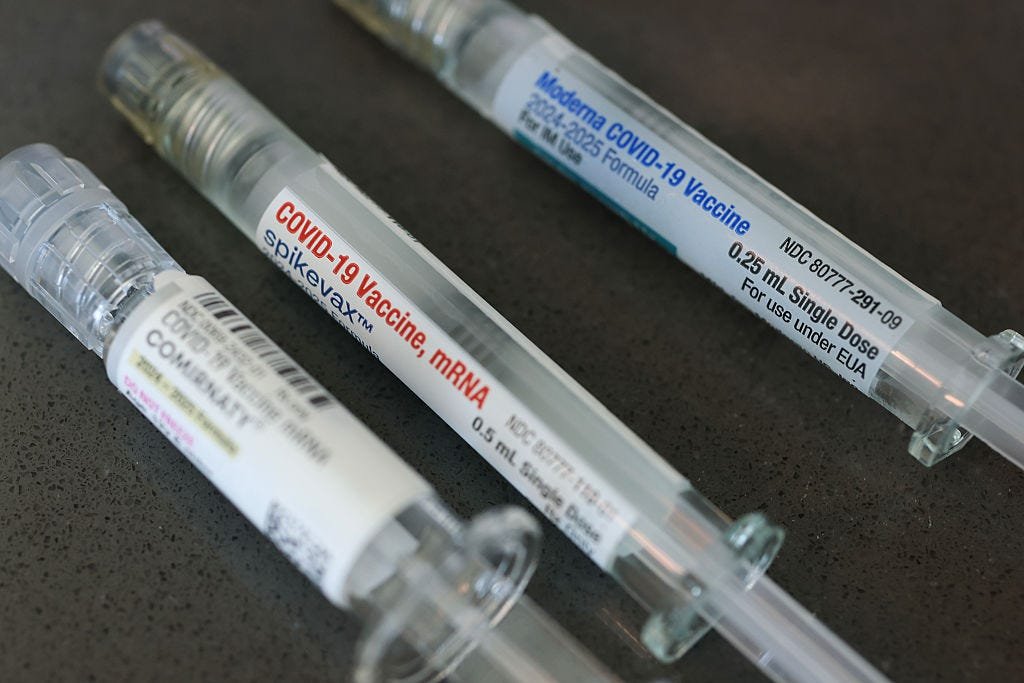
Millions of dollars in cuts to vaccine technology. Canceled research. Mass resignations at the Centers for Disease Control and Prevention. Overhauled health councils and ever-changing guidelines that result in sparring between government officials and professional medical agencies.
Keeping up with public health and, specifically, who can get a COVID-19 vaccine, has become more of a challenge since Health and Human Services Secretary Robert F. Kennedy Jr. took office earlier this year. Kennedy ruffled feathers in health communities in June when he upended the Advisory Committee on Immunization Practices (ACIP), replacing all 17 original members with new picks, some with a history of anti-vaccine advocacy. The committee provides guidance on vaccine use to the CDC.
The disruption to the usual process for approving the updated fall vaccine has resulted in a crunch where people looking for their seasonal shots suddenly are unsure if they can get them. And, with cases on the rise, new Food and Drug Administration guidance handed down in late August still hasn’t provided the concrete answers many were looking for.
Here’s what we know so far about your ability to access a COVID-19 vaccine this season.
Who is approved for a COVID-19 vaccine under FDA guidelines?
On Aug. 27, Kennedy announced that emergency-use authorizations for COVID-19 vaccines had been terminated. Here’s what was approved.
Moderna, Pfizer and Novavax immunizations were approved only for “those at high risk” and people over 65.
Moderna vaccine was approved for children 6 months and older with an underlying condition and people over 65.
Pfizer was approved for those 5 and older with an underlying condition and people over 65.
Novavax was approved for those 12 and older with an underlying condition and people over 65.
When announcing the restrictions, Kennedy did not specify which conditions are considered as putting people at “high risk.” However, the CDC lists a bevy of health conditions that make someone “higher risk,” including common health issues like asthma, cancer, kidney disease, diabetes, obesity, mood disorders and a history of smoking.
It is unclear if these factors will be the same ones used to determine eligibility for the updated COVID-19 vaccine. Pregnancy, for example, is listed as a “high-risk” condition here, but Kennedy previously announced the removal of pregnant women from the vaccine recommendation list.
Can you still get the vaccine if you’re not in the approved groups?
It depends on your state and what happens when the ACIP convenes next on Sept. 18 and 19.
Usually, the process for placing vaccines on the CDC’s formal immunization schedule begins with the FDA reviewing data and issuing its opinion on whether it should be distributed and to whom, Dr. Brigid Groves, Vice President of Professional Affairs for the American Pharmacists Association (APHA), told USA TODAY.
Then the ACIP meets, brings forth its scientific advisors, analyzes the data, looks at the evidence and comes up with a recommendation. That recommendation then goes to the CDC director for review and independent approval, at which point the vaccine formally becomes part of the federal schedule.
In some cases, ACIP’s final decision differs from the indications first given by the FDA, such as in the case of the shingles vaccine, which was originally recommended for people 50 and older. After a review, the ACIP decided to focus first on getting the vaccine to people at the absolute highest risk, people 65 and up, a recommendation ultimately accepted by the CDC.
However, the formal federal schedule has yet to be reviewed or approved by the ACIP, which failed to pass a recommendation about the COVID-19 vaccine during its June 25-26 meeting and the July U.S. Preventive Services Task Force meeting, which was postponed. Usually, the committee makes its fall recommendations during this May or June meeting before respiratory illness season begins, said Groves.
Some states need ACIP and CDC recommendations in place before distributing vaccines over the counter at pharmacies, while others just need FDA approval. Therefore, the vaccine may not be available via the standard walk-in process of previous years.
Thirty-four states allow pharmacists to administer vaccines without an ACIP reccomendation, including Alaska, Alabama, Arkansas, California, Connecticut, Delaware, Hawaii, Iowa, Idaho, Illinois, Indiana, Kansas, Maryland, Michigan, Minnesota, Missouri, Mississippi, Montana, Nebraska, North Dakota, New Hampshire, New Jersey, Ohio, Oklahoma, Oregon, Rhode Island, South Carolina, South Dakota, Tennessee, Texas, Vermont, Washington, Wisconsin and Wyoming.
In some cases, said Groves, a prescription may be necessary. In others, patients can self-attest to having a condition that qualifies them for the vaccine, meaning they assert either verbally or through a consent form that they have an underlying illness.
Should children get the vaccine?
On May 27, Kennedy announced that the COVID-19 vaccine would no longer be included in the CDC’s recommended immunization schedule for healthy children and pregnant women, a move that broke with expert guidance and bypassed the usual scientific review process.
This drew the ire of multiple professional medical organizations, including the American Academy of Pediatrics (AAP), which went as far as to release its own schedule on Aug. 19, saying the federal process was no longer credible. It recommends that all children 6 months to 23 months old receive the latest COVID-19 vaccine to reduce the chance of serious illness. Children and adolescents ages 2 to 18, without other high-risk factors like immunosuppression, can receive and should be offered the vaccine if they were not immunized before, according to the guidance.
In a response posted to social media, Kennedy hit back at the pediatrics academy’s criticism, implying that the organization’s views were influenced by corporate pharmaceutical funders.

As of Sept. 2, CVS said its pharmacies can only offer the COVID-19 vaccine without a prescription in 34 states.
Can you get the COVID-19 vaccine at pharmacies?
The majority of Americans receive their seasonal vaccines, including COVID-19, in pharmacies. Since August 2024, more than 27 million Americans received the vaccine at a pharmacy, according to the CDC, as opposed to just 2.5 million administered in physicians’ offices.
“You’ve seen a number of statements from HHS and others saying that nobody that wants a vaccine is going to be prevented from getting that, but we don’t have guarantees for that,” said Dr. Robert H. Hopkins, medical director of the National Foundation for Infectious Diseases (NFID).
Supply will not be an issue, as 2025-2026 formulations of the vaccine have already been or are in the process of being shipped to pharmacies, said Groves.
Until ACIP issues its recommendations or designates an exception, people in 13 states and DC can get the vaccine at CVS only with an “authorized prescriber’s prescription”: Arizona, Colorado, Florida, Georgia, Kentucky, Louisiana, Maine, North Carolina, New York, Pennsylvania, Utah, Virginia and West Virginia.
Pharmacies are unable to administer COVID-19 vaccines in Massachusetts, Nevada, and New Mexico, where state laws don’t allow any pharmacists to give a vaccination not recommended by ACIP.
Walgreens did not respond to USA TODAY’s request for comment, but told CBS News that it was “prepared to offer the vaccine in states where we are able to do so.”

The FDA approved updated COVID-19 vaccines by Moderna, Pfizer and Novavax in late August, but with new restrictions.
Will insurance cover the COVID-19 vaccine?
It’s not yet known how insurance companies will handle COVID-19 vaccine coverage amid changing guidance.
Commercial health insurers are required to cover vaccines on the ACIP schedule at no cost-sharing or copay as per the Affordable Care Act, said Groves. Medicare and Medicaid plans are also required to cover vaccines based on ACIP recommendations.
If the ACIP follows the FDA’s new recommendations, healthy people under the age of 65 with no underlying condition may have to pay out-of-pocket for the COVID vaccine, which Grove said averages around $140.
America’s Health Insurance Plans (AHIP), a national trade association and lobby for health insurance providers, told USA TODAY in a statement that insurers also take into consideration recommendations from medical organizations when deciding what to cover.
Vaccines with recommendations for shared clinical decision-making from ACIP are also required to be covered at no cost, it said. The “shared clinical decision-making” language was applied to vaccines for children by the CDC in May after Kennedy announced the removal of recommendations for healthy children and pregnant women.
Regardless of ACIP’s decision in September, commercial insurers can only implement policy changes in the next benefit year. Changes to Medicare and Medicaid plan coverage would happen immediately, however. Doctors could prescribe the vaccine off-label to people not covered by ACIP recommendations, but AHIP said this is not a practice typically applied to vaccines.
“We’re working closely with our members to review [the] FDA announcement and will be monitoring the forthcoming meetings and recommendations from ACIP and CDC on considerations around coverage,” said Tina Stow, AHIP spokesperson. “Individual health plans and plan sponsors will be prepared to make coverage decisions informed by science, the latest medical evidence and data. This process will be evidence-based, evaluate multiple sources of data, including but not limited to ACIP, and will be informed by customer needs.”
What should you do if you want the COVID-19 vaccine?
Access to the vaccine is largely dependent on location, at least until ACIP makes a final determination in September. Those hoping to get the vaccine but concerned that they may not be able to should first contact their medical provider to ask about their state’s requirements, said Hopkins.
“I encourage my patients to reach out to me through our patient portal or to call the office. I’m going to help them navigate that situation. If they’ve got a pharmacy or a pharmacist that they work with, contact that pharmacist. They should be able to let them know what the situation is in their community,” he said. “But I would encourage anybody who wants to get the vaccine to get vaccinated.”
This article originally appeared on USA TODAY: Confused by changing COVID vaccine recommendations? We break it down.
