


A staggering 95% of generative AI pilots at companies are failing, according to a recent report published by MIT’s NANDA initiative. But rather than giving up on the technology altogether, the most advanced organizations are experimenting with agentic AI systems that can learn and be supervised.
That’s where Maisa AI comes in. The year-old startup has built its entire approach around the premise that enterprise automation requires accountable AI agents, not opaque black boxes. With a new, $25 million seed round led by European VC firm Creandum, it has now launched Maisa Studio, a model-agnostic self-serve platform that helps users deploy digital workers that can be trained with natural language.
While that might sound familiar — reminiscent of so-called vibe coding platforms like Cursor and the Creandum-backed Lovable — Maisa argues that its approach is fundamentally different. “Instead of using AI to build the responses, we use AI to build the process that needs to be executed to get to the response — what we call ‘chain-of-work,” Maisa CEO David Villalón told TechCrunch.
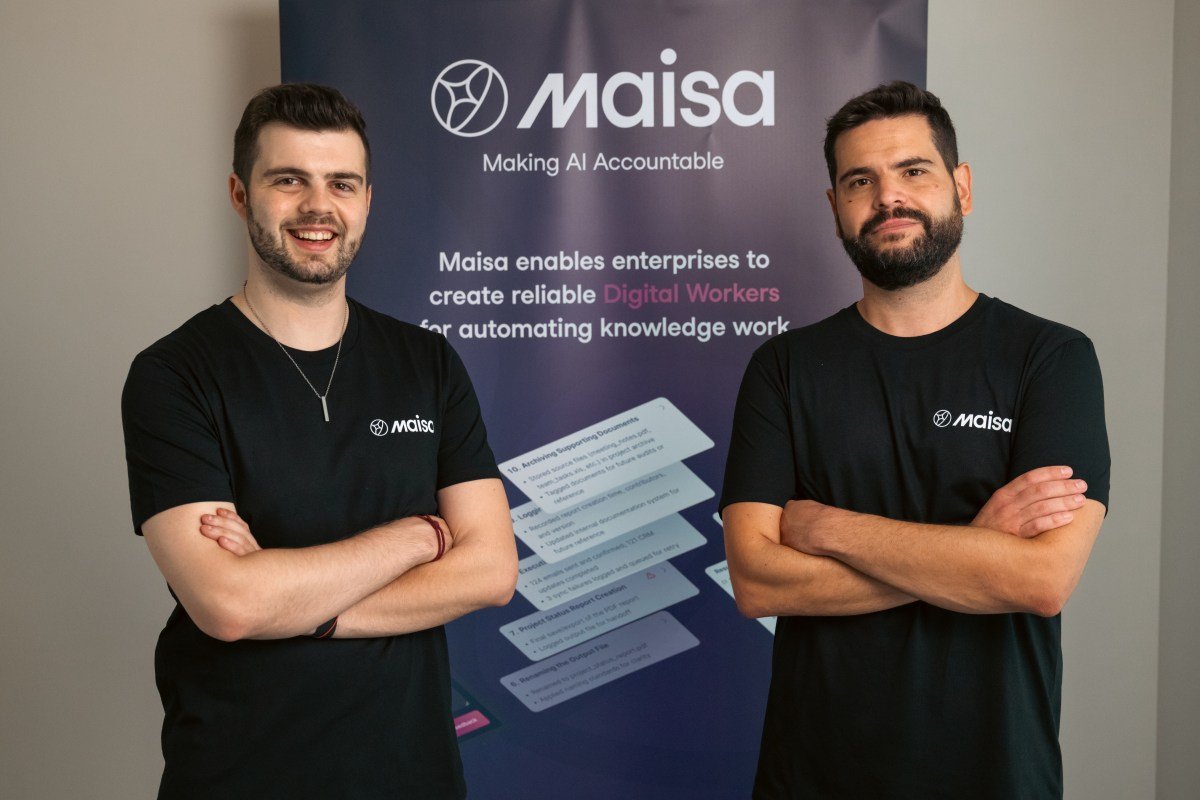
The principal architect behind this process is Maisa’s co-founder and Chief Scientific Officer, Manuel Romero, who had previously worked with Villalón at Spanish AI startup Clibrain. In 2024, the duo teamed up to build a solution to hallucinations after seeing firsthand that “you could not rely on AI,” Villalón said.
The pair isn’t skeptical about AI, but they think it won’t be feasible for humans to review “three months of work done in five minutes.” To address this, Maisa employs a system called HALP, standing for Human-Augmented LLM Processing. This custom method works like students at the blackboard — it asks users about their needs while the digital workers outline each step they will follow.

The startup also developed the Knowledge Processing Unit (KPU), a deterministic system designed to limit hallucinations. While Maisa started out from this technical challenge rather than a use case, it soon found that its bet on trustworthiness and accountability resonated with companies hoping to apply AI to critical tasks. For instance, clients that currently use Maisa in production include a large bank, as well as companies in the car manufacturing and energy sectors.
By serving these enterprise clients, Maisa hopes to position itself as a more advanced form of robotic process automation (RPA) that unlocks productivity gains without requiring companies to rely on rigid predefined rules or extensive manual programming. To meet their needs, the startup also offers them either deployment in its secure cloud or through on-premise deployment.
Techcrunch event
San Francisco
|
October 27-29, 2025
This enterprise-first approach means Maisa’s customer base is still very small compared to the millions flocking to freemium vibe-coding platforms. But as these platforms are now exploring how to win enterprise customers, Maisa is moving in the opposite direction with Maisa Studio, which is designed to grow its customer funnel and ease adoption.
The startup also plans to expand with existing customers that have operations in multiple countries. With dual headquarters in Valencia and San Francisco, Maisa itself already has a foothold in the U.S., as reflected in its cap table; its $5 million pre-seed round last December was led by the San Francisco-based venture firms NFX and Village Global.
In addition, TechCrunch learned exclusively that U.S. firm Forgepoint Capital International participated in this new round via its European joint venture with Spanish bank Banco Santander, highlighting its appeal for regulated sectors.
Focusing on complex use cases demanding accountability from non-technical users could be a differentiator for Maisa, whose competitors include CrewAI and many other AI-powered, business-focused workflow automation products. In a LinkedIn post, Villalón highlighted this “AI framework gold rush,” warning that the “quick start” becomes a long nightmare when you need reliability, auditability, or the ability to fix what went wrong.”
Doubling down on its goal to help AI scale, Maisa plans to use its funding to grow from 35 to as many as 65 people by the first quarter of 2026 in order to meet demand. Starting in the last quarter of this year, the startup anticipates rapid growth as it begins serving its waiting list. “We are going to show the market that there is a company that is delivering what has been promised, and that it’s working,” Villalón said.
