


NEW YORK (AP) — States are warning beachgoers about a summertime surge in infections from a frightening, flesh-eating bacteria found in coastal waters.
Vibrio vulnificus are becoming an annual threat along the Gulf Coast and — increasingly — up the Eastern Seaboard.
People should listen to the warnings, said Bernie Stewart, a 65-year-old retired bounty hunter in Florida who counts himself lucky to have survived an infection.
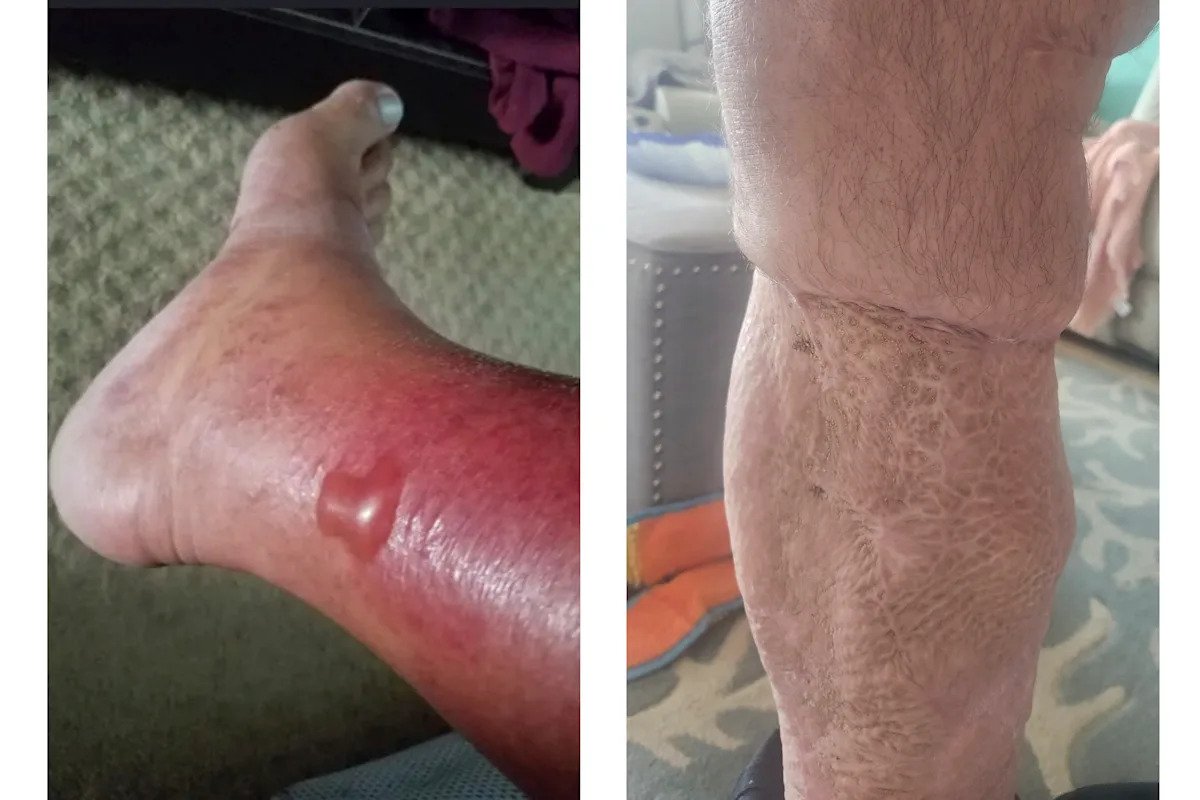
In August 2019, Stewart’s right leg was infected while he was kayak fishing in Pensacola Bay. What at first appeared to be a sun blister led to three months in the hospital, where doctors performed 10 surgeries to remove decaying skin and prevent the bacteria from killing him.
“This ain’t nothing to play with,” Stewart said.
Vibrio bacteria thrive in seawater and in the mix of fresh and saltwater found in estuaries and lagoons. Most infections are reported from May to October, and most happen in states along the Gulf Coast.
The Gulf’s water is “the perfect convergence of the right amount of salt and the right amount of heat to let this organism proliferate,” said Dr. Fred Lopez, an infectious diseases specialist at the LSU Health Sciences Center in New Orleans.
At least a dozen kinds of Vibrio can cause human illnesses
The nastiest type is Vibrio vulnificus. It accounts for around 200 of the more than 1,000 Vibrio illnesses each year, according to CDC data.
As many as 1 in 5 of those infections are fatal — a much higher rate than other types of Vibrio bacteria.
Some people become infected by eating eat raw or undercooked shellfish — particularly oysters. But a large percentage fall ill when the person is in ocean or brackish water and the bacteria enter the body through small breaks in the skin.
The antibiotics used to treat food poisoning cases don’t work as well when the germ enters through breaks in the skin, Lopez said.
“They may require multiple surgeries to remove dead or infected tissue, and sometimes require amputation,” he said.
Doctors say severe cases are seen more often in elderly patients, people with weakened immune systems, and those with liver disease, diabetes and certain chronic illnesses.
Cases are up in some places, but not all
Louisiana has seen an alarming jump in cases this summer, but other states are not. More cases are expected, as this is peak season for Vibrio vulnificus infections.
“It is really easy to sound unnecessary alarms because cases have increased, or feel too complacent because cases are low,” when data is incomplete, said Salvador Almagro-Moreno, a St. Jude Children’s Research Hospital who has studied the germ.
Infections have been reported as far north as New England — Massachusetts recently issued an alert after someone reportedly was infected on Cape Cod.
Scientists say climate change is helping the germs proliferate and spread northward. A 2023 study found that the northernmost case has been shifting by about 30 miles each year, and that cases overall have been rising.
As of late last week, 20 cases of Vibrio vulnificus had been reported among Louisiana residents this year. All were hospitalized and four died, the state’s health department said. That’s more than twice the average number of cases for this point in the season, and four times the death toll, state officials said.
Cases are not unusually higher in other Gulf States, however.
Florida, which tends to have more infections than other states, has reported 17 Vibrio vulnificus cases and five deaths this year, compared with 82 cases and 19 deaths at the same point last year.
State officials say they typically see more cases in years when Florida is hit by tropical storms, and hurricane season is only just beginning, Lopez noted.
How to prevent infections
Vibrio vulnificus can enter the body through unhealed cuts and scrapes, recent piercings and tattoos, and recent surgical incisions. If you have such a wound, try to stay out of saltwater or brackish water, and cover it with a waterproof bandage if there’s a chance of exposure.
If you do come in contact with coastal waters or raw seafood, immediately wash cuts and scrapes thoroughly with soap and clean running water, the CDC advises.
And see a doctor if you start to develop symptoms such as fever, chills, and hot red areas on the skin that start to turn dark and blister.
You can also become infected by eating seafood. Health officials say not to eat raw or undercooked oysters or other seafood, and do not let raw seafood, its drippings, or its juices contaminate other foods.
Oysters are a particular risk, and there is no way to tell if an oyster is contaminated just by looking at it.
Wash hands with soap and water after handing raw shellfish, and wear protective gloves if you have a weakened immune system and are at a higher risk of infection.
Health officials also offer cooking instructions for clams, mussels and other shellfish. They recommend throwing away any with open shells before cooking.
In Pensacola, Stewart said he’s advocated — unsuccessfully — for local officials to post signs about the dangers of going into the bay.
“Not everyone’s immune system is going to be strong,” he said.
___
The Associated Press Health and Science Department receives support from the Howard Hughes Medical Institute’s Department of Science Education and the Robert Wood Johnson Foundation. The AP is solely responsible for all content.
