


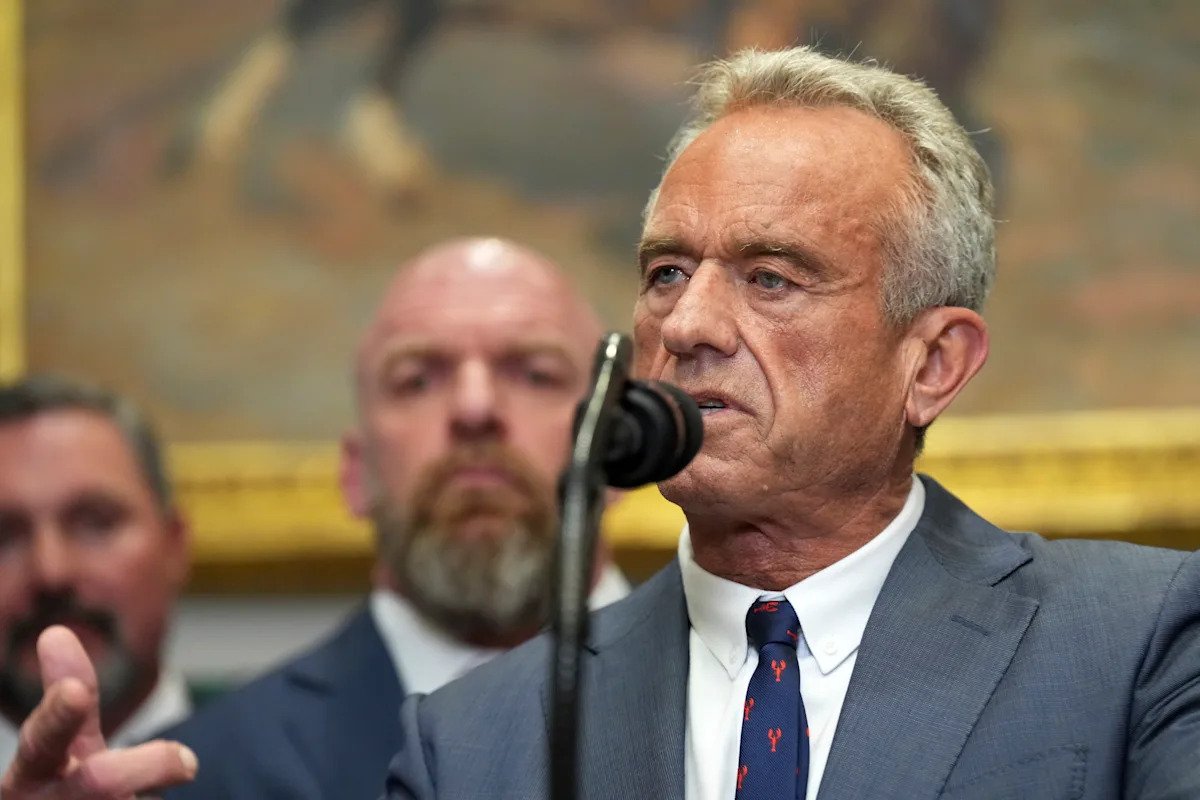
Although mRNA vaccines saved millions of lives during the COVID-19 pandemic, U.S. Health Secretary Robert F. Kennedy Jr. incorrectly argued they are ineffective to justify the Department of Health and Human Service’s recent decision to cancel $500 million in government-funded research projects to develop new vaccines using the technology.
The longtime vaccine critic said in an X video posted Tuesday evening that mRNA vaccines do not adequately prevent upper respiratory infections such as COVID-19 and the flu, advocating instead for the development vaccines that use other processes.
COVID-19 is the only virus for which real-world data on mRNA vaccine effectiveness is currently available, as mRNA vaccines for other diseases, including the flu, are still under development. The two scientists whose discoveries enabled the creation of mRNA vaccines against COVID-19 won a Nobel Prize in 2023 for their work.
Kennedy’s claim ignores how mRNA vaccines work, according to experts. They prevent against severe infection and death, but cannot completely prevent an infection from occurring in the first place. Plus, years of research supports the effectiveness of COVID-19 vaccines that use mRNA technology.
Here’s a closer look at the facts.
KENNEDY: “As the pandemic showed us, mRNA vaccines don’t perform well against viruses that infect the upper respiratory tract.”
THE FACTS: His claim is contradicted by scientific evidence. Countless studies show that vaccinated individuals fare far better against COVID-19 infections than those who are unvaccinated, while others have estimated that COVID-19 vaccines prevented millions of deaths during the global pandemic. The mRNA vaccines do not prevent respiratory diseases entirely, experts say. Rather, they can prevent more serious illness that leads to complications and death. For example, an mRNA vaccine against COVID-19 may prevent an infection in the upper respiratory tract that feels like a bad cold from spreading to the lower respiratory tract, where it could affect one’s ability to breathe.
“A vaccine cannot block a respiratory infection,” said Dr. Jake Scott, an infectious diseases physician and clinical associate professor at Stanford University School of Medicine. “That’s never been the standard for a respiratory virus vaccine. And it’s never been the expectation, and it’s never been that realistic.” He called Kennedy’s claim “misguided.”
Jeff Coller, a professor of RNA biology and therapeutics at Johns Hopkins University, had a similar outlook.
“Vaccinations don’t have to be neutralizing, meaning that you’re not going to get COVID,” he said. “But the important part of a vaccination is that they reduce hospitalization and death. And a reduction in hospitalization and death is proof of an effective vaccine.”
HHS officials did not immediately respond to a request for comment.
Vaccines have traditionally required growing viruses or pieces of viruses called proteins and then purifying them. Then a small dose of the vaccine is injected to train the body how to recognize when a real infection hits so it’s ready to fight back. But this method takes a long time. The mRNA technology speeds up the process and allows existing vaccines to be updated more quickly.
The “m” in mRNA stands for messenger because the vaccine carries instructions for our bodies to make proteins. Scientists figured out how to harness that natural process for vaccines by making mRNA in a lab. They take a snippet of the genetic code that carries instructions for making the protein they want the vaccine to target. Injecting that snippet instructs the body to become its own mini-vaccine factory, making enough copies of the protein for the immune system to recognize and react.
Scott explained that mRNA vaccines are not a “magic force field” that the immune system can use to block an infection, as it can’t detect whether a virus is nearby. It can only respond to a virus that has already entered the body. In the case of COVID-19, this means that the virus could cause an upper respiratory tract infection — a cold, essentially — but would be significantly less likely to cause more severe consequences elsewhere.
Myriad studies on the effectiveness of COVID-19 vaccines have been published since they first became available in late 2020. Although protection does wane over time, they provide the strongest barrier against severe infection and death.
For example, a 2024 study by the World Health Organization found COVID-19 vaccines reduced deaths in the WHO’s European region by at least 57%, saving more than 1.4 million lives since their introduction in December 2020.
A 2022 study published in the journal Lancet Infectious Diseases found that nearly 20 million lives were saved by COVID-19 vaccines during their first year. Researchers used data from 185 countries to estimate that vaccines prevented 4.2 million COVID-19 deaths in India, 1.9 million in the United States, 1 million in Brazil, 631,000 in France and 507,000 in the United Kingdom. The main finding — that 19.8 million COVID-19 deaths were prevented — is based on estimates of how many more deaths than usual occurred during the time period. Using only reported COVID-19 deaths, the same model yielded 14.4 million deaths averted by vaccines.
Another 2022 study, published in The New England Journal of Medicine, reported that two mRNA vaccines were more than 90% effective against COVID-19.
Operation Warp Speed, the federal effort to facilitate the development and distribution of a COVID-19 vaccine, began under the first Trump administration.
“What I don’t understand is why is President Trump is allowing RFK Jr. to undermine his legacy that led to a medical intervention that literally saved millions of lives?” Coller said. “Why is Trump allowing RFK to undermine U.S. leadership in biomedical research and drug development?”
___
Find AP Fact Checks here: https://apnews.com/APFactCheck.
