


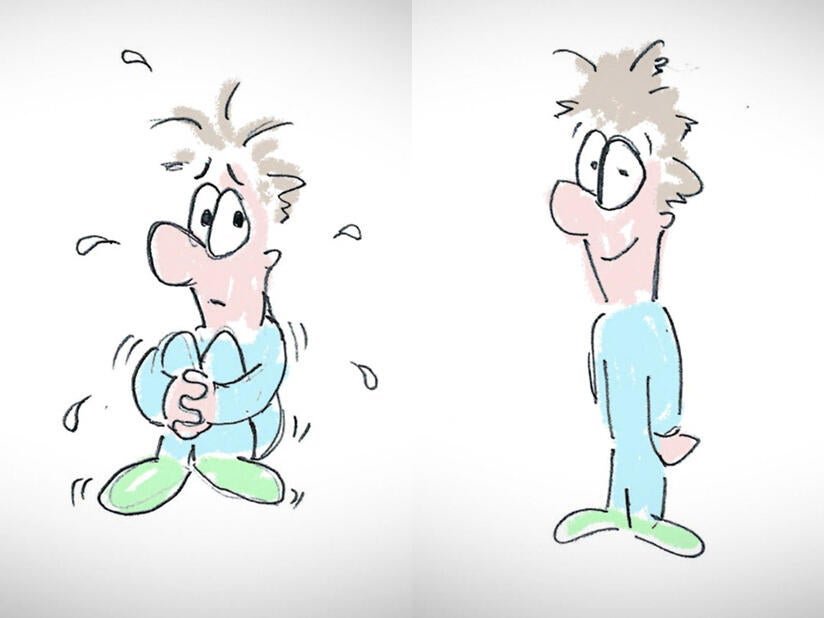
For years, Olga Khazan, a Virginia-based staff writer at The Atlantic, knew she had a big problem: she hated much of her own personality. “I was constantly worried about everything,” she said. “Just never living in the moment. And I didn’t really like doing anything fun with other people. Just wasn’t my thing.”
How might she function at a party? “I would kind of stand off to myself, and honestly, sometimes just, like, read articles on my phone or just basically not engage,” she laughed.
Not surprisingly, a lot of folks didn’t want to engage with Khazan, either. “One person called me a pressure addict, that I was sort of obsessed with working, and just doing as much work as possible, and never taking a minute to appreciate life,” she said. “One person told me that she was kind of afraid of me when we worked together.”
Predictably, when she took a personality test four years ago, she was off the charts – way off – in neuroticism, or negative emotions … not that she hadn’t tried to find help: “This whole time I’d been in therapy,” Khazan said. “I had taken different medications. I did yoga. And I did all the self-care things. Nothing was truly working.”

An introvert unhappy with the box she found herself in, writer Olga Khazan consciously strived to redesign her personality. / Credit: CBS News
Frustrated, Khazan set out to do something much more radical: She vowed to redesign her whole personality. “I decided to spend a year trying to change my personality traits,” she laughed.
Professor Shannon Sauer-Zavala described one’s personality as “your characteristic way of thinking, feeling, and behaving. It’s how you think about your behavior and how you act.”
I asked, “I always assumed that once you had reached a certain age, your personality was your personality?”
“That really is, I think, the prevailing way to think about personality, but it doesn’t line up with our science,” Sauer-Zavala replied.
Personality science is her specialty, and her research at the University of Kentucky could be a game-changer for how we approach mental health issues. She says data tells us it is possible to scientifically change your personality, and that, with the right intervention, introverts can become extroverts … sloppy people can get neater … slackers can gain ambition … and anxious people can learn to be calm. “In my almost 20 years of treating people with anxiety disorders, I’ve seen dramatic changes in 12, 16, 20 weeks,” Sauer-Zavala said.
Step one is a baseline personality test, which asks questions such as: “I sometimes manipulate people into doing what I want.”

Shannon Sauer-Zavala developed a test, the Personality Compass Assessment, based on her study of personality traits. / Credit: CBS News
The next step is forcing yourself to act the opposite of how you normally would. If you’re shy, make conversations. If you’re messy, make the bed.
Sauer-Zavala said, “When we make intentional changes to our thinking, our feeling, and our behaviors, and we maintain those changes over time, then we’re essentially shifting our personality. We’re changing the way we’re gonna fill out those bubbles on the personality questionnaire.”
“So, you consciously adopt the behavior of the personality that you think you want?” I asked. “You make it sound easy.”
“It’s not easy,” Sauer-Zavala replied. “The principles are simple, but the execution is difficult.”
It wasn’t easy for Olga Khazan, the lifelong introvert. Among other strategies to tackle her social anxiety, she enrolled in an improv class with total strangers … something completely outside her comfort zone. “I was very, very scared,” she said. “Probably for the first three or four months that I did it, my heart was really beating in my chest, and I was deeply uncomfortable.”
What about it scared her? “I didn’t like looking silly!” she laughed.

Olga Khazan took improv lessons from Murphy McHugh, and overcame her fear of looking silly. / Credit: Olga Khazan
Murphy McHugh, who was Khazan’s improv teacher, said, “For me, doing improv was a life-changing thing. I opened up socially. I became a better listener, a better collaborator.”
He said as Khazan continued coming to class, he noticed changes in her: “Relaxing, a little bit less of the cross-armed body language. You see someone relaxed, you see their shoulders drop. You see them laughing, and coming into scenes with an idea.”
Along with improv, Khazan meditated, went sailing, took conversation classes, and kept a journal, as she describes in a new book, “Me, But Better: The Science and Promise of Personality Change.”

/ Credit: Simon & Schuster/Simon Element
“Journaling kind of helps you focus on some of the more positive elements of your life that, if you’re very neurotic, you tend to kind of gloss over or forget,” she said.
I asked, “Is this a case of fake it ’til you make it?”
“Yeah, it is fake it ’til you make it,” Khazan said. “Because if you think about it, anything is gonna feel fake if it feels new, right? Anything that you’re not accustomed to doing is gonna feel really unnatural. But the only way to make it natural is to do it over and over and over again”
“And just incorporate it in who you are?”
“Exactly.”
Today, Khazan is happily married, with a 14-month-old baby. As for that personality she once so disliked, she said, “I feel like I am a different person today than I was three years ago. I think I genuinely have a different way of living my life, and approaching problems, than I did before.”
So, what advice does Shannon Sauer-Zavala have for everyone watching with completely unsatisfactory personalities? “Not to get stuck in a personality-type box,” she said. “Think about the life that you want to have, and then know that you can intentionally develop the traits that will facilitate that journey for you.”
READ AN EXCERPT: “Me, But Better: The Science and Promise of Personality Change”
For more info:
“Me, But Better: The Science and Promise of Personality Change” by Olga Khazan (S&S/Simon Element), in Hardcover, eBook and Audio formats, available via Amazon, Barnes & Noble and Bookshop.orgOlga Khazan, The AtlanticShannon Sauer-Zavala, associate professor, Department of Psychology, University of KentuckyDC Arts Center
Story produced by Amiel Weisfogel. Editor: Ed Givnish.
See also:
Introverts and the making of a “Quiet Revolution” (“Sunday Morning”)
Would you go on a retirement cruise?
Passage: Remembering Connie Francis
Restaurateur Keith McNally regrets “almost everything”
