


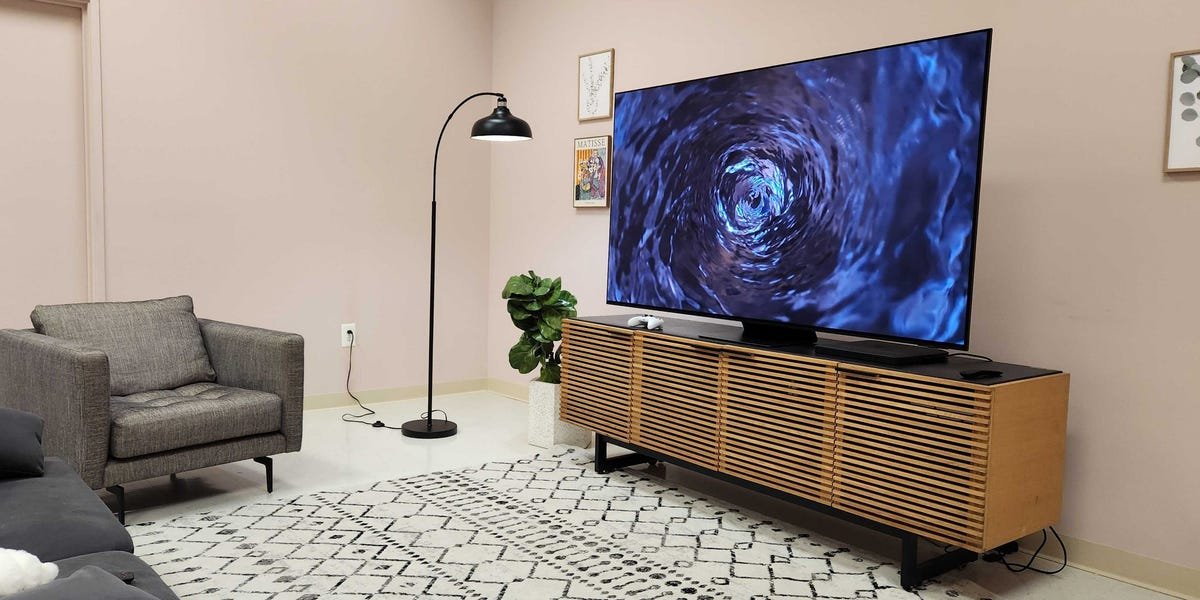
Though they used to be rare, 75- and 77-inch TVs are now available from every major brand and are a lot more affordable than they used to be. I have a 75-inch TV in my living room, and I love the sense of scope and immersion it offers for movie nights, gaming sessions, and big sports events.
But you shouldn’t buy just any TV simply because it’s big. Certain models offer better features, image quality, and overall value than others. To help you find the right display for your needs, I’ve rounded up my top five picks for the best 75-inch TVs on the market.
I’ve been reviewing home entertainment products for over a decade, and my recommendations are all based on extensive testing. The 77-inch Samsung S90D earns my highest recommendation. This OLED display has unmatched color and contrast performance for its price range. But while it’s an excellent TV, the S90D isn’t cheap. For budget-conscious shoppers, I recommend the 75-inch Roku Plus Series QLED, which delivers solid image quality and reliable smart TV features for a common sale price of just under $700.
Note: LCD-based TVs (LED, QLED, Neo QLED) are often manufactured with a 75-inch screen size, but OLED displays are sold at a slightly larger 77-inch size. For that reason, I’ve included 77-inch OLED TVs in this guide.
Our top picks for the best 75-inch and 77-inch TVs
Best overall: Samsung S90D 4K OLED TV – See at Amazon
Best for picture quality: LG G5 4K OLED TV – See at Amazon
Best on a budget: Roku Plus Series 4K QLED TV – See at Amazon
Best anti-glare model: Samsung S95D 4K OLED TV – See at Amazon
Best high-end QLED: Hisense U9N 4K QLED TV – See at Amazon
Best overall
Samsung 77-inch S90D 4K OLED TV
The 77-inch S90D is a fantastic extra-large TV. Its QD-OLED screen delivers an infinite contrast ratio and bright colors, offering some of the best image quality you can get at this price range.
When it comes to balancing picture quality and price, Samsung’s S90D OLED is the best 77-inch TV you can buy.
The S90D uses a QD-OLED screen to enable pixel-level contrast control and a wide range of colors. This gives the TV deep black levels that avoid the washed-out and uneven look that some QLED and LED sets have in dark scenes. The TV also uses quantum dot technology (where the “QD” comes from in QD-OLED), and this feature helps it produce brighter colors than competing LG OLEDs.
During my tests, I measured a peak brightness of 1,240 nits, which is excellent for a midrange OLED and 200 nits more than Samsung’s previous S90C TV model. That level of brightness is more than enough to deliver fantastic high-dynamic-range (HDR) performance. HDR movies and shows look stunning, with sharp images and rich colors that come close to rivaling many pricier TVs.
Steven Cohen/Business Insider
You can also sit toward the side of the screen without any major loss in image quality. QLED and LED sets struggle with viewing angles, so this is a key perk of an OLED like the S90D. Gamers will appreciate the TV’s high 120Hz refresh rate (144Hz with a PC), which enables smooth motion when paired with a PS5, Xbox Series X, or Switch 2. Samsung TVs also have built-in access to the Xbox app. This app enables Game Pass subscribers to play games without a console via cloud streaming.
The TV’s Tizen operating system is solid, with all the streaming apps you could want, but its navigation speed isn’t as consistent as the best streaming devices I’ve reviewed. Though smooth most of the time, lag occurs here and there. I also ran into an issue with frequent notifications popping up for various updates despite disabling notifications in the menu. However, I expect this to be easily fixed in a software update.
Like all of Samsung’s TVs, the S90D lacks Dolby Vision support. Dolby Vision is an HDR format that can offer a more accurate picture when playing Dolby Vision videos from apps like Disney Plus. It’s a nice perk, but its benefits are subtle, so I don’t consider it a must-have. Visit our HDR TV guide for more information about the pros and cons of different HDR formats.
All things considered, very few 75- and 77-inch TVs can match the S90D’s performance in this price range. It’s not the most affordable option out there, but if you have the budget, it’s well worth the money. A 2025 version of this TV, called the S90F, is also available. The S90F is a slightly better TV, but it’s more expensive. For now, the 2024 version remains the best value.
Check out our guides to all the best TVs, best smart TVs, and best Samsung TVs.
Best for picture quality
LG 77-inch G5 OLED 4K TV
The G5 is LG’s most impressive consumer TV. It’s the brightest OLED on the market, and it offers exceptional image quality. It’s pricey, but few high-end TVs can compete with the G5’s overall picture performance.
The G5 is LG’s latest flagship OLED TV. Like all OLED displays, it provides an infinite contrast ratio with deep black levels, but this model can also get exceptionally bright, beating every other OLED I’ve tested.
I previously recommended the Sony A95L in this spot, and though that model remains an excellent high-end TV, the G5’s brightness capabilities are substantial enough to dethrone it. While the A95L peaked at around 1,500 nits in small highlights, I measured a peak of 2,410 nits on the G5 using the TV’s HDR Filmmaker Mode (its most accurate setting).
That’s a notable bump, and it makes a difference when watching high-brightness HDR content. Specular highlights like explosions, laser blasts, shimmering reflections, sunsets, and lightning bolts pop from the screen with a bit more impact. Though some QLED TVs can get even brighter, they lack the pixel-level contrast control that the G5’s OLED panel enables. Check out our QLED vs OLED comparison for more details.
This combination of high brightness and high contrast creates a nearly flawless image with black levels that disappear into a dark room and bright elements that shine with precision, free from any backlight imperfections like blooming or vignetting. Like all OLEDs, the G5 also has wide viewing angles, so you get fantastic image quality even if you’re sitting off to the side of the screen. The G5 even supports a 165Hz refresh rate for PC gaming, while most competing high-end displays max at 144Hz.
Steven Cohen/Business Insider
That said, the G5 isn’t perfect. When watching some HDR videos, the TV initially had issues with posterization (blocky instead of smooth gradations of shadows and colors). Thankfully, LG released two firmware updates to address this. In my testing, these instances were so rare and tied to such specific conditions that I don’t consider it a major con.
The G5 uses LG’s webOS smart TV system, which is a decent platform with plenty of apps and smooth navigation. I ran into some initial glitches with the TV’s voice search, but this ironed out as I tested the set more. Still, I do find other operating systems like Roku and Google TV to be more user-friendly.
Design-wise, the G5 offers an elegant look with a mount that can be hung flush on your wall with virtually no gap. But unlike LG’s step-down OLED models, the G5 doesn’t include a traditional stand. If wall mounting isn’t an option for your room, you need to buy a TV stand separately.
Though the G5 is the current high-end 77-inch OLED to beat, there are some alternatives to consider. Panasonic is set to release a similar 77-inch OLED, the Z95B, later this year. However, pricing and an exact release date are still pending. I’ll test the Z95B when it’s available to see how it compares.
Read our LG G5 4K TV review.
Best on a budget
Roku 75-inch Plus Series QLED 4K TV
The Plus Series is Roku’s entry-level QLED TV model. It has quantum dots and local dimming to offer good contrast, brightness, and color performance for the money. The display also uses our favorite smart TV system and comes with a convenient rechargeable remote.
The Roku Plus Series is the best 75-inch TV on a budget. It’s often on sale for as low as $700, which is an excellent price for a QLED TV with its specs. Though there are some less expensive options available, the Plus Series is the most affordable with local dimming, which is an essential feature for good picture quality on a QLED.
Local dimming gives the TV more precise control over its contrast levels, which helps it produce deeper black levels and brighter highlights. Cheaper QLEDs lack this feature, which results in a big drop in overall image performance, especially if you like to watch movies in a dark room.
Of course, this is still a budget TV, so the Plus Series’ dimming performance isn’t as good as you’d get on a pricier QLED model, like the Hisense U9N. The Plus Series produces solid black levels without too many instances of blooming (where halos appear around bright objects), but it’s prone to delayed dimming and fluctuations from time to time. That said, these issues are to be expected in this price range.
Thanks to its QLED panel, the Plus Series also offers a wide range of colors and decent HDR brightness, with a peak of about 600 nits. For the best HDR performance, I recommend finding a set that can hit 1,000 nits or higher, but 600 is good for this class. The Plus Series is compatible with every HDR format, including Dolby Vision, which Samsung TVs don’t support.
I also love the Plus Series’ intuitive Roku interface, which offers easy access to popular streaming services. The Roku OS (operating system) has a simple and straightforward homepage that’s free from clutter. The included remote is also handy, with a built-in rechargeable battery, hands-free voice control, and a tiny speaker that can play a chime if you ever misplace it.
On the downside, the TV’s viewing angles are subpar, which means colors and contrast fade if you sit to the side of the display. This is a common drawback for many QLED TVs, so I recommend opting for a pricier OLED if that’s a dealbreaker. The display is also limited to 60Hz, so it can’t support 120Hz gameplay on a PS5, Xbox Series X, or PC. But again, that’s an expected tradeoff for a budget-friendly set this big.
Roku also sells an upgraded version of the Plus Series for 2025, which uses a more advanced Mini LED backlight. This should improve local dimming performance. But the 2025 Plus Series is more expensive, so this older model remains the better budget buy.
Read our Roku Plus Series 4K TV review.
Check out our guide to all the best Roku TVs and best budget TVs.
Best anti-glare model
Samsung 77-inch S95D OLED 4K TV
Samsung’s high-end S95D uses a unique matte screen that can nearly eliminate glare and reflections. It’s also the brightest OLED we’ve ever tested. However, the anti-glare design can give black levels a slightly faded look in bright rooms.
In addition to being an excellent high-end OLED TV, the Samsung S95D has a unique feature that’s ideal for solving one specific frustration: screen reflections. Though not a problem in every room, certain spaces with lots of lights and windows can be a headache for viewers since most displays have glossy screens that show lots of glare. This can be especially irritating when trying to watch sports during the day.
However, the S95D has a matte screen that nearly eliminates this issue. There are some drawbacks, but if you struggle with reflections in your room, the S95D could be a game changer. The only notable TVs with similar matte finishes are Samsung’s Frame TV and QN90F, Hisense’s CanvasTV, and TCL’s NXTFrame TV, but those models can’t match the overall image quality of the S95D. In my testing, the S95D’s matte screen worked exactly as advertised, and I didn’t encounter any of the typical mirror-like reflections I see on other TVs.
Steven Cohen/Business Insider
On the downside, the S95D’s matte screen does have a negative side effect: it leads to elevated black levels in bright rooms. The S95D’s black levels look perfect with the lights off, but in a bright environment, blacks can take on a slightly gray and hazy look. This is especially true when watching dimmer scenes in movies and TV shows. Glossy screens, like those used on every other TV in this guide, are much better at preserving black levels in a bright environment, but the tradeoff is that they suffer from more reflections. Ultimately, whether you prefer the S95D’s matte screen over a glossy screen comes down to your needs as a viewer.
Outside its unique screen, the S95D also offers great brightness for an OLED. I measured a peak of 1,700 nits. It’s also got a 144Hz refresh rate for smooth PC gaming, and a premium design that uses a separate box for inputs rather than having them built into the back of the TV.
Samsung also sells a newer version of this TV, the S95F, which can get even brighter. However, the S95F costs a lot more, so I only recommend it to big enthusiasts. For most people, the S95D remains the better value.
Read our Samsung S95D 4K TV review and our Samsung S95F 4K TV review.
Check out our guide to the best sports TVs.
Best high-end QLED
Hisense 75-inch U9N QLED 4K TV
People who want an extra-bright 75-inch TV should check out the Hisense U9N. This high-end QLED has a Mini LED backlight with great contrast control and one of the brightest images on the market.
Hisense’s U9N is the best 75-inch TV for viewers who want a high-end QLED TV with an especially bright image. The display’s high luminance allows it to deliver impressive HDR images, even in rooms with lots of ambient light.
During my evaluation, I measured a peak brightness of 4,100 nits using a 2% test window and 3,200 nits with a 10% window. Those numbers blow away every other TV on this list. Now, such high brightness is only required in certain situations and when watching certain types of content, but if you need to overcome ambient light in your room or you want to get the full impact of every HDR video you watch, the U9N has you covered.
Steven Cohen/Business Insider
Of course, just getting bright is only one part of great image quality. To achieve good picture performance, a TV needs to be able to control its brightness with enough precision to enable high contrast. Thankfully, the U9N is able to do just that. The TV’s Mini LED backlight and local dimming allow the panel to produce inky black levels, so dark scenes look wonderful in a dim home theater room.
That said, the TV’s contrast still can’t match that of an OLED display. Some halos and vignetting around bright objects on dark backgrounds are visible in some instances, but the U9N performs well for a TV of this type. As is the case with all QLEDs, the display’s image quality does take a hit if you sit off to the side of the screen. But the U9N’s viewing angles are wider than most competing QLEDs I’ve reviewed.
The TV is well equipped for gaming, too, with a fast 144Hz refresh rate and VRR. However, I did notice some annoying instances of flicker when playing some PS5 games with VRR enabled. This is a common flaw on some other TVs, but it’s more pronounced here than I’d like.
The U9N is also prone to some glitches here and there, including an error that led to the TV defaulting to the wrong picture mode when I watched certain sources. I also ran into an issue with the TV’s HDMI 3 input when hooked up to my Panasonic 4K Blu-ray player. The player’s signal would sometimes get lost, but this didn’t occur on the U9N’s other inputs.
Ultimately, the TV’s strengths outweigh any of those issues, especially when you consider the frequent discounts it receives. The 75-inch U9N has dropped to as low as $1,772, which is fantastic for a display in this class. Those willing to spend more can get similar brightness and a more refined picture with Sony’s flagship Bravia 9. But the U9N is a better value overall.
How we test 75-inch TVs
Steven Cohen/Business Insider
We picked the best 75-inch TVs through hands-on testing with various display models. We’ve been reviewing home entertainment products for over 10 years and used that expertise to inform our testing parameters and requirements.
When evaluating TVs, we focus on 65-inch options since that’s the industry’s flagship standard. However, overall performance for a specific TV model typically stays the same across sizes 55 inches and up. For example, a 77-inch LG G5 OLED and a 65-inch G5 OLED have the exact same specifications. The only difference is the panel’s size. As such, most test results for 65-inch TVs apply to their 75- and 77-inch counterparts.
However, some QLED displays with local dimming, like the Roku Plus, have more zones in larger screen sizes than smaller ones. This can cause slight differences in contrast performance when comparing a 75-inch model to a 65-inch one, but not enough to change our overall takeaway. In rare cases, some TV models have more dramatic differences across sizes. We consider those differences when recommending displays and note those instances when applicable.
When we test TVs, we evaluate picture clarity, color quality, contrast performance, peak HDR brightness, gaming features, navigation speed, off-axis viewing, and general value. To measure brightness, we use a colorimeter in combination with test patterns on the Spears & Munsil UHD HDR Benchmark 4K Blu-ray disc.
Test patterns are great for objective measurements, but watching real-world content is the only way to fully evaluate how a TV looks. We sample plenty of shows and movies to see how a display performs in both dark and bright environments. Part of our evaluation involves watching the same assortment of scenes on each TV we review to compare performance. Sequences are chosen to show off HDR highlights, shadow detail, black levels, upscaling, and motion. We also mix up the quality of our material to see how a TV handles 4K, 1080p, and standard definition (SD) programs from Blu-ray discs, streaming services, and cable TV.
For more information about our testing process, check out our page detailing how we review tech products.
75-inch TV FAQs
Steven Cohen/Business Insider
Is 75 inches a good TV size?
A 75-inch screen is an excellent option for anyone who wants a display to fill a big space or offer an especially immersive experience in a smaller room. Big screen sizes fill more of your field of view, so your eyes can focus on the image and not the rest of your room. This creates a viewing experience that’s closer to what you’d get in a movie theater.
Many of our picks for the best 4K TVs and best OLED TVs are sold in the 75- and 77-inch screen class, so you have plenty of options.
That said, you need to consider certain logistics when buying a large TV. Most notably, you’ll need a stand or mount that can accommodate a 75-inch TV’s width and weight. If you need a new entertainment console or mount that supports a 75-inch TV, visit our guides to the best TV stands and best TV wall mounts, where we have several picks that can fit large displays.
But if you don’t have the space for a 75-inch TV, check out our guides to the best 65-inch TVs, best 55-inch TVs, and best 50-inch TVs to see our top recommendations for smaller sizes.
If you want something even bigger, check out our guides to the best 85-inch TVs and best 100-inch TVs.
Should you buy a 2024 or 2025 75-inch TV?
Brands like Samsung, LG, TCL, Sony, and Hisense released new TV models in the spring of 2025, and Panasonic will release new models later this year.
However, it’s key to remember that 2024 TV models will stay in stock for a good portion of the year, and they cost less than their successors. With that in mind, many 2024 models continue to offer excellent value and remain top picks in our guides. There are some exceptions, but generally, most buyers are better off buying a 2024 75-inch TV to get similar performance for less money.
For more details on new TV models, visit our 2025 TV roundups:
How much should you spend on a 75-inch TV?
Depending on the performance class you choose, the best 75-inch TVs can cost as little as $600 or as much as $5,000.
Budget-friendly 75-inch QLED TVs, like the Roku Plus Series, are sometimes on sale for as low as $600. Midrange QLED options with higher brightness typically sell for $800 to $1,400, while high-end models start at around $2,200.
If you want an OLED TV (made in 77 inches rather than 75), you’ll need to pay a bit more. The cheapest 77-inch OLED TVs start at around $1,600, while premium options can cost over $4,000.
The best 75-inch and 77-inch TVs periodically go on sale, but the biggest discounts appear during shopping events like Black Friday and Prime Day and around major sporting events like the Super Bowl and March Madness.
For cheaper TV recommendations in smaller sizes, check out our guide to the best TVs under $500.
Do 75-inch TVs have good sound quality?
Even the best 75-inch TVs have mediocre built-in audio performance. Some of our pricier recommendations, like the LG G5, have better clarity and a bit more bass than our entry-level picks, like the Roku Plus, but they still lack the depth and range that you’d get with a separate audio system.
Companies typically build their displays with small speaker drivers to keep costs down and screens slim, and this leads to a lack of low-frequency performance and overall fidelity. To get more powerful and crisp sound quality, we recommend purchasing a separate soundbar or surround sound system, especially one with Dolby Atmos support.
Check out our soundbar and speaker guides to see our top recommendations:
How far should you sit from a 75-inch 4K TV?
A large screen size of 75 inches enables you to sit farther away from your display while still getting an immersive experience. To start seeing the benefits of 4K resolution with an optimal field of view, the recommended distance is about one to 1.5 times the size of your TV.
So, for a 75-inch 4K TV, you should aim to sit between 6.25 and 9.38 feet from your screen.
However, for your eyes to be able to make out the full benefits of a 4K resolution image, you’d need to sit just 4.9 feet away from a 75-inch screen. Of course, most people don’t sit that close to their displays, and you can still enjoy a 75-inch 4K TV from a greater distance.
Should you buy a 75-inch 8K TV?
Some brands, like Samsung, sell 75-inch 8K TV models. However, in most cases, 8K TVs aren’t worth the extra money they cost. Outside some YouTube videos, there’s no 8K content available to watch. Though 8K TVs benefit from upscaling and higher pixel density, which can provide a slightly sharper image if you sit very close to your screen, this benefit is subtle.
As it stands, most people are better off buying a 75-inch 4K set with high-end features than they are spending a similar amount or more on an 8K model.
That said, if you’re dead set on making the jump to 8K, we suggest taking a look at the Samsung QN900D. This QLED TV delivered impressive contrast and brightness in our testing. But again, if you’re willing to sacrifice resolution, we think a good 4K TV, like the 77-inch Samsung S90D, actually offers a better overall image for less money.
