


About 5.5 million Americans live with dementia, requiring US$53 billion in annual medical spending on doctor visits, hospitalizations, medications, home health aides and nursing homes. But the true cost of dementia care in the U.S. is far higher because it relies heavily on unpaid care from family and friends.
I am a researcher who studies health spending, and my colleagues and I set out to quantify the true costs of dementia care – not just to the health system, but to families and communities. After factoring in the value of unpaid care, we found that the total cost of dementia care increases fivefold to $277 billion per year.
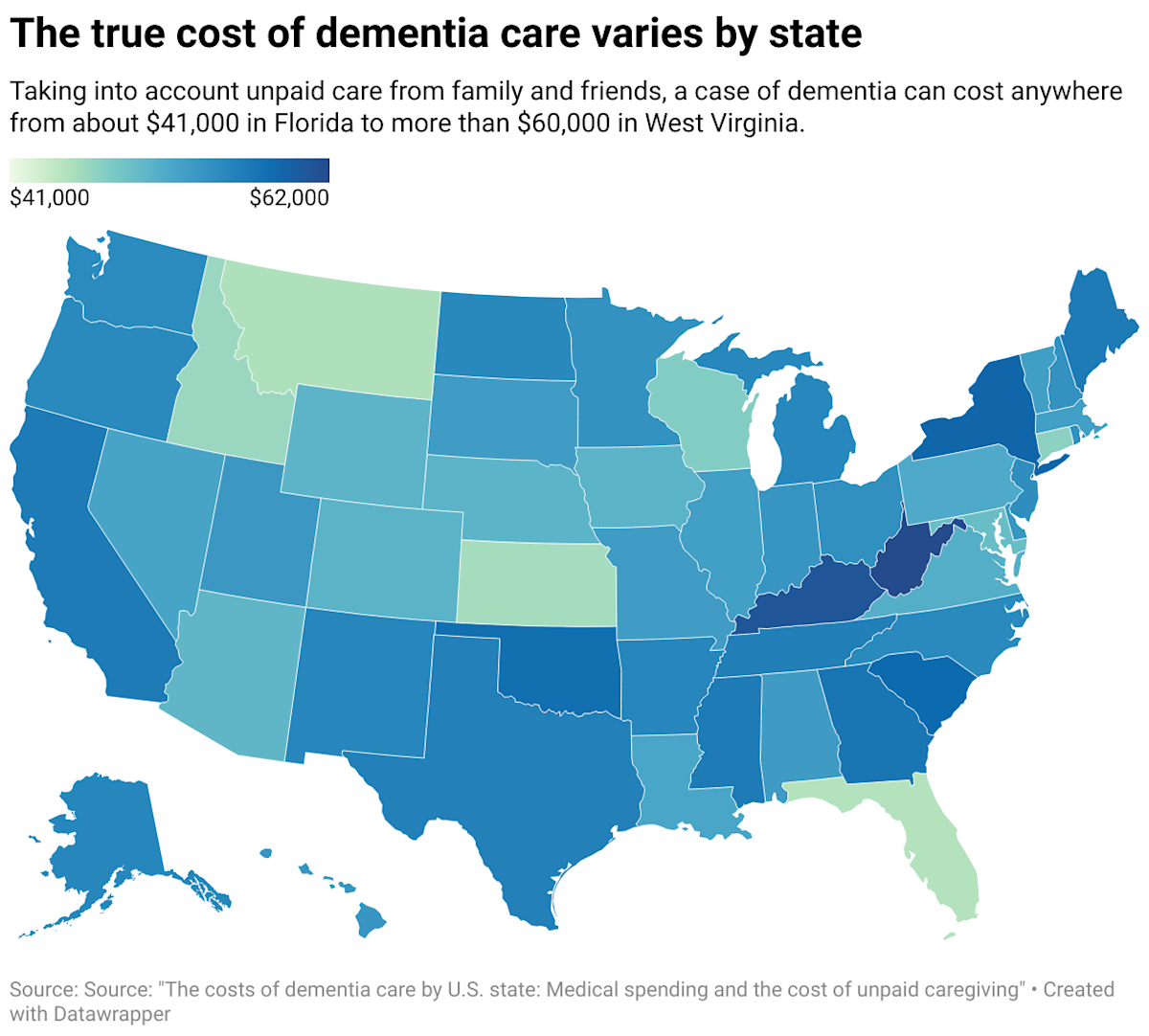
Our first-of-its-kind estimate of dementia care costs by state also revealed dramatic cost disparities by geography. In the District of Columbia, the average annual cost for a person living with dementia – including both medical spending and the cost of unpaid care – is $37,000, while in West Virginia it is $61,000.
Moreover, we found that the total cost was highest in some of the poorest states, with West Virginia and Kentucky in the top three most expensive states despite a low cost of living. The biggest contributing factor to costs was the hours of unpaid care provided.

Why it matters
Cost-of-illness studies often include a monetary value of unpaid care, which is referred to by economists as an indirect cost. While no money is changing hands, unpaid care represents the use of a resource – caregivers’ time. Caregiving is often rewarding, but it also has tangible impacts on caregivers’ well-being.
Recent work by our team found that 12% of all caregivers have had to reduce their work hours or quit their jobs altogether. Caregivers who remain in the workforce often miss days of work due to caregiving responsibilities, or they experience reduced productivity while they are at work. Caregivers who aren’t working for pay often have to give up other activities, such as volunteer work or leisure time.
The indirect cost of care is particularly important in the context of dementia care.
Direct medical spending for dementia is relatively small because there aren’t many treatments available. While a new Alzheimer’s drug, Leqembi, has recently been approved by the FDA, it is available only for a small portion of people living with dementia. People living with dementia also require significantly more hours of care than older adults without dementia. While many elderly adults eventually need help with activities of daily living, such as eating and bathing, people living with dementia often need constant or near-constant supervision.
The fact that our study also found indirect costs varying widely by state raises important questions about why hours of unpaid care varies so much geographically. Here, several contributing factors are worth considering.
First, many of the states above average in unpaid-care hours also have high rates of chronic conditions such as diabetes. People living with dementia coupled with other illnesses will require more care.
Similarly, the severity of dementia affects the amount of care needed. Dementia progresses from mild to moderate to severe, with each stage needing progressively more care. The severity of dementia cases likely varies by state due to different rates of smoking, obesity and other dementia risk factors. And finally, available support from government and community − including the extent of programs such as Meals on Wheels − varies widely in each state.
What’s next?
Researchers should continue to look at dementia care costs in the post-COVID-19 era. The stressors on caregivers have likely increased. Almost all states have a shortage of home health workers, and many states have experienced closures of adult day centers, assisted-living facilities and home health agencies over the past year.
One-third of Meals on Wheels programs had a waitlist as of 2024. These shortfalls may worsen amid large-scale cuts to federal programs by the Trump administration. The Department of Health and Human Services recently announced plans to dissolve the Administration for Community Living, which oversees the Area Agencies on Aging, a network of nonprofit agencies that administer Meals on Wheels as well as other services aimed to maximize the independence of older adults.
Our study highlights the massive contribution of family caregivers and the disproportionate reliance on unpaid care in states with some of the highest poverty rates in the U.S. More work is needed to pinpoint the factors driving these differences and to improve the well-being of caregivers.
The Research Brief is a short take on interesting academic work.
This article is republished from The Conversation, a nonprofit, independent news organization bringing you facts and trustworthy analysis to help you make sense of our complex world. It was written by: Amy Lastuka, University of Washington
Read more:
Amy Lastuka does not work for, consult, own shares in or receive funding from any company or organization that would benefit from this article, and has disclosed no relevant affiliations beyond their academic appointment.
