


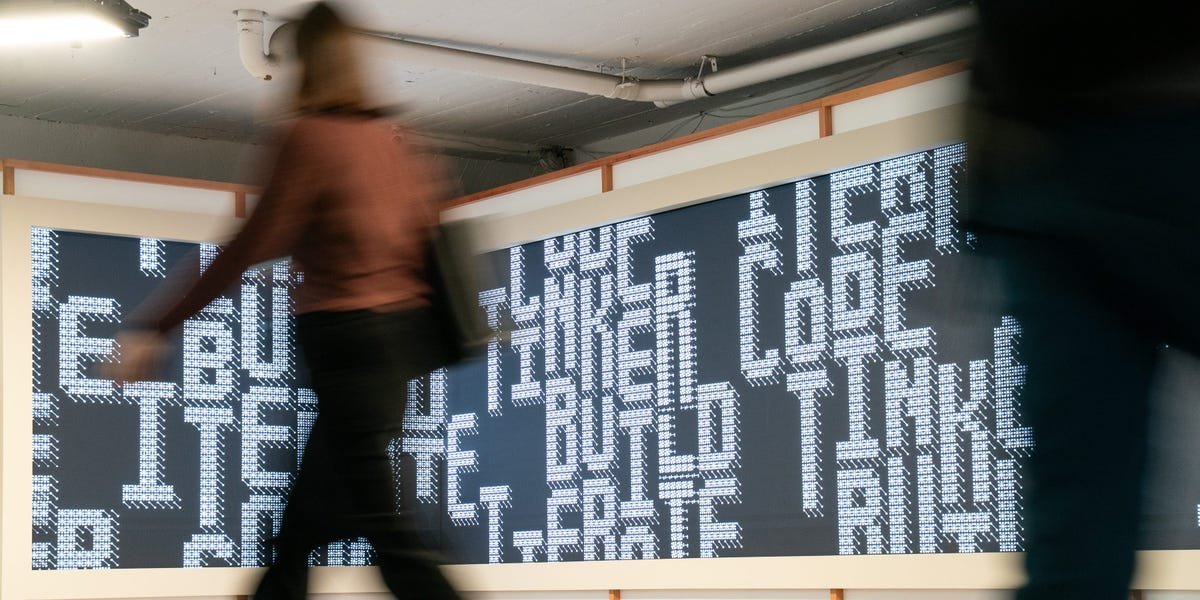
Inside Anthropic, an unorthodox group can take a lot of credit for the AI company’s meteoric rise.
The company’s Labs team is a rotating cast of around 20 employees, tasked with spinning up entirely new ideas. Led by Anthropic cofounder Ben Mann, it’s responsible for the definitive AI tool of the year: Claude Code. As Anthropic prepares to go public, Labs will play a crucial role in turning its frontier AI models into impactful products.
Mann spoke with Business Insider about the team’s efforts and changing ambitions, and how he views product development inside the AI company.
A few years ago, Mann said he had to convince the company that it needed to start releasing products at all, rather than ride philanthropic funding toward advanced AI. He created Labs in 2024 to freely ideate on new product ideas, and the team has served as an engine of growth, building the uber-popular Claude Code, the Model Context Protocol that connects AI agents to data sources, and this year’s Claude Design. It also counts leaders like Instagram cofounder Mike Krieger.
The idea of incubating new product ideas on a special team is hardly new. Mann cited the famous research organization Bell Labs as a model, and he worked on a Labs-esque team at Google called Area 120 in 2018. Google also has its “moonshot factory,” known now as X, which helped build Waymo and Google Brain.
Labs helps Anthropic seize a crucial advantage: its product developers quickly hear how AI models are improving, which gives them a head start on building tools.
“We do treat it as a startup incubator in the true sense of the term,” Mann said, “and we expect most of the bets to fail.”
Mann said Labs has about a 20% to 30% success rate with its ideas, some of which get folded into other prototypes or products, such as Anthropic’s Claude Chrome extension.
“We’ve had more hits than I would have expected, and the hits that we’ve had have gone really far,” he added.
Anthropic Labs’ core advantage: a close eye on AI’s frontier
The Labs group works in cycles, bringing up its prototypes, or “bets,” for a “persevere or pivot” review about every two weeks. Bad product ideas get tossed or merged into other ideas, and their employees jump to another task. Good ideas — like Claude Code or Claude Design — “graduate” out of Labs into their own teams within the company. It’s similar to how some of Google’s successful moonshot bets, like Brain, grew into larger divisions.
Anthropic
Mann said developers have access to the “Anthropic milieu of what’s going well in research,” which helped them build Claude Code, a tool that uses Anthropic’s underpinning AI models to write, edit, and run code. He said that well before the tool’s development in late 2024, his team heard from researchers that new models showed signs of strength in agentic coding.
Mann assigned this task to the then-new employee Boris Cherny. A prototype by Cherny became popular internally, and Anthropic released it as a preview in February 2025. The company’s model releases over the following year turned Claude Code into an uber-popular product, pouring gasoline on Anthropic’s growth.
Cherny, who now leads Claude Code, had originally suggested that he make a code analysis tool. Mann told the engineer it wasn’t a big enough idea, he said.
“Especially when people are new to the company, they need to change their level of ambition to much higher,” Mann said. “Because a lot of what the agents can do, nobody knows.”
How Labs could serve a post-IPO Anthropic
Mann said Claude Code fits into a Labs team goal of growing AI’s “action space,” or the amount of things that strong AI models can actually do in the world.
For example, Mann said his team has pushed Anthropic researchers on other teams to improve audio models to better understand the Ethiopian language, Amharic, and that building Claude Design has driven research interest in improving visual outputs.
It remains to be seen how Anthropic’s product development will unfold once it goes public. Mike Gualtieri, an AI analyst at Forrester, told Business Insider that Anthropic has a high-wire act ahead as it adds tools that compete directly with much of the software used by business customers. For example, the Claude Design tool competes with design software from companies like Adobe and Figma.
“As they build the platform, they’re going to likely create features that make it more attractive to use their platform than someone else’s,” Gualtieri said. “It’s going to be a little dance.”
Plus, the Labs team has to do its own dance. Because projects usually “graduate” when they grow larger than four people, Mann said the team has constant churn as members move to other teams and Labs pulls in new staffers.
The Labs ethos has spread to other parts of the company, and other product engineering teams now have “bets” groups, Mann said. He would like to see Labs contribute to breakthroughs in biological research, clean energy storage, and other real-world applications. Mann says those achievements would help the team’s work feel more aligned with the company’s mission to help humanity through stronger AI systems.
“The ability to accelerate the hard sciences is extremely exciting and very, very important for sort of starting to deliver more benefits to people,” Mann said.
Have a tip? Contact this reporter via email at scouncil@businessinsider.com, or over text, Signal, Telegram, or WhatsApp at 415-757-8198. Use a personal email address, a nonwork WiFi network, and a nonwork device; here’s our guide to sharing information securely.
