


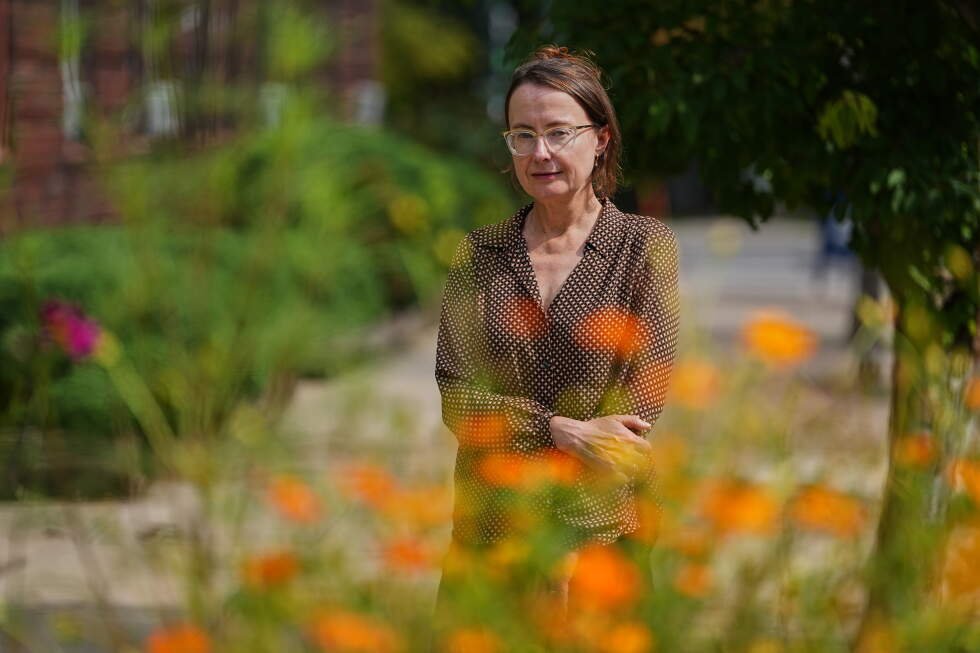
NEW YORK (AP) — If you’re among the many readers who learned to love “The Odyssey” through Emily Wilson’s 2017 translation, you might be surprised that she’s going to translate it again.
“It’s a complete retranslation. It’s not a revision of the old version,” Wilson told The Associated Press during a recent Zoom interview from her home in Philadelphia, where she is a professor of classical studies at the University of Pennsylvania. “I’m about halfway through.”
Regarded as the first major English-language translation of Homer’s epic by a woman, her book was already a bestseller and a culture-wars flashpoint before the release of Christopher Nolan’s blockbuster adaptation. But she says her translation methods have become more sophisticated and that enough time has passed for her to see some flaws in her work — as an example, she overused the word “slave” when ancient Greek had different terms for different categories of enslaved people. The new edition will be longer, she says, and will better reflect the differing social worlds of Homer’s poem.
Fiction writers and poets, from Henry James to Walt Whitman, have revised and reissued early works. But translators rarely start over on a full-length text — especially not within a decade of the original work’s completion, and not when the translation has had the success of Wilson’s “Odyssey.”
“I can’t really come up with a previous example of this situation,” says Kate Deimling, who oversees the literary division of the American Translators Association. “It’s not unheard of for translators to go back and make some corrections or edits in subsequent editions, but that’s not the same as a retranslation.”
Asked how her publisher responded, Wilson says her decision was “very controversial.” She says she’s “very much aware” that having two recent editions by the same translator would be a challenge for teachers, and hopes they won’t “curse” her name. Her editor at Liveright Publishing, Peter Simon, said in a statement that since she “has poured so much of her life and scholarship into ‘The Odyssey’ … her new approach is bound to be thrilling.”
Fame was of prime importance to the ancient Greeks, and Wilson is the rare classical scholar who has firsthand knowledge of a public life. Wilson’s 2017 translation was praised by many critics for making “The Odyssey” feel more modern and accessible, but also faced criticism online for making the story “woke.” Her “Odyssey” has now sold more than a million copies, and Wilson has again become a reason to argue.
Nolan had cited her translation and its opening sentence, “Tell me about a complicated man,” as inspiration for his epic film. Wilson, who says she will “probably” leave the line unchanged in the next edition, did not return his admiration. In interviews with the AP and other media outlets, and in an assessment for the London Review of Books, she called the movie grandiose and superficial, and at times incoherent.
Her reaction to the film has been extensively — even obsessively — defended and denounced, including by Joyce Carol Oates, who faulted her “haughty superiority.” Nolan has yet to respond directly, although, while being interviewed by podcaster Zhong Shu, he did speak out against “amateur criticism” for lacking the cinematic background essential for understanding the language of movies.
Wilson’s current prominence aligns with the release of her new collection of essays, conceived well before Nolan’s movie came out: “Crossing the Wine-Dark Sea,” a book that arrives Tuesday with blurbs from Salman Rushdie and “Song of Achilles” novelist Madeline Miller. It features a long section on translating “The Odyssey,” with tough assessments of modern editions by Daniel Mendelsohn and the late Robert Fagles. Other chapters take on the “slut-shaming” of Helen of Troy, offer tribute to the Roman poet Catullus and point to how some of the most famous words ever spoken by Robert F. Kennedy — his quoting Aeschylus in the aftermath of the Rev. Martin Luther King’s assassination — echoed author Edith Hamilton’s mistranslation.
During her interview, Wilson also discussed her feelings about celebrity, her disdain for Rick Riordan’s “Percy Jackson” books (Riordan, through a spokesperson at Penguin Random House, declined to comment) and her renewed appreciation for Stoic philosophy.
This conversation has been edited for brevity and clarity.
AP: In your essay on translating “The Odyssey” you write that Robert Fagles’ translation is “very loud, lively and chatty, so it’s not surprising that it has remained a bestseller in the U.S.” As you are also a bestseller, what qualities do you think you were able to bring to your book?
WILSON: I was going for the ancient idea of “enargeia,” vividness, that sort of emotional impact, emotional directness, the narrative pacing, the sense you can fully understand how does this character feel every time she or he is speaking.
AP: One theme of your essays is how wrong we can be about the Greeks, like Robert Kennedy misquoting Aeschylus because he had been reading Edith Hamilton’s popular writings, which themselves have many inaccuracies.
WILSON: Part of the theme of the book is not just that we make mistakes — maybe we can fix them — but that the particular kinds of mistakes those scholars and translators and popularizers or teachers like Hamilton make are very much determined by their own time. Obviously, I make mistakes, too. I’m obviously going to come to Homer and to the whole of antiquity with particular preoccupations which are going to be different from the preoccupations of a Homerist or a translator some 50 or 100 years ago.
AP: In a lot of these essays, you’re very conscious of bringing the ancient world into the present. In your essay on Stoicism (“Chill Out with the Stoics”), you start out by writing, “Stoicism is having a moment.” Are you more of a Stoic now than you were a month ago?
WILSON: I’m quite suspicious that through philosophy you can have security. The last few weeks have been a clear illustration of how I’m not in control of the reception of my work. I can write an essay; people will do whatever they want. They will have their own opinions of me. I have zero control. I actually think in some ways there’s a useful reminder about the powerlessness that comes with the awareness that “I’m going to be misunderstood. I’m going to be misread. People are going to hate me.” I’ve got to accept that.
AP: What is it about ancient Greece that made you study it, as opposed to Elizabethan England or 18th century France?
WILSON: I see it as a kind of intellectual greed. Through studying ancient Greece and Rome, I’m also interested in studying how did these cultures get reinvented, reimagined in each of these later periods.
AP: In your book, you criticize Rick Riordan’s “Percy Jackson” books. You find an ideology that puts you off.
WILSON: Many of my students love them so much. I think if I had read them as a child, I might have been a fan. They’re not designed for an adult literary reader. I think especially in the first Percy Jackson book, “The Lightning Thief,” there’s very much an ideology of: “Here’s this white boy in America who’s going to gather the whole of Western civilization, and there’ll be a hero’s journey, which will really be the heroism of American exceptionalism.” And I just think that is ideologically and historically quite questionable.
AP: In your chapter on comedy in ancient Greece, you begin with a reference to Cardi B’s (and Megan Thee Stallion’s) “WAP.” Does this happen to you a lot, where things pop up in the culture and it just resonates and you’re thinking, “Oh, that reminds me of something from classical times”?
WILSON: It happens to me all the time. Yes. This is not necessarily an explicit trope in the book, but I very much want to be constantly doing that, suggesting that we can find echoes of antiquity in places we might not expect. I use the discussion of “WAP” and of hip-hop as a way of talking about ancient comic poetry. My main point is not just that there’s lots of obscenity in both, but also lots of poetics in both. And if we somehow turn around our expectations about antiquity, we can turn around our expectations about modernity.
