


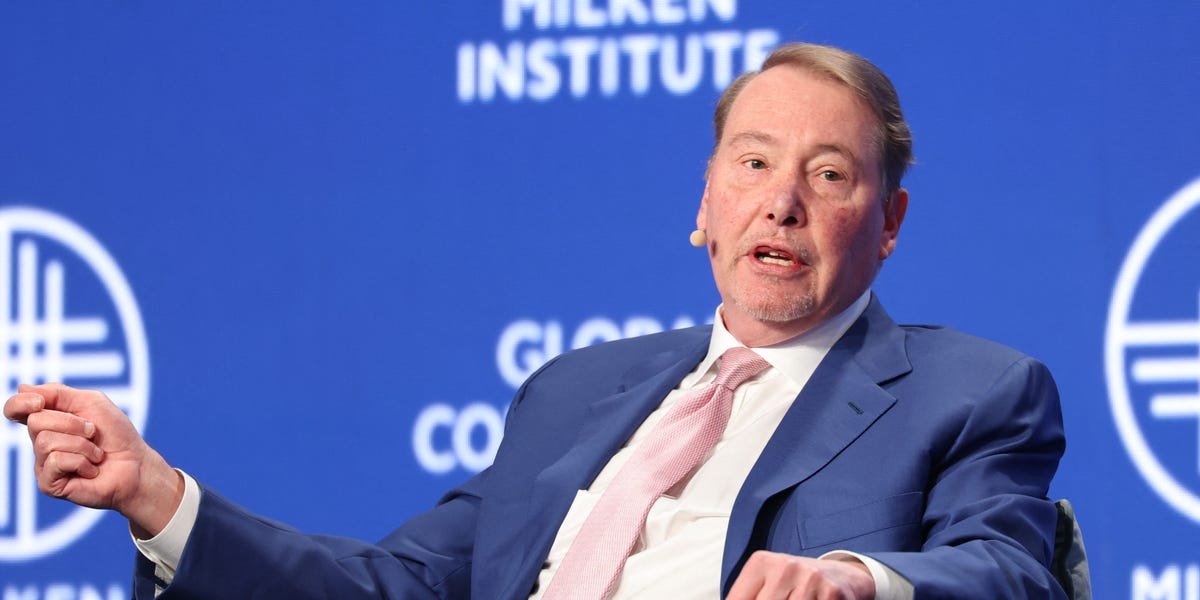
Billionaire investor Jeff Gundlach says Wall Street’s bid to turn artificial-intelligence chips into an investable asset class could be a warning that risk markets are nearing a peak.
The DoubleLine Capital CEO and chief investment officer took aim at Nvidia’s newly announced partnerships with six finance heavyweights, which are intended to mobilize more than $500 billion for AI infrastructure.
Nvidia said last week that it had signed memoranda of understanding with Apollo, BlackRock, Blackstone, Brookfield, Goldman Sachs, and KKR to create financing platforms for its customers.
In a press release, the chipmaker said the capital would help companies fund access to Nvidia chips and broader “AI factories,” while its partners pitched compute as long-lived infrastructure suitable for institutional investors.
Gundlach was unconvinced.
The investor, known as the “Bond King,” questioned the wisdom of using fast-evolving technology as collateral for long-term borrowing.
“Assets of unknown life as collateral for long term debt?” he wrote on X, adding that the consortium plan “will not likely age well.”
Gundlach compared the idea to issuing 30-year asset-backed securities against warehouses of bananas, even if they were “newly engineered bananas of unknown life.”
NVDA $500B fund (not to be confused with funding) consortium plan will not likely age well. Assets of unknown life as collateral for long term debt? Why not do a 30 year ABS deal backed by warehouses of bananas? It’s OK, they’ll be newly engineered bananas of unknown life.
— Jeffrey Gundlach (@TruthGundlach) August 15, 2026
Nvidia did not immediately respond to a request for comment from Business Insider.
Gundlach’s argument largely centered on a mismatch between the debt’s duration and how long the chips remain valuable.
AI processors can generate strong cash flow while demand is high, but given the rapid technological advances in AI, there are concerns that today’s chips could lose value before the loans that financed them are paid off.
In a separate post on Saturday, Gundlach said no one “rings a bell” at the top of risk markets. Still, he suggested investors should watch for proclamations of new asset classes built on financial innovation and aided by what he called “questionable” credit ratings.
It is said noone “rings a bell” at risk market tops, but there are declarations of “new asset classes involving ‘financial innovation’ abetted by questionable ratings” to watch out for.
— Jeffrey Gundlach (@TruthGundlach) August 15, 2026
Mark Cuban offered his own terse comparison: “Chips as an asset class will be the new crypto.”
Chips as an asset class will be the new crypto
— Mark Cuban (@mcuban) August 15, 2026
Gundlach’s message echoes an argument frequently made by Michael Burry, the “The Big Short” investor, in recent months. Burry — who has been a vocal critic of what he sees as an AI bubble and publicly shorted a number of AI companies — has long argued that tech giants are overinvesting in microchips that will quickly become obsolete as the tech evolves.
