


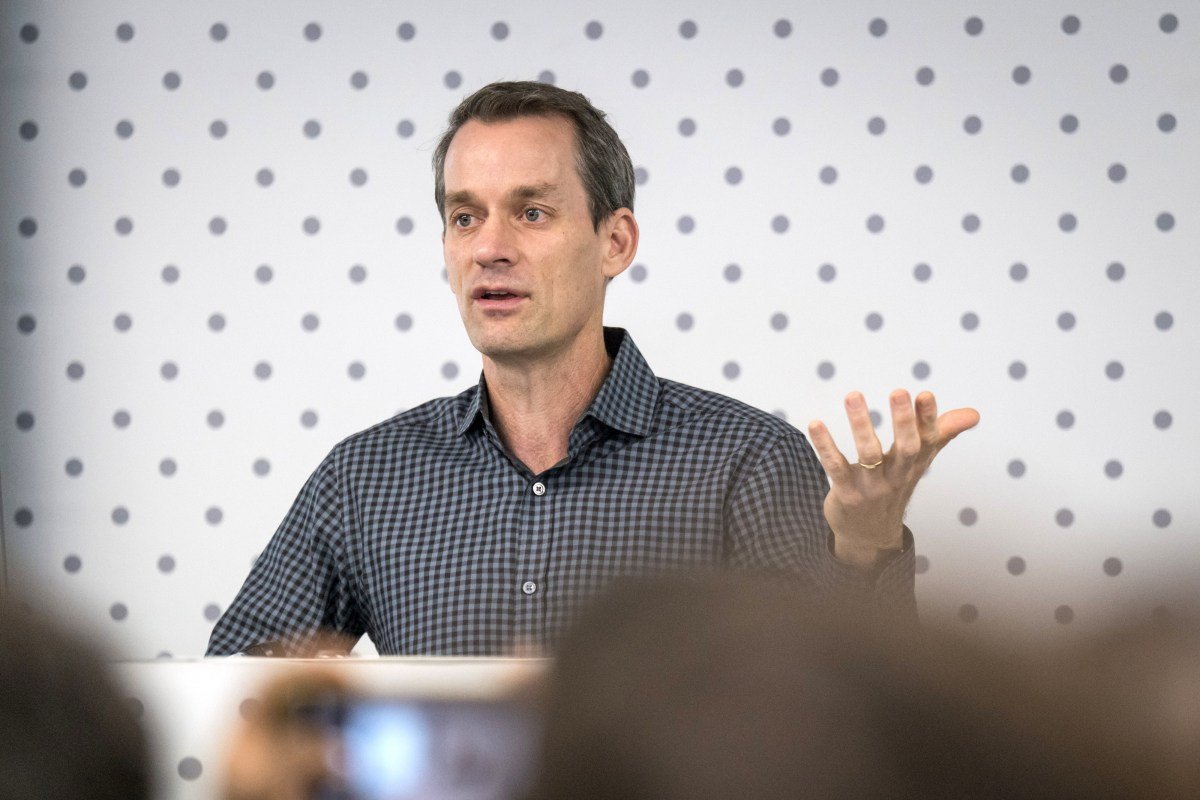
Jeff Dean, one of the longest-serving and most influential executives at Google, is stepping down from the search giant to launch his own AI startup.
Coming with him as co-founders are several other top researchers at the company, including Sanjay Ghemawat, a top engineer and senior fellow at Google; Quoc Le, a key AI researcher and founding member of Google Brain; and Oriol Vinyals, a senior research scientist at Google DeepMind. Dean reportedly plans to serve as CEO.
Together, the group is starting Discovery Loop, a public benefit corporation that seeks to use AI to turbo-charge scientific research.
Discovery Loop says it plans to use high-octane algorithms to initiate and iterate thousands of experiments simultaneously, with the goal of partially automating the research process and expanding the scale at which experimentation can be conducted.
The startup is also interested in using AI to help create more powerful AI (a process known as recursive self-improvement), which would cut human iteration out of the loop entirely.
“While science and engineering have tremendously advanced society over past centuries, progress has traditionally relied on slow, sequential human iterations, creating a significant bottleneck,” the company said in a press release. “Discovery Loop is developing advanced AI systems that leverage massive computational scale to fundamentally transform the speed and efficiency of innovation by automating complete experimental loops.”
Using AI to accelerate scientific discovery has been a key interest of the science and tech communities for many years, but until recently, it remained a largely experimental field with limited commercial application.
The company has received financial support from a number of different sources, including Google’s parent company Alphabet. The initial funding round is being co-led by Radical Ventures and Khosla Ventures, the company announced Wednesday. Kleiner Perkins, Lightspeed, and Doerr Capital also participated.
“The next great frontier for AI is to go beyond answering questions and to begin making discoveries,” the founding team said in a joint statement. “By fundamentally accelerating how engineering and scientific discovery are conducted, we can deliver the benefits of transformative technologies to the world far sooner.”
Dean has worked at Google since 1999 and was Google’s 30th employee. Over the years, he has contributed to Google search’s core infrastructure, including its crawling and indexing system and its query-serving system. He has also had a significant impact on Google Gemini’s multimodal models and played a leading role in the company’s early AI research.
“We think there is opportunity for AI to more fully automate what has traditionally been a very human-intensive experimental loop,” Dean told the New York Times. “You will get both a higher quantity and a higher quality of experiments, and that will lead to scientific breakthroughs and advances.”
When you purchase through links in our articles, we may earn a small commission. This doesn’t affect our editorial independence.
