


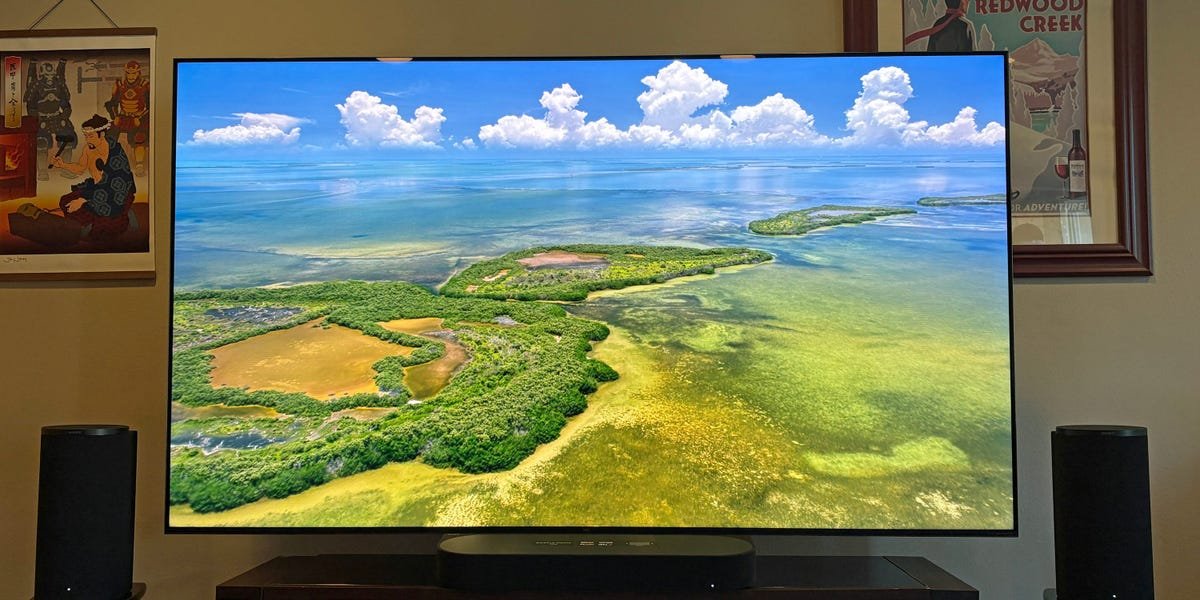
This year, TCL is putting the “super” in quantum dots, the tiny nanocrystals that have been enhancing TV colors and brightness for over a decade. TCL’s newly developed Super Quantum Dot (SQD) TVs, including the midrange QM7L, take QD technology to new heights. They’re designed to compete with other cutting-edge TV tech, such as RGB LED and OLED.
As the first SQD TV I’ve tested, the QM7L had a lot to live up to, and in many ways it exceeded my expectations. Its black levels and contrast rank among the best I’ve seen in a TV with LED backlighting (read non-OLED), and it pairs that with striking brightness and, as promised, expansive colors.
The QM7L still reveals its midrange status in a few minor shortcomings, including a notably reflective screen and so-so off-center viewing, but in many ways it comes tantalizingly close to premium performance. It’s a worthy successor to last year’s QM7K, which was one of our favorite midrange TVs. And it easily earns its place as a more affordable alternative to TCL’s higher-end QM8L and X11L SQD TVs.
Looking for more TV recommendations? Check out our guides to the best TVs and best TCL TVs.
TCL 75-inch QM7L SQD 4K TV
The QM7L is the successor to our favorite midrange TV from 2025. This 2026 model uses TCL’s new SQD technology to deliver a brighter, more colorful image, offering excellent performance for the money.
The QM7L is stylish and available in many sizes
Ryan Waniata/Business Insider
The QM7L comes in five sizes, from 55 to 98 inches. In keeping with the current big-screen trend, my review unit was a 75-inch model rather than the traditional 65-inch. Even at this size, TCL has kept the weight down to just 44 pounds, which makes unboxing the TV and attaching its pedestal stand relatively easy as long as you’ve got a partner.
Peeling off the last of several layers of clingy plastic reveals a stylish set with a relatively thin frame and slim, smoked-chrome bezels. The faux-metal stand looks good, but at 14.5 inches long, it takes up a lot of space on your console. Unlike Hisense’s rival U7SG, the QM7L doesn’t use a matte screen, which results in significantly more reflections, even in low lighting, though it also makes black levels more convincing in some scenarios.
The TV has onboard microphones for hands-free smart commands, now handled by Gemini rather than the Google Assistant. However, I prefer to mute this feature and use the remote for voice control instead. The wand-style remote is generally intuitive to use, save for the mute key, which is oddly banished to the far left corner. That caused me to confuse it with the power and input keys several times.
Ryan Waniata/Business Insider
At the TV’s right flank is a solid collection of inputs, including four HDMI 2.1 ports, though only two support high-bandwidth data speeds for gaming features like VRR (Variable Refresh Rate) at up to 144Hz. That’s still on par with Sony and Panasonic flagships, and I appreciate that neither gaming input overlaps with the HDMI eARC port, leaving it free for connecting an audio device. The built-in Bang & Olufsen speakers include dual woofers along the back panel for decent bass, but you’ll still do much better with a good soundbar or surround system.
As with previous models, the QM7L supports all major HDR flavors, including both dynamic formats in Dolby Vision and HDR10+. Other handy features include support for Dolby Atmos and DTS: X audio, streaming via AirPlay and Chromecast, and Bluetooth 5.4. One notable omission for those with indoor TV antennas is ATSC 3.0, which supports NextGen channels for 4K HDR broadcasts. TCL is far from the first to drop the feature, which seems to be falling out of favor across brands.
Contrast and colors are a big step up, but there’s still room to grow
Ryan Waniata/Business Insider
TCL says the QM7L’s Mini LED backlight system uses up to 2,100 dimming zones to preserve black levels (though it doesn’t specify by size), further refined by the company’s Enhanced Halo Control system. That’s supplemented by the titular Super Quantum Dot layer and a specialized color filter, which, in theory, allows the TV to achieve up to 100% of the next-gen BT.2020 color gamut.
TCL says that number is based on “typical achievement,” and results may vary due to multiple factors. I measured a still-impressive 85% of the BT.2020 spectrum using a Portrait Displays C6 HDR5000 colorimeter, a G1 pattern generator, and Calman software. Frankly, BT.2020 isn’t a huge benefit for most content available today, since most movies and shows still stick to the narrower DCI-P3 color spectrum, but the TV covers nearly all of P3 and should be primed for the future.
Contrast, the way our eyes perceive the difference between the darkest and brightest images, has always been key to TV performance — and one of the biggest challenges for backlit TVs. That includes Mini LED TVs that use tiny light modules and tons of dimming zones, like the QM7L. No matter how good the design, it’s tough to replicate the perfect black levels and laser-cut precision of OLEDs that light each of their millions of pixels independently.
Even so, today’s best Mini LEDs are blurring the lines beyond recognition for most viewers, and this new SQD tech gets marvelously close. The QM7L looks fantastic, rendering ultra-bright images on black backgrounds, from dim TV shows and sizzling demo reels to even torture tests like Spears & Munsil’s starfield scene. It still can’t match the micro-contrast of OLED, and if you look for it, you’ll see some foggy light bleed, especially in a pitch-black room or from off-axis, but man, are these screens getting good.
Ryan Waniata/Business Insider
Speaking of off-axis viewing, it’s still largely OLED’s domain. Due in part to the inherent design of LED local dimming, you’ll naturally lose some image color and brightness at a hard angle in nearly all backlit displays, and the QM7L is no exception. It still looks good from a few feet left or right, providing a small improvement over previous models, but it washes out quickly from my side-set easy chair. On the bright side, the TV’s screen uniformity is among the best I’ve seen at its price point, offering clear sailing for skylines or a soccer pitch, with few noticeable smudges or aberrations (AKA dirty screen effect).
Brightness is where Mini LED TVs really excel, and while I never clocked the 3,000 nits TCL claims, I measured around 2,400 nits in the TV’s most accurate Filmmaker Mode. That’s a solid 600 nits higher than last year’s QM7K model. This means the QM7L is plenty bright, to the point where my wife could barely look at the screen during contrast demos. There’s more than enough juice for streaming content, and even most well-mastered Blu-rays. The TV tends to overbrighten some scenes, but it mainly does so judiciously, and dimmer films tend to look natural in its most accurate picture modes.
However, I did encounter an oddity in one of my brightest test discs, “Mad Max: Fury Road,” in which a few bright white highlights were rendered an odd blue. Senior tech editor Steven Cohen noticed a similar issue when reviewing the step-up TCL X11L TV, and though neither of us has seen it crop up with other content, it’s worth noting. We reached out to TCL to learn more, and their reps told us this is a known issue with the film due to its HDR10 mastering. While this is the first I’ve heard about the disc’s potential mastering issues, it’s not something I noticed in other high-brightness content.
Ryan Waniata/Business Insider
The QM7L’s hottest feature, its expansive color reproduction, is nearly as showy as its brightness. While the colors aren’t wholly accurate out of the box, they mostly look natural, with some hyperrealism in blues and greens that served to zhuzh up scenes like a neon coral reef in aqua waters or the vividly detailed green mangroves in Netflix’s “Our Planet.” Skin tones look excellent in HDR and SDR content alike, including impressive detail in subtle color shifts, such as Harry Potter’s maroon undershirt beneath his denim button-down in my HD Blu-ray version of “The Deathly Hallows.”
There’s plenty of good shadow detail in that film’s challenging scenes, like Voldemort’s hilltop attack, with only minor crushing or obscuring of finer images. The TV’s shadows aren’t quite as good with HDR video, but I was still able to use the dimmest and most accurate Dolby Vision setting, Dolby Vision Dark, in all but the darkest content, like the “Chilling Adventures of Sabrina.” The TV’s reflective screen doesn’t help, revealing a fair bit more of my room than premium models or midrange matte screens like Hisense’s U7SG.
I encountered a few other quibbles during testing, such as some noticeable moiré or flickering in images with dense fabrics, and minor motion stuttering. Even without using the motion interpolation settings, though, the display’s zippy refresh rate handles high-speed content well, from fast-paced sports to video games.
Google TV is intuitive and responsive
Ryan Waniata/Business Insider
Setting up the QM7L’s Google TV smarts is quick and straightforward, if slightly more onerous with the Google TV app than the previous Home app. You’ll have to dive through legalese, including several moments where both Google and TCL want to track your viewing, but you can bow out of most of it, and you can always change the settings later.
Google TV makes streaming, finding content, and adjusting picture performance a breeze, and the interface was snappy and responsive throughout testing. I also love the extras that reward those more deeply invested in G Suite, like the ability to use Google Photos as screen savers for a constant stream of nostalgia. Gemini is more invasive than Google Assistant, especially with some of the creepier voices you can choose from, but it’s smarter and works well for voice search and other commands if that’s your bag.
Gaming looked great by default, but you can easily adjust settings on the fly with TCL’s game bar, including options like VRR, picture modes, and even a virtual crosshair. The response felt quick thanks to ALLM (Auto Low Latency Mode), and it’s easy to lose yourself in immersive games, especially with the 75-inch model.
Should you buy the TCL QM7L TV?
Ryan Waniata/Business Insider
If you’re looking for a relatively affordable TV that goes well beyond your average LED, the TCL QM7L is a great pick. Its blend of striking contrast, showy brightness and colors, good screen uniformity, and intuitive usability adds up to real value. The picture has its quirks, but hardly anything worth kicking it to the curb.
While its price is still higher than last year’s model, it’s already dropped from its launch MSRP. The 75-inch model I reviewed is often on sale for $1,498 and has dipped to $1,298. You could still save some money on certain sizes by opting for last year’s QM7K, but that model is getting harder to find in stock. If you’re interested in a midrange TV that tilts further toward premium performance, the QM7L is worth it.
If you want to push things further, TCL’s QM8L provides improved performance for its higher price, including higher peak brightness and more refined image quality across the board. On the other hand, if you’re more worried about screen reflections than next-gen colors, Hisense’s similarly priced U7SG offers a lot of the same goodies, along with a matte screen designed for more challenging viewing environments.
You’re spoiled for choice in the current TV landscape, but if you want a bright, highly capable performer, TCL’s QM7L is a sweet set poised to get even sweeter as prices drop.
