


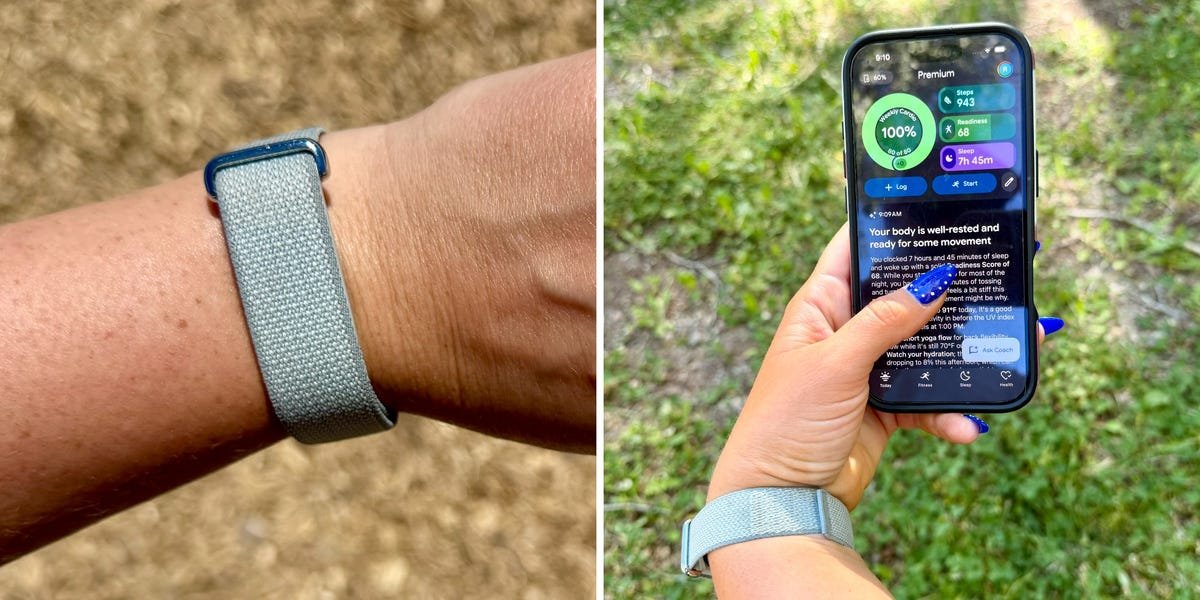
The Fitbit Air is Google’s latest health tracker, and it’s a significant pivot from other Fitbits. It’s smaller and sleeker, and unlike most wearables, it doesn’t have a screen.
With no display to glance at your step count or check your pace mid-run, the Air is a more passive device than a typical smartwatch. It’s still backed by Fitbit’s powerhouse heart rate sensors, tracking software, and newly improved Health app, but this is a distinct left turn from the brand’s traditional experience. It does its work quietly behind the scenes, and then lets you check in on your sleep, recovery, and daily movement on your phone.
This is also one of the most aesthetically pleasing health trackers I’ve tested. Its design reads more like a chic accessory than a fitness device. After wearing the Fitbit Air nonstop for two and a half weeks, I found the slim band blended in with just about anything I wore. This meant I was more likely to keep it on through a night out with friends and had more continuous, accurate data.
That said, I definitely got frustrated with the screenless design a handful of times, namely during workouts when I wanted my data instantly on my wrist. The Google Fitbit Air isn’t the best Fitbit, nor the perfect fitness watch — but, I would argue, it’s the ideal tracker for someone who wants insight into how they’re moving and recovering without looking like they’re wearing a workout watch.
Google Fitbit Air
The Fitbit Air is a screenless health tracker. It’s not ideal for real-time workout data, but it’s a great choice for people who want a discreet wearable for basic health insights.
What I like
Rachael Schultz/Business Insider
It doesn’t look like a fitness tracker
The Google Fitbit Air is one of the few fitness wearables among the 15+ I’ve tested that doesn’t immediately announce itself as one. The most obvious reason: It has no watchface.
The device looks somewhat like a bracelet, but it’s also remarkably slim and lightweight. At just 12 grams (band included) and 8.3 millimeters thick, the Air is noticeably less bulky than nearly every smartwatch I’ve tried, including other faceless trackers like the Whoop.
Rachael Schultz/Business Insider
What stands out even more is how visually understated it is as an accessory. I personally don’t like the look of a fitness watch outside the gym or lounging at home, so I was impressed that the included Performance Loop Band blended in with most everything I wore. Whether you’re in gym clothes or dressing for a dinner out with friends, the Air doesn’t scream — or even whisper, really — “I’m tracking my steps.”
This meant I wore it way more often and, therefore, had much more accurate tracking of my steps, calorie burn, and overall readiness for the day.
Note: Fitbit also offers a sporty silicone Active Band ($35) and a sleek polyurethane Elevated SoftFlex Band ($50) for different aesthetics or functions.
The Google Health app got a serious upgrade
Rachael Schultz/Business Insider
The biggest thing that surprised me while testing the Fitbit Air wasn’t the hardware — it was the software.
Fitbit’s app has officially migrated to Google Health (available on both iOS and Android), and the redesign feels significantly cleaner and more intuitive than before. Daily metrics like steps, readiness, weekly cardio, and sleep are organized in a way that’s easy to scan without digging through multiple menus or charts.
Sleep tracking, in particular, stood out as seriously improved. Over two weeks of wearing the Air through both sound sleep and restless nights, I consistently found the app’s explanations of my sleep quality straightforward and genuinely useful. Rather than overwhelming you with graphs or abstract recovery scores, Google Health does a nice job translating its data into practical insights about what actually happened while you slept.
I found the organization, visual layout, and language of this information easier to interpret than some of the data-heavy insights I receive from my Oura Ring. For example, while Oura’s analysis of your sleep “efficiency” and “latency” requires some brainpower, Google keeps it straightforward with “time to sound sleep” and “amount of sound sleep.”
The Premium Subscription offers a lot of great tools, including Google’s new AI coach
The Fitbit Air may be a steal at $100, but you’ll need a Google Health Premium subscription to get the most out of your tracker (a three-month free trial is included with purchase).
The free app covers the basics, like daily step count, heart rate, calories burned, basic sleep tracking, and high-level health trends. But for $10/month, the Premium subscription delivers more detailed sleep and recovery analysis, longer-term health insights, and, most of all, access to the new Google Health Coach, which is built with Gemini AI.
Rachael Schultz/Business Insider
This coach can review your objectives and patterns to create a fitness plan tailored to your life, goals, and abilities. The Health Coach is meant to connect trends across your sleep, activity, recovery, heart rate, and longer-term habits — all of which play into what workout you should do today and how hard you should train.
The concept isn’t unique — most wearables have some kind of AI coach. But if you’ve been using Fitbit devices for years, Google’s AI coach can leverage all your historical data rather than starting from scratch, as most other brands are forced to do. Instead of simply saying that you slept poorly or walked fewer steps than normal yesterday, the goal here is to identify patterns over time (years, for many brand loyalists) and explain how these recurring habits might be affecting your recovery or fitness progress.
I asked the Google Health Coach for recommendations on my low back pain. It then offered insights on improving my sleep setup, suggested gentle in-bed stretches I could do, and pulled from my recent sleep data to note that restlessness might be adding strain to my back and recommended a restorative yoga flow I should do in the morning.
Even if you’re new to Fitbit and it doesn’t have much data stored for you, the Google Health Coach is smart enough to ask you questions to deliver the workout plan or sleep advice you might be looking for.
I’ve tried a lot of AI coaches across Oura, Garmin, and Whoop, and a big advantage I see in Google’s is accessibility. The experience is designed for everyday users who want help improving their foundational life, rather than dedicated athletes who want to analyze dozens of training metrics for a 1% advantage on their day.
The basics are still very good
Despite its minimalist design, the Fitbit Air still covers the fundamentals most people actually care about. It continuously tracks heart rate, monitors sleep, records steps, measures blood oxygen overnight, and tracks skin temperature variations for ovulation. It also automatically tracks your activity and workouts (though during testing, I found this was true only for activities like running or other high-intensity movements, not so much for your average daily dog walk).
The battery life is rated for up to seven days, which I found to be accurate as it recorded a week of regular workouts, movement, and sleep.
Setup is refreshingly painless as well. Adding the Air through the Google Health app took only a couple of taps, and it synced quickly without any troubleshooting or disconnects at low battery.
Where it falls short
Rachael Schultz/Business Insider
I missed the screen more than I expected
While the screen-free visual appeal is perhaps the Fitbit Air’s biggest sell, it’s also responsible for its biggest compromise.
During everyday life, I didn’t miss having a screen on my wrist. In fact, I appreciated not being flashed with notifications or feeling tempted to check my wrist every few minutes.
But during exercise, the lack of a screen was a major drawback.
On walks, runs, and bike rides, I repeatedly found myself wanting to see my pace, distance, or heart rate zone. These stats live entirely on your phone — which is not exactly convenient to access when you’re panting and moving.
The screenless design is manageable if you’re simply trying to move more each day — though you’ll need to remember to open the app to check where your step count has landed before you wrap up your day.
But having no screen is much less convenient if you’re wearing a Fitbit to track your actual fitness. You can’t do zone training or even track your running pace easily with the Fitbit Air.
Google made a fitness tracker for people who don’t want to look like they’re wearing one. But the trade-off is that it also asks you to interact with it less like a fitness tracker.
It doesn’t remind you to move
Rachael Schultz/Business Insider
One of Fitbit’s strongest features is its Reminder to Move, which vibrates if you haven’t taken at least 250 steps in the last hour. But while every other Fitbit and Google watch has this function, the Fitbit Air does not vibrate or even push a notification on your phone to prompt you to stand and walk around regularly.
This surprised me since I would argue a prompt to move frequently is one of the simplest yet most helpful features any smartwatch could have, especially for the majority of us who sit at a desk for hours Monday through Friday.
When I asked the Google team about this, they said this aligns with the Air being designed for people who prefer a minimalist device without the distraction or stress of notifications. However, they said that this could be a feature they add in the future, and the Air does have the capability to vibrate (which it does at low battery).
To me, this seems like a huge missed opportunity and reinforces the idea that the Air is more of a passive health tracker than a tool to help you actively become fitter and healthier.
The minimalist approach isn’t for everyone
Many people buy a Fitbit because it provides small moments of accountability throughout the day: a reminder to move, a quick glance at step count, or confirmation that a walk is getting their heart rate high enough to count as moderate exercise.
Without a screen, those interactions become much more passive.
The Fitbit Air quietly collects your data and presents it later in the app, which some people will love, and others may find less motivating.
How it compares to other screenless wearables
Rachael Schultz/Business Insider
Whoop 5.0 Activity Tracker
Whoop is the most obvious comparison to the Fitbit Air since it’s one of the best fitness trackers without a screen. But while the two bands may look similar, they function very differently.
Having tested both, I can confirm Whoop remains the better choice for serious athletes and anyone who wants to optimize training and recovery. Its AI coaching is built around strain, recovery, and long-term performance, with significantly deeper analysis than what Fitbit currently offers. That said, Whoop is more expensive out of the box, requires a pricier membership, and presents a lot of unnecessary information unless you’re worried about optimizing your recovery.
The Fitbit Air is smaller, sleeker-looking, significantly cheaper, and generally more approachable for someone who simply wants to move more, sleep better, and keep tabs on getting enough movement throughout the week.
Oura Ring 4
Perhaps surprisingly, I would describe the Fitbit Air as most comparable to the Oura Ring. In real-world use, both are screen-free designs that prioritize passive health tracking over real-time workout metrics (though each can show in-the-moment workout stats if you look in the app). Both record and translate your health and fitness data to encourage better sleep, recovery, and movement throughout the day and week. And neither bothers you with notifications throughout the day, except for the occasional update on how close you are to your activity goal.
A few major differences: The Oura Ring is even more discreet, as it sits on your finger rather than your wrist. The Oura Ring is arguably more accurate at recording super nuanced biometrics because it’s fitted with more sensors, and its app interface caters more toward optimizing your health, whereas Google’s interface focuses more on fitness and recovery. Most of all, the Oura Ring 4 starts at $349 while the Fitbit Air is just $100.
Should you buy the Fitbit Air?
Rachael Schultz/Business Insider
The Google Fitbit Air is an exciting, modern launch for the brand, and, moreover, it fills a big hole in the health wearables market: A sleek, faceless fitness tracker that blends in out of the gym and has both the hardware to log your stats accurately and software to deliver those numbers in a digestible way. It’s also incredibly well-priced for the technology behind it at $100.
It’s designed for the person who wants to understand their sleep a little better, confirm they hit 10,000 steps after dinner, and see how their daily activity and habits influence their readiness for the day ahead. Most of all, it’s designed for someone who wants to keep an eye on their overall health without wearing a piece of technology that constantly demands their attention.
The redesigned Google Health app and the new AI-powered Health Coach reinforce that philosophy, emphasizing long-term habits and personalized insights rather than real-time metrics.
The flip side is that the Air won’t make your workouts better in the moment like a traditional Fitbit or fitness tracker. If you like to know your heart rate zone while training, check your pace mid-run, or train by time intervals, you’ll most certainly miss having a display readily accessible.
If you’re happy to trade those real-time stats for a slimmer profile, a more understated look, and a wearable that quietly fades into the background until you’re ready to check in on your health, the Fitbit Air is an ideal fit. It’s less of a workout watch and more of an everyday health companion — but one that looks good and won’t break the bank.
