


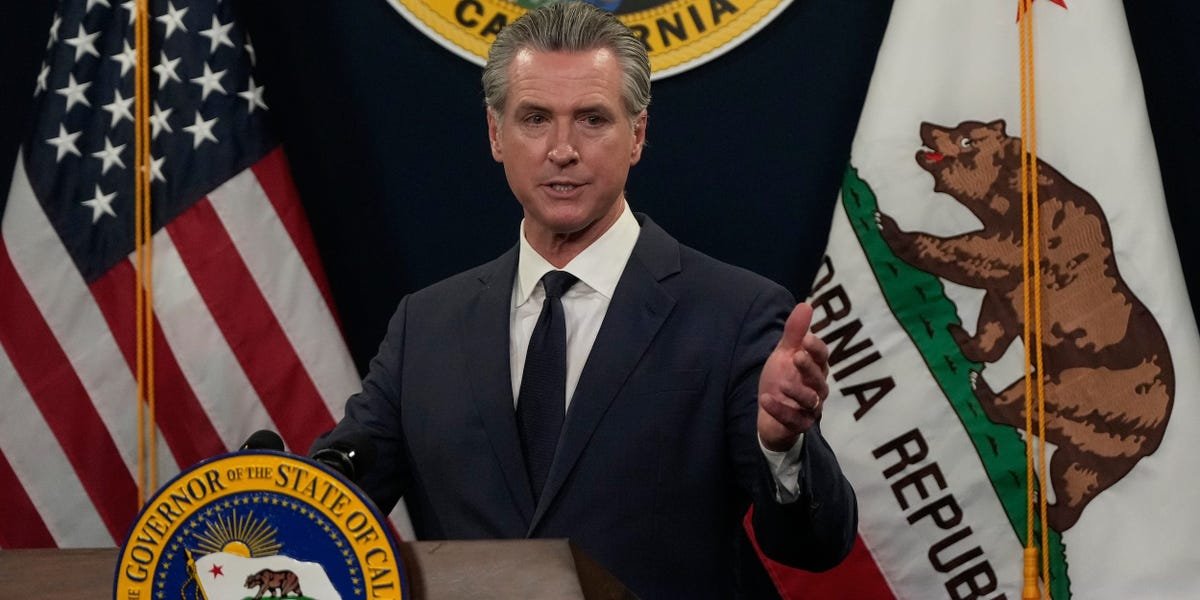
Gov. Gavin Newsom says a controversial California initiative to impose a one-time tax on billionaires is aimed at the wrong place.
“The fight to make the wealthiest Americans pay more in taxes is not one we should be fighting state by state,” Newsom wrote in a Substack post. “You may not be able to pick up and move to Texas or Florida to shelter your income from taxation, but I promise you that billionaires can, and do. “
Instead, Newsom called for the passage of a nationwide billionaire tax, which he described as “a true minimum tax on billionaires — a modern Buffett Rule,” a nod to the Obama-era policy that sought to ensure that billionaire Warren Buffett would not pay a lower effective federal tax rate than his secretary.
“Today, the office worker can shoulder a higher tax rate than the heiress,” Newsom wrote. “The construction worker could pay a higher rate than the developer. And the delivery driver can end up paying a higher rate than the founder of the company whose packages he delivers.”
Newsom called for the end of “tax-free lifestyle loans,” in which some wealthy Americans use assets such as stock shares as collateral to raise cash without selling shares, thereby avoiding capital gains taxes because the loans are not considered income. He also called for a return to the pre-Trump 2017 corporate tax rates, a major part of the Republican tax overhaul passed during President Donald Trump’s first term, and a “rewrite” of inheritance tax rules.
“If we do not act, that transfer of wealth among the ultra-wealthy will lock in a permanent American aristocracy of inherited wealth, with all the political consequences the founders warned us about,” he wrote.
A potential 2028 presidential hopeful, Newsom also embraced a growing belief that Americans should hold some equity stake in the largest AI companies.
It’s time for a national billionaires tax and a new social contract.
10% of Americans own two-thirds of the wealth. Wages have stagnated. The cost of living has skyrocketed.
The system is fundamentally broken.
The federal tax code, a corporate code, and an inheritance code… pic.twitter.com/tLRbUId6yi
— Gavin Newsom (@GavinNewsom) June 26, 2026
Under his policy, the federal government would create a national public equity fund that would hold the stakes. He said the fund could be use to help workers transition careers as AI disrupts the workforce.
“Simply, as artificial intelligence reshapes the country, every American should own a piece of the future it builds,” he wrote.
Sen. Bernie Sanders, a Vermont independent and former presidential hopeful, has called for the US government to take 50% equity stakes in large AI companies. Trump has said he is interested in a similar arrangement. Already, SpaceX, which controls xAI, has gone public. Anthropic and OpenAI have confirmed that they are preparing to pursue their own highly anticipated IPOs.
Newsom wrote that Friday’s announcement was just the beginning of his policy proposals, which will only heighten speculation that he wants to be the next president.
“In the weeks ahead, I’ll be writing more about the national agenda I just laid out, starting with how we close the lifestyle loan loophole, rewrite the inheritance code, and build a future for everyone in the AI century,” he wrote.
No love for the California initiative
Newsom outlined in detail why he will continue to oppose a so-called billionaire tax that would impose a one-time 5% tax on California residents whose assets exceed $1 billion.
The outgoing governor said that the initiative, which has been pushed primarily by the SEIU-UHW, a healthcare workers union, sends the wrong message.
“This is not how we should set California’s budget priorities,” Newsom wrote. “We can’t let a single advocacy organization, however well-intentioned, write the state’s tax code on its own terms.”
The initiative will go before voters this November after organizers and Newsom failed to reach an agreement before Thursday’s deadline. Competing initiatives funded by billionaires like Google cofounder Sergey Brin will also be on the ballot. The resulting fight could easily become one of the most expensive in state history.
One of the most controversial aspects of the proposal is that it retroactively applies to billionaires living in California, the state home to the most billionaires, as of January 1. Before the deadline, Business Insider reported how Google cofounders Sergey Brin and Larry Page moved assets out of California. Others, such as Nvidia CEO Jensen Huang, made it clear they were not leaving.
Famed Silicon Valley investor Ron Conway previously said that Newsom stopping the initiative was the best hope for opponents lined up against it.
“We must keep this off the ballot,” Conway said in March. “So a whole bunch of work has to happen for that.”
