


The drive to discover the next big thing in AI has funded some pretty ambitious projects — but one company is taking it as a chance to rebuild computing architecture from the ground up.
Led by Naveen Rao, formerly the head of AI at Databricks, Unconventional AI promises to make inference processing vastly more power efficient. The secret weapon: a new kind of oscillator-based computer architecture.
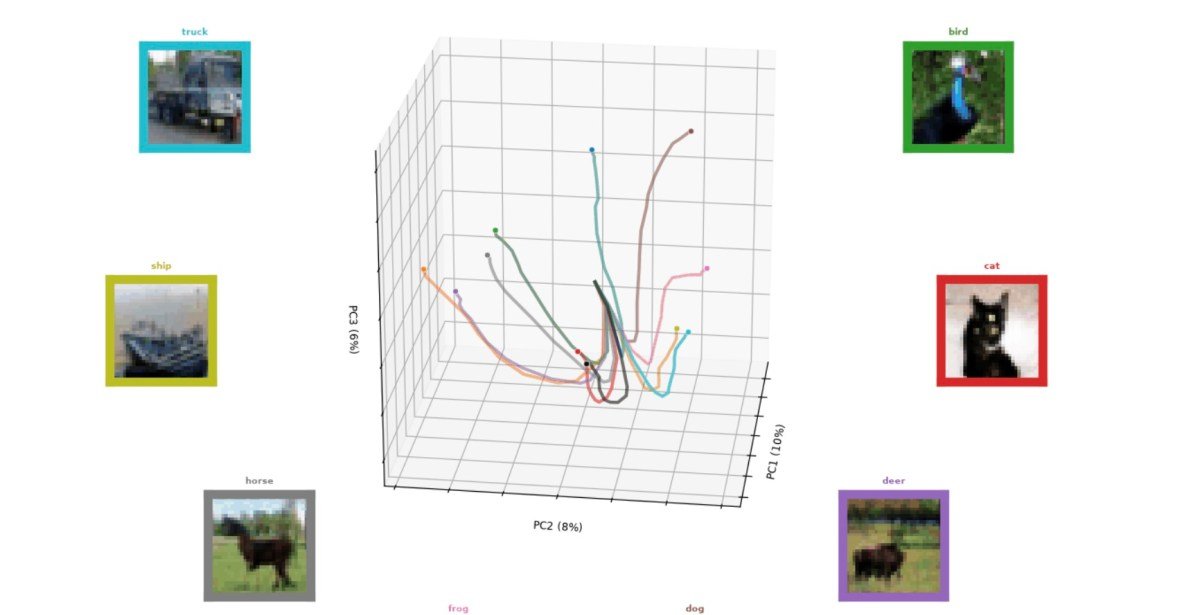
On Thursday, the company released its first model AI — called Un-0 — an image-generation system tool that shows for the first time how the company’s technology can replicate conventional AI systems. In an accompanying new paper, the company’s research team details how they built a fully functional image-generation model using a software simulation of the new architecture — one that performs just as well as state-of-the-art diffusion models.
“This is the ‘hello world’ of a new kind of computer,” Rao told TechCrunch. “Over the next year, you’re going to start seeing some pretty interesting news around this.”
The output from the new Un-0 model is similar to that of image-generation models like Stable Diffusion or OpenAI’s GPT Image 1. The impressive part is how it arrives at that performance. The model is built on an oscillator-based architecture that is completely different from the chips that power conventional computing and traditional LLMs. The advantages of the oscillator-based computing are complex, but Rao believes it will ultimately reduce power use by as much as 1,000 times.
Much of the infrastructure to get there is still being built. The current version of Un-0 runs on a software simulation of Unconventional’s oscillator chips, but the company plans to release schematics for an actual chip soon. From there, the plan is to build an entire inference stack from the ground up, with Unconventional AI eventually supplying compute capacity just like any other provider.
“We will build a new kind of system composed of our chips,” says Rao. “We will run AI models there, and we will have a network cable where prompts come in and inferences go out, but it’ll be done at 1/1000 of power.”
It’s a stunningly ambitious goal, particularly for a company that still counts less than 50 employees. But given the scale of the AI buildout and the anticipated cost of meeting the growing demand for inference, it may be one of the few efforts to meet the scale of the problem. As Rao sees it, the available supply of power will be one of the hard limits for AI in the years to come — and Unconventional is one of the few projects able to address it.
“AI scaling is hard because of energy. It’s going to be the fundamental limit in the next few years. You just can’t go past it. It’s going to be an energy-limited problem, at the end of the day,” he says.
When you purchase through links in our articles, we may earn a small commission. This doesn’t affect our editorial independence.
