


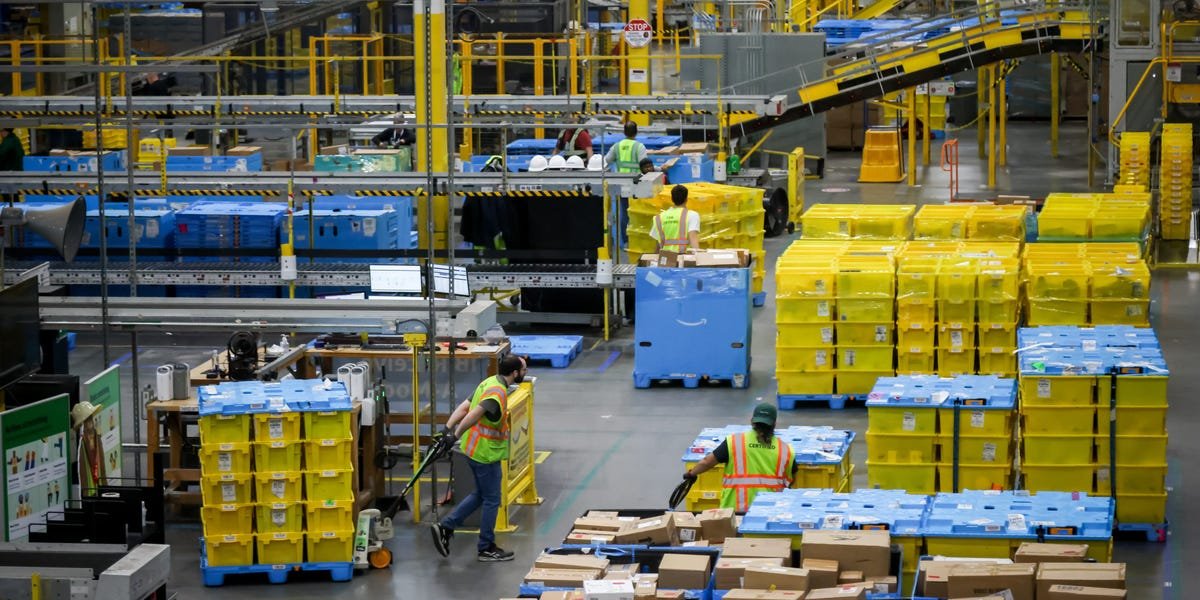
Inside Amazon’s newer, robot-filled warehouses, the next big efficiency drive focuses on how humans move around the facilities, not just packages.
If the plan works and scales, this could wring millions of labor hours out of the company’s e-commerce operations every year, according to internal analysis viewed by Business Insider.
These planning documents reveal Amazon is piloting a system called Full Facility Load Balancing, or FFLB, that automatically reassigns workers as package volumes and workloads change throughout the day.
The goal, according to one of the documents, is to “remove the dependency on manual staffing decisions.”
Initial estimates show the technology could recover roughly $193 million annually in labor costs and cut almost 7 million labor hours each year.
From packages to labor
The initiative reflects a broader shift inside Amazon’s warehouses. After years of using robots and software to automate the flow of packages, the company is increasingly applying the same approach to labor decisions, such as staffing assignments that managers have traditionally handled manually.
According to the documents, FFLB continuously evaluates package volumes, forecasts, and other operational signals to determine staffing needs across the warehouse. The system recalculates staffing requirements approximately every three minutes and recommends moving workers when one area appears overstaffed and another requires additional support.
“FFLB dynamically calculates the recommended headcount for different process segments and automatically assigns and balances associates between roles,” one document stated.
An Amazon spokesperson said the technology is intended to help managers respond more quickly to changing conditions inside warehouses, not replace them. FFLB is one component of Amazon’s broader staffing system that’s used for specific roles at certain types of facilities, and a “natural extension” of its existing software, not a “net-new invention,” the spokesperson added.
The spokesperson also said the projected savings are “inaccurate” because they were based on hypothetical modeling rather than measurements of individual productivity.
“We’re continuously evaluating and making improvements to how work flows through our sites, like testing technology at select facilities to help match staffing to volume throughout any given shift,” the Amazon spokesperson added. “The goal is simple: streamline the complex operational decisions that can pull managers away from the floor so they can spend more time with their teams. Managers remain the decision-makers; this gives them better information in a more efficient way.”
‘Largest labor automation opportunity’
Amazon believes many inefficiencies are concentrated in Container Build, a warehouse function where human workers place packages into outbound carts and containers before shipment. According to the documents, the role accounts for a significant share of labor hours at robotics-enabled fulfillment centers, making it the company’s “single largest labor automation opportunity.”
Amazon this year wants to roll out FFLB across its Amazon Robotic Sortable, or ARS, facilities, according to the documents. In these warehouses, workers and robots collaborate to fulfill customer orders ranging from books and toys to household goods.
Container Build is the “biggest role” in sortation, so any adjustments to this role would have “outsized impact when assessed at scale,” an Amazon spokesperson said.
One internal analysis of 97 fulfillment centers found that 48 facilities were operating below targeted productivity levels, generating roughly 309,000 excess labor hours each month, or 3.7 million hours a year. According to the documents, those sites were operating about 14% below targets because they process fewer units for every hour of labor.
Another 266,000 labor hours per month were associated with workers assigned to stations with little or no work available. That’s another 3.2 million hours per year, for a total of 6.9 million hours. The Amazon spokesperson said this is a tiny fraction of total warehouse labor hours.
The company estimated that 25% of Container Build labor time is associated with overstaffing and projects FFLB could reduce unproductive labor in the function by roughly 40%.
“No WIP”
Amazon is also focused on a metric known as “No WIP,” which measures associates at workstations with no work in progress. That figure increased from 4.2% to 5.6% this year for Container Build functions, one of the documents stated.
FFLB is the “primary lever” poised to close this gap, the document noted.
The Amazon spokesperson said the numbers from the documents are “incomplete and misleading” because they represent “theoretical modeled opportunities and aspirational targets based on hypothetical analysis, not what’s happening in real time guaranteed savings, nor existing losses.”
The spokesperson added that the analysis measured one specific role within a portion of its warehouses, and it captured fluctuations in package flow and worker assignments, not individual productivity or employees standing around without work.
Deployment plans
Amazon has already begun deploying the technology at dozens of warehouses and plans to expand it to all North American robotics-enabled fulfillment centers this year, according to one of the documents.
The company also plans to expand FFLB beyond Container Build, one of the documents indicated. The Amazon spokesperson told Business Insider that future deployment plans remain subject to change.
Meanwhile, the rollout has exposed some of the challenges of introducing software into decisions traditionally handled by managers. Internal documents show some managers struggled to adjust to automated labor moves, frequently requesting configuration changes or feature disablement. The documents suggested many of those concerns reflected a learning curve.
“As with any new technology, we test, iterate, and are always looking to understand our teams’ experiences with various tools — that’s how we learn what works for them and what doesn’t,” the Amazon spokesperson said.
Have a tip? Contact this reporter via email at ekim@businessinsider.com or Signal, Telegram, or WhatsApp at 650-942-3061. Use a personal email address, a nonwork WiFi network, and a nonwork device; here’s our guide to sharing information securely.
