


Paradromics, a competitor of Elon Musk’s Neuralink, recently completed its first brain implant in a human patient, marking a major milestone in the startup’s decadelong effort to use brain-computer interfaces (BCI) to restore lost human functions.
The startup announced Wednesday that its Connexus brain-chip was implanted in a Michigan woman who has difficulty speaking due to a motor neuron disease. The woman’s identity has not yet been disclosed to protect patient privacy.
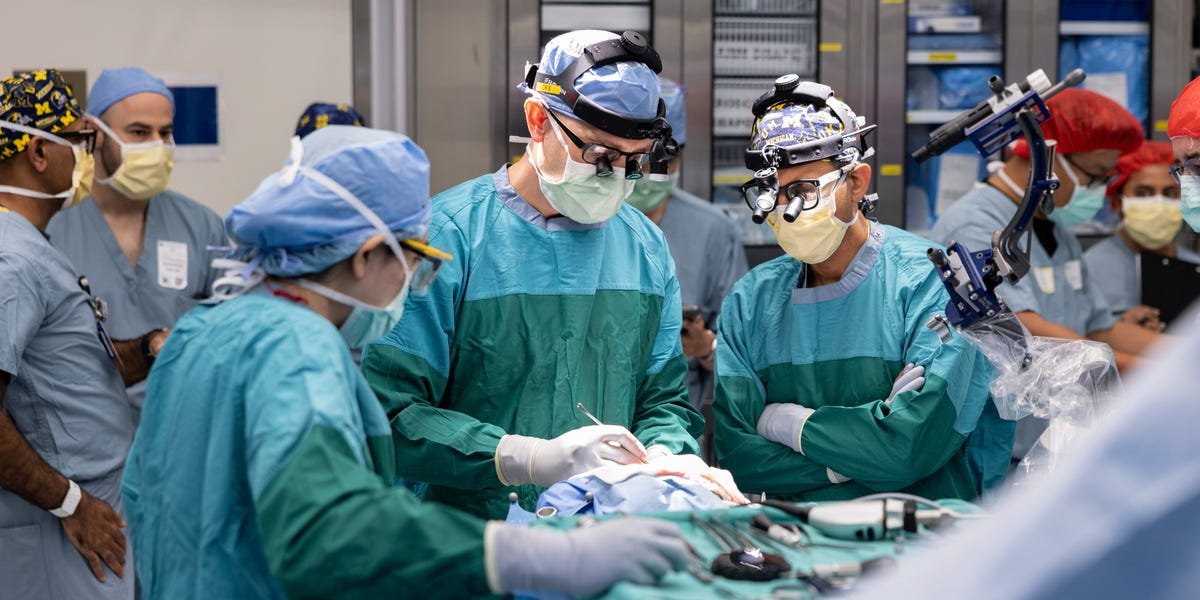
The procedure was part of an FDA-approved clinical study conducted at University of Michigan Health. The operation, which took place in early June, lasted about four hours, a representative for Michigan Medicine, the university’s academic medical center, said.
Paradromics founder and CEO Matt Angle told Business Insider the patient is now at home recovering from the operation.
“The surgery went well,” Angle said. “We’re super happy that she placed her trust in us, and we’re really excited to be working with her.”
From theory to reality
Paradromics, founded in 2015 and based in Austin, is one of a growing number of BCI companies trying to turn once-theoretical neuroscience into a practical medical application.
Connexus is designed to help people with severe motor impairments communicate through a computer by recording brain signals associated with speech. The device itself does not restore speech by biologically repairing a person’s vocal cords or mouth muscles. Instead, the person attempts to speak, the implant records neural activity linked to speech, and, with software, those signals are translated into text or synthesized speech on a computer.
Angle said the company expects to begin seeing the device “in action” over the next couple of weeks, though he cautioned the process will depend on the participant’s recovery.
“We will work with her in a training and rehabilitation environment to teach her how to speak through a computer so that she can attempt to say things,” he said. “The device can read out the representations of speech in her brain. And then our hope is that the computer will then be able to complete speech on her behalf.”
Connexus includes a small brain implant, Angle said, about the size of a dime. The device sits on the surface of the brain and has 421 tiny platinum-iridium microwires that insert into the brain tissue. Each wire is less than half the diameter of a human hair.
Dr. Matthew Willsey, a neurosurgeon at the University of Michigan who led the procedure, told Business Insider that the Connexus device also includes extension leads running under the skin down the left side of the neck to a transceiver implanted beneath the left clavicle. The chest device communicates wirelessly through the skin with an external receiver, Willsey said.
University of Michigan and Paradromics
Paradromics said the Michigan woman will be evaluated over the next six years. Angle said there will be a year during which the startup collects data, including safety, words per minute, vocabulary size, and how many bits of information the device can move during a conversation.
In this case, bits refers to the amount of usable data the Connexus device can extract from brain signals per second.
Human enhancement
Paradromics’ milestone comes as the field has so far been dominated by Neuralink, Musk’s brain chip company that was founded in 2016.
Neuralink’s first patient, Noland Arbaugh, is a quadriplegic who received an implant in January 2024. Arbaugh previously told Business Insider that the device enabled him to control his computer and interact with others online.
Brain implants carry risks. Business Insider previously reported how BCIs and other brain implants raise concerns around safety, privacy, and dependency.
Angle said that any surgery involving general anesthesia or implantable devices carries “non-zero risk,” including infection, and that Paradromics designed Connexus to last for a long time to reduce the need for repeat surgeries.
For now, Angle said the company is focused on therapy, but that the applications of BCI will eventually extend beyond restoring lost human functions. The company said in its announcement that the use cases could include “direct AI interaction,” advanced prosthetics, and treatments for mental health and other neurological conditions.
“Anyone who’s building interfaces with the nervous system is building both the capability to restore capabilities and enhance capabilities,” Angle said.
The CEO added that his employees aren’t waking up each morning thinking about human enhancement through brain chips. However, the technology inevitably raises broader questions around human “enhancement.”
“I don’t think that building devices with the capability to enhance people has to be ethically fraught,” Angle said. “I just think it has to be addressed.”
