


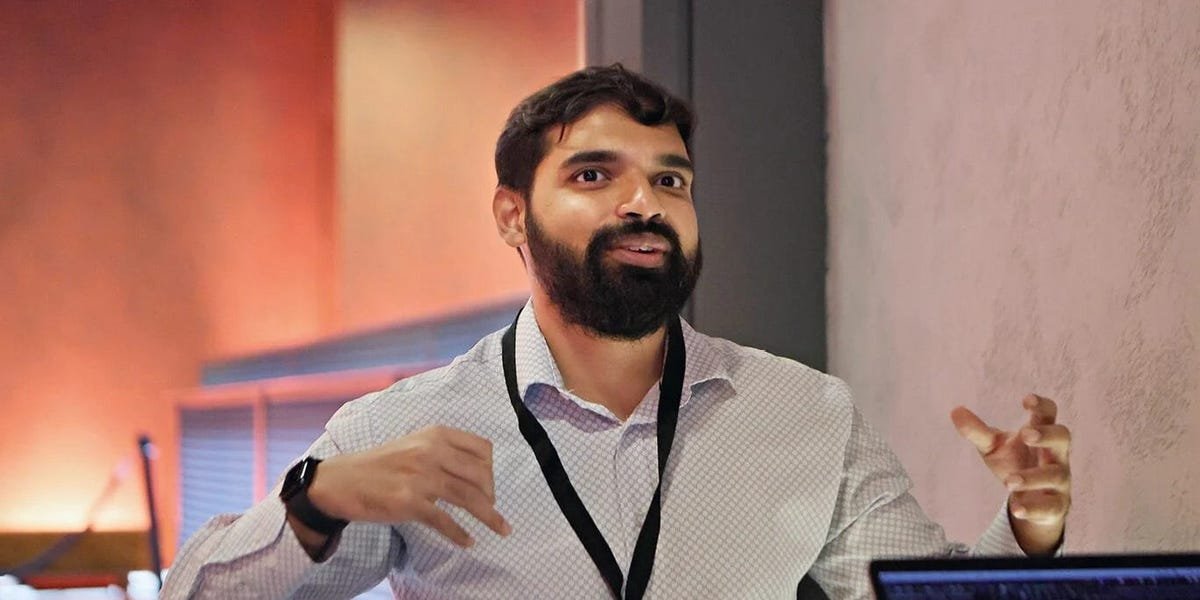
Vivek Natarajan is one of the Google DeepMind researchers trying to prove that advanced AI can do more than improve search, ads, and recommendations.
His work sits at the center of one of Google’s most ambitious bets: that AI can become a collaborator for doctors and scientists, helping diagnose disease, propose experiments, and speed up the search for new treatments.
For Natarajan, that mission stems from seeing his father suffer. His dad spent 35 years at a widely read Indian newspaper. Then Parkinson’s disease began to change him. While Natarajan was completing a master’s degree in the US, his father started showing physical and cognitive symptoms, and his mother took on the role of caregiver. Determined to finish his career on his own terms, his father continued working until retirement, before later passing away.
The experience left Natarajan with an urgent focus that has guided his career.
“I asked this question to myself, ‘okay, where is AI going to generally have the most impact?’ And to me, that answer felt like medicine and science,” Natarajan told me in a recent interview. “That was influenced by what I was seeing in my personal life and with my family.”
Vivek Natarajan
By 2017, he was at Meta, working in a leading AI lab as deep learning was moving from academic breakthrough to industrial engine. But after watching his father’s decline, Natarajan found himself increasingly drawn to a different use for the technology.
He’d been thinking about healthcare since growing up in India, where access to care could shape a family’s fate. As an undergraduate, he and a few friends mocked up a rules-based app called “Ask the Doctor Anytime, Anywhere.” The technology was crude, but the ambition stuck.
At Meta, Natarajan saw what modern AI could do inside one of the world’s most sophisticated technology companies. But he also noticed research from Google and DeepMind pointing in a different direction.
Google researchers were using AI to analyze retinal images and identify disease, while publishing work on breast cancer detection from mammograms. These were narrow systems, but they suggested that frontier AI could be aimed at medicine, not just online engagement.
In 2019, he joined Google after connecting with Greg Corrado, a founder of Google Brain.
“Greg was just starting to put together this team to work at the intersection of AI and medicine, and he told me all about it,” Natarajan recalled. “I was excited, but I told him I knew nothing about medicine, and he said, ‘just come over, and we’ll teach you.'”
Inside Google, Natarajan found a culture that could be both liberating and frustrating. Healthcare did not move like consumer software. Progress depended on earning the trust of physicians, patients, regulators, and policymakers. Scientific rigor mattered as much as technical innovation.
What frustrated him was that Google could publish impressive papers in journals like Nature while seeing relatively few AI systems actually reach doctors and patients.
After settling in, he began focusing on deeper questions: reliability, uncertainty, generalization, and interactivity. An AI system that simply outputs a probability score is not enough for medicine. Doctors need explanations. Patients want conversations. Medicine is contextual and deeply human.
Corrado introduced him to Alan Karthikesalingam, a physician-scientist who had worked at DeepMind and shared a similar ambition. The pair were inspired by Google’s biggest scientific breakthroughs, including AlphaGo and AlphaFold.
“I distinctly remember texting Alan like, ‘Why are we not doing these kinds of things? What are we doing? We should be having the same amount of impact,'” Natarajan said.
LLMs and dosas
Vivek Natarajan
In 2021, the pair saw an early version of Google’s PaLM model demonstrate something striking: it could learn from just a handful of examples. They sensed it could become the foundation for a new generation of medical AI.
Over dosas at dinner in Mountain View, they drafted a proposal for Google Brain’s Moonshots program, which focused on riskier long-term bets. More than 50 researchers across Google Brain, Google Research, and DeepMind eventually joined the effort.
The first major result was Med-PaLM. The team wanted to test whether large language models contained useful medical knowledge. Using MedQA, a benchmark based on US Medical Licensing Exam-style questions, they watched performance improve rapidly. Within months, the models moved from near-random guessing to passing-level scores, and eventually to expert-level performance with Med-PaLM 2.
The work helped catalyze a broader push into medical AI. But Natarajan and Karthikesalingam were not satisfied. Passing a medical exam, Natarajan argued, does not make an AI system a doctor.
A Stanford talk
Their next project, AMIE, moved closer to clinical reality. The system was designed to take patient histories, reason through diagnoses, and communicate empathetically.
That work laid the foundation for Co-Clinician, a broader initiative that envisions AI functioning as a collaborative member of a care team, interacting as a go-between with patients and their physician.
Then the focus expanded from medicine to science itself.
In 2023, after Natarajan and teammate Tao Tu gave a Stanford talk on Med-PaLM, Stanford professor Gary Peltz approached them with a question: Could these systems generate scientific hypotheses, not just answer questions?
Many colleagues were skeptical. Hallucinations remained a serious concern. Natarajan and a small group pushed ahead anyway.
The result was Co-Scientist, a Gemini-based multi-agent system designed to help researchers generate, debate, rank, and refine hypotheses.
One of the first moments that convinced Natarajan this system might work came through two professors at Imperial College London, Jose Penades and Tiago Costa.
Those two researchers had spent roughly a decade investigating antimicrobial resistance. They had a breakthrough but had not yet published the results, making it an ideal test case.
The professors gave Google’s system the same research challenge. Natarajan’s team ran Co-Scientist for several days and sent back the results, expecting criticism.
Instead, Penades demanded to know whether Google had somehow accessed his computer. The results were that good.
Natarajan assured him they were not cheating.
“It’s not just that the hypothesis they provided was the right one, it’s that they provided another four, and all of them made sense,” Penades told the BBC in an interview. “For one of them, we never thought about it, and we are now working on that.”
Since then, Co-Scientist has been tested on other problems, including cancer drug repurposing and liver fibrosis.
In the liver-fibrosis project, the system looked for ways to slow or reverse liver scarring. It suggested several existing drugs that might help. In experiments conducted with Stanford collaborators using tiny lab-grown liver models made from human cells, some of those suggestions showed promise, including the FDA-approved cancer drug Vorinostat.
For Natarajan, that’s the point of being at Google DeepMind. The company’s mission is to build responsible artificial general intelligence. He sees projects like Co-Clinician and Co-Scientist not as a side quest, but as an expression of this mission — a way for general AI capabilities to help medicine and science move faster.
Natarajan is also clear-eyed about the risks. A bad scientific hypothesis can waste months of research. A medical model released too early can cause harm.
Still, his father’s illness left him deeply aware of the gap between scientific possibility and real-world treatments — and the urgency to close this as quickly and safely as possible.
“I think we now have a line of sight towards understanding mechanisms of diseases very broadly,” Natarajan told me. “Hopefully, we can put all of these learnings to work and really help accelerate finding cures for many of them.”
Sign up for BI’s Tech Memo newsletter here. Reach out to me via email at abarr@businessinsider.com.
