


TV tech can feel bewildering, weighed down by confusing terminology and tons of acronyms, like HDR, QLED, and OLED. All that jargon can start to seem like marketing speak, but one term you’ll see often — Mini LED — is genuinely worth paying attention to.
This small but mighty technology plays a major role in picture quality for some of the best TVs, enabling improved contrast and searing brightness. But just when we thought Mini LED had reached its peak, in comes a new display tech, RGB LED, which offers a few cool advancements. Though the technology has some quirks to keep in mind, RGB LED models present an exciting step forward for TV innovation.
So what are RGB LED TVs, and how do they compare to more traditional Mini LED TVs? Below, we break it all down, so you can make an informed decision about your next TV purchase. Here’s everything you need to know about RGB and Mini LED, and how they stack up against other TV types.
What is a Mini LED TV?
John Higgins/Business Insider
The majority of consumer TVs have used the same basic structure for decades now: an array of white or blue LEDs (Light-Emitting Diodes) shining through a Liquid Crystal Display (LCD), along with filters and other substrates to produce color. This is the baseline for most TV tech, including Mini LED TVs.
But as its name implies, Mini LED takes standard LED backlighting to another level by using smaller backlight modules. These smaller LEDs enable all sorts of improvements, including more advanced contrast control, which is key to better picture quality.
This is accomplished through full-array local dimming, which allows a TV to dim certain LEDs while lighting others. Imagine a bright spaceship floating across a black, starry backdrop on your screen. Without local dimming, such images tend to look washed out, especially in dark rooms, but local dimming improves contrast between the brightest and darkest areas, enhancing realism and detail.
The more individual dimming sections, or zones, an LED TV has, the more accurate its picture will look. Think back to that space scene again, and the need to light not just the ship, but each of those tiny stars set amid the blackness of space. That’s where Mini LEDs come in, offering enhanced precision for greater accuracy and realism than standard LEDs. Today’s most advanced Mini LED TVs feature thousands of light modules and dimming zones to achieve deeper black levels and higher brightness.
While backlighting is important, displays can also be enhanced in other ways, such as with quantum dots, tiny nanoparticles that glow when light passes through them. In TVs, quantum dots are commonly red and green, which, when exposed to blue LEDs, can reproduce a broad spectrum of vibrant colors. This advancement spawned another TV acronym, QLED (Quantum LED). These days, most Mini LED TVs are also QLED TVs.
What is an RGB LED TV?
Steven Cohen/Business Insider
RGB LED TVs can be seen as a new type of advanced Mini LED TV. They still employ thousands of miniature LEDs as backlights, but instead of only white or blue LEDs, they use RGB LEDs with thousands of tri-colored red, green, and blue diodes. This allows RGB LED TVs to produce a brighter, purer, and more expansive range of colors.
Most TV makers now offer some form of RGB tech, including Hisense, TCL, Sony, Samsung, and LG. From the beginning, we’ve been calling these displays RGB LED, but each manufacturer has put its own spin on the name, which can lead to some confusion.
Most notably, Hisense and TCL use the RGB Mini LED branding, Sony uses True RGB, and Samsung and LG are calling their RGB TVs Micro RGB. There are some differences in how each brand is implementing RGB tech, including the actual size of the LEDs being used in each panel, but the underlying idea is the same.
Here’s a rundown of recently released RGB LED TV models:
What are the advantages of RGB LED?
Steven Cohen/Business Insider
The most obvious advantage of RGB LED is enhanced color, including greater accuracy and a higher overall color volume. In Sony’s press release for its new Bravia 9 II and Bravia 7 II RGB LED TVs, the brand says its True RGB TV models achieve the largest color volume in Sony TV history, alongside better accuracy from wider viewing angles.
Other RGB TV makers have been more specific, with brands like Hisense, Samsung, and LG all saying their top RGB models can reproduce an incredible 95-100% (or higher) of the next-gen BT.2020 color gamut, which goes well beyond the DCI-P3 color space currently used for most Hollywood productions.
That said, our initial measurements with RGB LED TVs like the Samsung R95H and Hisense UR9 have been closer to 91% of BT.2020. That’s not quite as high as each brand touts, but it’s still the widest color gamut we’ve ever seen. For comparison, most traditional Mini LED and OLED TVs top out at around 70-85% of BT.2020.
However, there are some caveats to keep in mind about the benefits of BT.2020 color. Most notably, it’s important to remember that most movies and TV shows don’t fully utilize BT.2020. That will likely change in the future, but right now, most Hollywood colorists don’t take advantage of such a wide gamut.
Steven Cohen/Business Insider
That said, colors aren’t the only potential advantage of RGB LED displays. Top models are also incredibly bright, with some flagship RGB LED TVs, like the Hisense 116UX, rated at up to 8,000 nits in small highlights.
Again, there are some important caveats here. Most consumer RGB LED TVs won’t actually get that bright in real-world viewing. The few models we’ve tested so far have approached 3,000 and 4,000 nits. That’s still impressive, but it’s no different from what we’ve already seen from high-end Mini LED models.
Likewise, even if future RGB LED TVs consistently hit 10,000 nits, there isn’t a lot of content that requires that level of brightness right now. Most streaming video is mastered for a max of around 1,000 nits, and the best 4K HDR Blu-rays generally don’t go beyond 4,000 nits in their most searing highlights, like sunlight bouncing off a window.
Steven Cohen/Business Insider
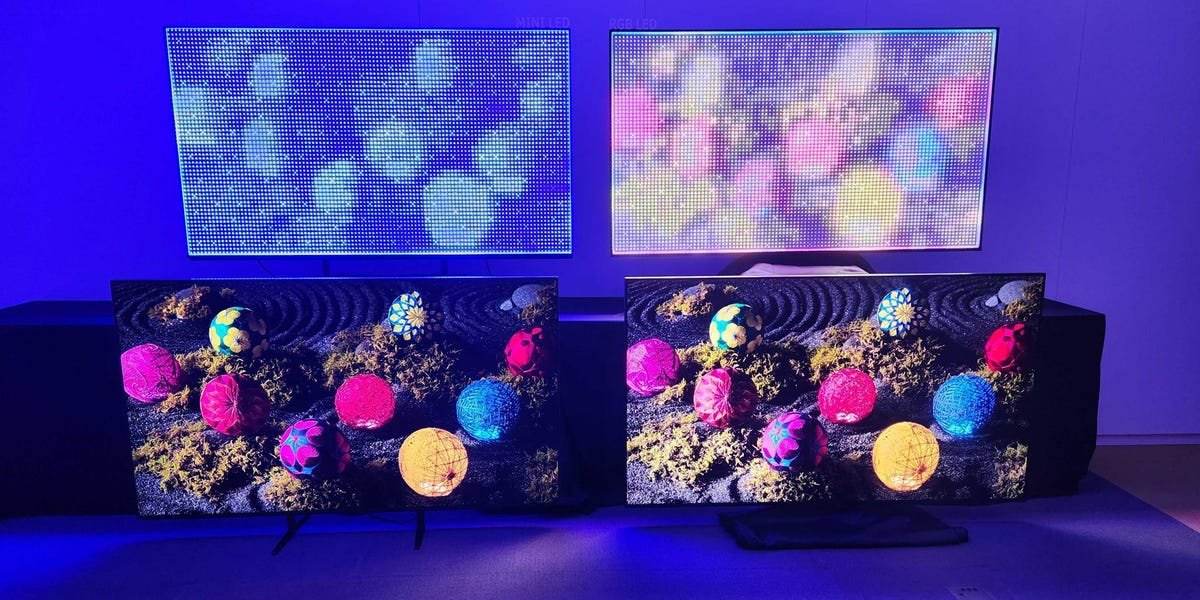
Other potential RGB LED advantages include better off-axis viewing thanks to the new structure of their light modules and improved local dimming, which enhances contrast and reduces light bleed or blooming around bright objects. When our team viewed a Sony Bravia 9 Mini LED TV side-by-side with a new Sony Bravia 9 II True RGB TV, the advantages of the RGB LED tech were clearly evident.
Though the Mini LED TV still looked good, its colors were slightly faded compared to the RGB LED model, which produced noticeably richer hues. Likewise, the RGB LED TV’s image distorted less at angles, and its black levels were deeper with less blooming around bright objects.
Do RGB LED TVs have disadvantages?
Steven Cohen/Business Insider
As with any display tech, RGB LED TVs aren’t perfect. This new backlight technology can introduce its own flaws. Despite having thousands of light modules, even the most advanced RGB LED TVs still don’t have enough dimming zones to match the 8.3 million pixels in a 4K image. As a result, some RGB LED TVs are prone to an issue called crosstalk (also known as color blooming).
Since RGB LEDs produce color from their backlight, that color can spread into areas of an image that it shouldn’t, creating crosstalk. For instance, an RGB LED TV displaying a vibrant green car against a white background might cause the green light to bloom into the surrounding white area, tinting it green.
Each brand uses its own local dimming algorithm to help prevent crosstalk by intelligently controlling a TV’s LED zones to create color and light as precisely as possible. Some RGB LED TVs even switch to white or blue light during scenes that are too complex to display without crosstalk.
Our team has observed crosstalk on RGB LED TVs during side-by-side comparisons hosted by various TV brands. These demos have also shown instances in which certain TVs revert to white or blue backlighting rather than using their RGB LEDs. However, in our initial hands-on reviews with different RGB LED models, including the Samsung R95H, Hisense UR9, Sony Bravia 7 II, and Sony Bravia 9 II, we’ve yet to see this issue during normal viewing.
So, while it’s certainly possible that some RGB LED TVs, especially lower-end models, are susceptible to crosstalk, so far it hasn’t been a notable problem in our testing.
What about OLED TVs?
Steven Cohen/Business Insider
While most modern TVs use some form of LED backlighting, the major exception in the current market is OLED (Organic Light-Emitting Diode). OLED TVs can control each of their 8.3 million pixels independently for unparalleled contrast — no backlighting required. This eliminates the potential for blooming or crosstalk.
While OLED TVs can’t get as bright or colorful as the most powerful RGB LED TVs, they have other advantages, including near-perfect off-axis viewing and true black levels for contrast that RGB and Mini LED TVs still can’t match.
This is why the best OLED TVs have traditionally been the go-to choice for videophiles. But because OLEDs are tough to manufacture, they’re more expensive than LED technology. This is especially true in larger screen sizes. That’s why various LED TVs are so prominent, and why manufacturers have made so many cool advancements over time to improve their performance. You can learn more about how OLED tech stacks up against other display types in our OLED vs. QLED comparison.
The bottom line
Scott Tharler/Business Insider
We’ll need more time with RGB LED TV models to truly assess just how much of an improvement they offer over Mini LED. On paper, their advantages are clear, and certain models, like Sony’s flagship Bravia 9 II, have delivered noticeably better picture quality than any Mini LED TV we’ve seen.
However, it all comes down to how each brand and specific TV model uses the technology. Mini LED TVs are still impressive in their own right, as TCL continues to prove with its new “SQD” lineup of souped-up Mini LED models. SQD TVs still use traditional white or blue backlights, but they feature larger quantum dots and improved color filters to produce results similar to an RGB backlight. You can learn more in our reviews of the TCL X11L and TCL QM8L SQD TVs.
It’s a lot to take in, especially since RGB LED and SQD arrived at the same time. Still, even if you don’t have it all down, it’s an exciting time for display tech. As RGB backlighting improves, displays will continue to get better, brighter, and more colorful at an even faster pace. Acronyms or no, it’s hard to complain about that.
