

Close Menu
  • Home
  • AI
  • Education
  • Entertainment
  • Food Health
  • Health
  • Sports
  • Tech
  • Well Being

Subscribe to Updates

Subscribe to our newsletter and never miss our latest news

Subscribe my Newsletter for New Posts & tips Let's stay updated!

What's Hot

The Trump administration might take an equity stake in OpenAI

June 6, 2026

Uber’s AI Training Gig Work Offers Good Pay but Lacks Stability

June 6, 2026

Alex Karp Compares Tokenmaxxing to a Porn Addiction

June 6, 2026
Facebook X (Twitter) Instagram
  • Home
  • About Us
  • Advertise With Us
  • Contact us
  • DMCA
  • Privacy Policy
  • Terms & Conditions
Facebook X (Twitter) Instagram
IQ Times Media – Smart News for a Smarter YouIQ Times Media – Smart News for a Smarter You
  • Home
  • AI
  • Education
  • Entertainment
  • Food Health
  • Health
  • Sports
  • Tech
  • Well Being
IQ Times Media – Smart News for a Smarter YouIQ Times Media – Smart News for a Smarter You
Home » I Flew on a One-of-a-Kind Electric Plane That Could Reshape Air Travel
Tech

I Flew on a One-of-a-Kind Electric Plane That Could Reshape Air Travel

IQ TIMES MEDIABy IQ TIMES MEDIAJune 6, 2026No Comments6 Mins Read
Facebook Twitter Pinterest LinkedIn Tumblr Email
Share
Facebook Twitter LinkedIn Pinterest Email


The future of aviation isn’t a sleek jet — it’s a tiny whale-shaped airplane that could turn The Jetsons fantasy of aerial commuting into reality.

Vermont-based startup Beta Technologies aims to convince US consumers that electric aviation has arrived in ways that will change how they travel for work and leisure, and invited media to ride in the state-of-the-art all-electric aircraft that it calls the Alia CX300.

For 20 minutes, we zipped above Burlington at over 100 miles per hour as test pilot Chris “Pooter” Caputo showed us how it banks, glides, and manages energy. The ride was smooth, quiet, and surprisingly fast, with sweeping views of Lake Champlain and the Green Mountains below.

This new industry believes electric aircraft like the Alia CX300 will take over short regional routes from today’s small fuel-powered turboprops and helicopters — making travel cleaner, cheaper, and quieter.

Beta’s CX300, a type of aircraft designated cTOL, already has orders from carriers like Air New Zealand and is expected to begin revenue-cargo flights later this year under a Transportation Department pilot program. Full certification is expected in late 2027.

Beta is also developing an electric vertical takeoff and landing aircraft, or eVTOL — the Alia 250 — to certify in the years after its CX300. It mirrors much of the CX300’s technology but takes off from a vertiport rather than a runway, making it particularly suitable for city commutes.

This approach differs from that of other US competitors, such as Joby Aviation and Archer Aviation, which are primarily focused on eVTOL aircraft instead of stepped certification.

Beta president and CEO Kyle Clark said it’s a pragmatic strategy that ultimately makes vertical certification easier: “By the time you get the cTOL certified, you effectively have 80% of the requirements for the eVTOL.”

Still, the company faces major hurdles, particularly around charging infrastructure, certification, and public acceptance — especially if expected cost savings don’t translate into affordable fares. And the up to $13 million in projected battery replacement sales over each aircraft’s lifetime, outlined in a 2025 SEC filing, could spook potential customers.

Here’s a closer look at the Alia CX300 and what my flight was like.

Alia CX300 can carry five passengers and one pilot.

BETA cTOL passenger demo flight.

We wore headphones, but I found the electric engine was quiet enough that you could have a conversation without them.

Taylor Rains/Business Insider

The Alia CX300 can carry five passengers and one pilot, with no divider between the cockpit and the cabin.

Inside, two rows of seats sit behind the pilot. My colleague Dan Allen, who sat in the back row at over six feet tall, said he had plenty of legroom. I sat in the front and felt the same.

Flying from the cockpit gave me a bird’s-eye view, and the visibility below seemed to eliminate some blind spots.

That said, you do feel every bank and bump in a small aircraft like this, and some passengers may get motion sickness. Dramamine probably wouldn’t hurt.

It runs on rechargeable battery packs.

The CX300 and the charging cubes.

The charging cubes are to the left of the aircraft. One unit charges the batteries, while the other cools them during the process.

Taylor Rains/Business Insider

Up to five battery packs stored in the belly of the aircraft provide around 250 kWh of energy — roughly 390 miles of range under ideal conditions. The redundancy in case a battery fails is crucial for safety and certification.

While not fully certified yet, the company secured special federal permissions to operate demonstration flights like this one.

Beta has spent years developing its electric propulsion system in-house, with separate versions for its cTOL and upcoming eVTOL aircraft.

The batteries can be recharged in about an hour using large, cube-shaped charging units, which Beta also builds and sells to other operators for hundreds of thousands of dollars. The charging business is part of its broader strategy to diversify revenue beyond aircraft sales.

By designing and building much of its technology in-house, Beta has greater control over quality and costs, Clark said — a vertical integration strategy similar to SpaceX, which also builds much of its rockets and supporting infrastructure itself.

Our pilot cut the engines halfway through the flight.

The cockpit flight display on the CX300.

The cTOL can fly at about 175 mph. On my flight, we capped out at around 140. The cockpit display shows remaining energy in kilowatt-hours rather than a percentage.

Taylor Rains/Business Insider

To demonstrate the CX300’s glide, Caputo cut the engines at about 1,300 feet. While it was slightly rattling, the aircraft maintained a controlled glide and gradually lost altitude.

Caputo said that even in the event of complete power loss away from an airport, the aircraft could glide down onto a suitable landing strip.

The engine itself is also built with redundancy. The rear-mounted electric propulsion unit is designed with independent power paths, meaning one can fail while the other continues operating.

Our flight cost a few dollars. That doesn’t mean fares will be cheap.

CX300 flying over Burlington.

Beta has already certified the propeller, but still needs to certify the electric engine. It’s also making an electric aircraft for the US military.

Taylor Rains/Business Insider

Our flight technically cost only a few dollars in electricity, Caputo said. Transportation Secretary Sean Duffy similarly took a demo flight with Beta last week that cost $3, per the company. A similarly sized fuel-powered Cessna would cost a few hundred dollars.

But that doesn’t necessarily translate into cheap fares. Operating costs still include pilots, maintenance, insurance, and infrastructure — so the true economics are still a big question.

But electricity is still cheaper than jet fuel, especially as oil prices remain sky high amid the US war in Iran.

Alia CX300 has already been tested on real-life missions.

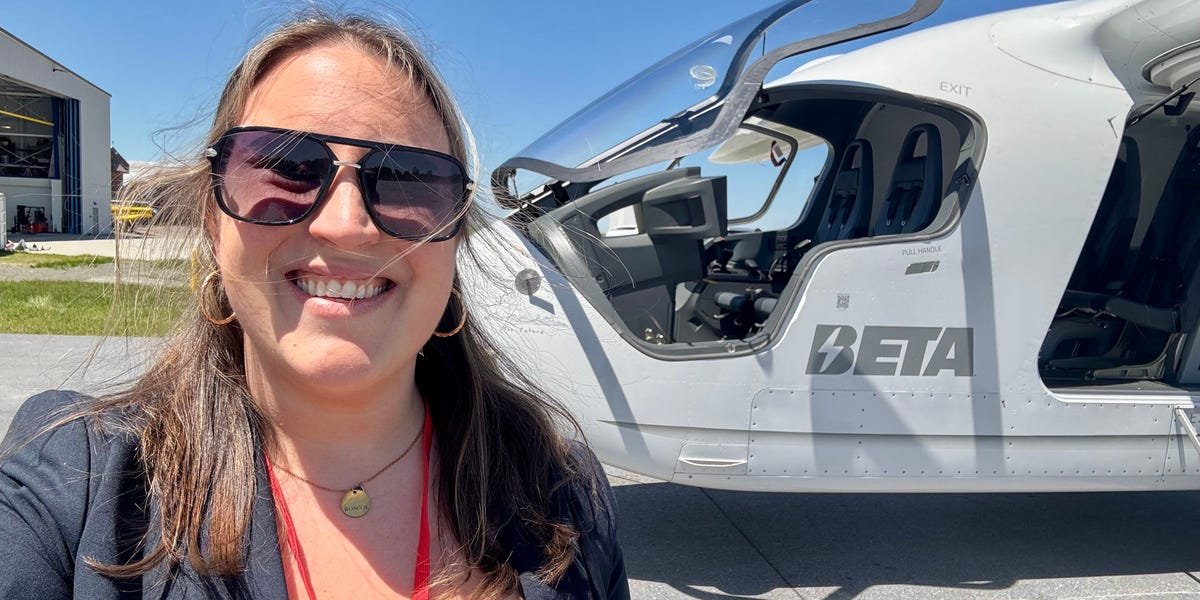
The author smiling at the camera during a deep bank on the CX300.

Caputo performed deep banks to show us the CX300’s maneuverability.

Taylor Rains/Business Insider

Beta has partnered with several airlines, including Republic Airways, Air New Zealand, and the UK’s Loganair, to conduct real-world test flights. For example, Beta and ANZ completed more than 100 flights — including organ deliveries — across 12 airports and roughly 7,000 miles earlier this year.

In the US alone, there are more than 4,000 public-use airports that are too rural or small for larger commercial jets, yet still need more affordable connections to the broader air network — think leisure places like the Hamptons and Catalina Island, or remote Alaskan communities that rely on regular supply flights.

That network could become the backbone for the Alia CX300, flying short-haul routes within airline fleets or as a standalone service opening untapped routes at lower cost — ultimately laying the groundwork for Beta’s vision of eVTOL flying taxis.

“We’re ready to go today with cargo cTOL aircraft,” Clark said. “Tomorrow it’s going to be passenger cTOL aircraft, then cargo VTOL aircraft, then passenger VTOL aircraft.”


Source link

Share. Facebook Twitter Pinterest LinkedIn Tumblr Email
IQ TIMES MEDIA
  • Website

Related Posts

Uber’s AI Training Gig Work Offers Good Pay but Lacks Stability

June 6, 2026

Alex Karp Compares Tokenmaxxing to a Porn Addiction

June 6, 2026

Smart People Weigh in on Anthropic’s AI Pause Proposal

June 5, 2026
Add A Comment
Leave A Reply Cancel Reply

Editors Picks

Photos show wrestling matches at public libraries in the US

June 6, 2026

Trump officials rewrite rules of academia after investigations

June 4, 2026

Ohio State University to pay $100M in sexual abuse settlement

June 3, 2026

Education Dept. backs away from addressing Black kids’ civil rights

June 3, 2026
Education

Photos show wrestling matches at public libraries in the US

By IQ TIMES MEDIAJune 6, 20260

BENICIA, Calif. (AP) — The handwritten sign at a Northern California public library warned patrons…

Trump officials rewrite rules of academia after investigations

June 4, 2026

Ohio State University to pay $100M in sexual abuse settlement

June 3, 2026

Education Dept. backs away from addressing Black kids’ civil rights

June 3, 2026
IQ Times Media – Smart News for a Smarter You
Facebook X (Twitter) Instagram Pinterest Vimeo YouTube
  • Home
  • About Us
  • Advertise With Us
  • Contact us
  • DMCA
  • Privacy Policy
  • Terms & Conditions
© 2026 iqtimes. Designed by iqtimes.

Type above and press Enter to search. Press Esc to cancel.