

Close Menu
  • Home
  • AI
  • Education
  • Entertainment
  • Food Health
  • Health
  • Sports
  • Tech
  • Well Being

Subscribe to Updates

Subscribe to our newsletter and never miss our latest news

Subscribe my Newsletter for New Posts & tips Let's stay updated!

What's Hot

Sam Altman, Jensen Huang, and the Pope: Three Reasonable Men on AI?

May 27, 2026

AI-Native Software Helps a Luxury Textiles Brand Avoid Costly Returns

May 27, 2026

Duke engineers develop robot with 20 legs and eyes

May 27, 2026
Facebook X (Twitter) Instagram
  • Home
  • About Us
  • Advertise With Us
  • Contact us
  • DMCA
  • Privacy Policy
  • Terms & Conditions
Facebook X (Twitter) Instagram
IQ Times Media – Smart News for a Smarter YouIQ Times Media – Smart News for a Smarter You
  • Home
  • AI
  • Education
  • Entertainment
  • Food Health
  • Health
  • Sports
  • Tech
  • Well Being
IQ Times Media – Smart News for a Smarter YouIQ Times Media – Smart News for a Smarter You
Home » Duke engineers develop robot with 20 legs and eyes
Education

Duke engineers develop robot with 20 legs and eyes

IQ TIMES MEDIABy IQ TIMES MEDIAMay 27, 2026No Comments3 Mins Read
Facebook Twitter Pinterest LinkedIn Tumblr Email
Share
Facebook Twitter LinkedIn Pinterest Email


DURHAM, N.C. (AP) — A robot being developed at Duke University is almost ready to face the world, in any direction.

Instead of trying to copy symmetrical shapes from nature by building robots that look like people, dogs or insects, engineering professor Boyuan Chen and his team focused on uniformity in action, or what he calls “dynamic symmetry.”

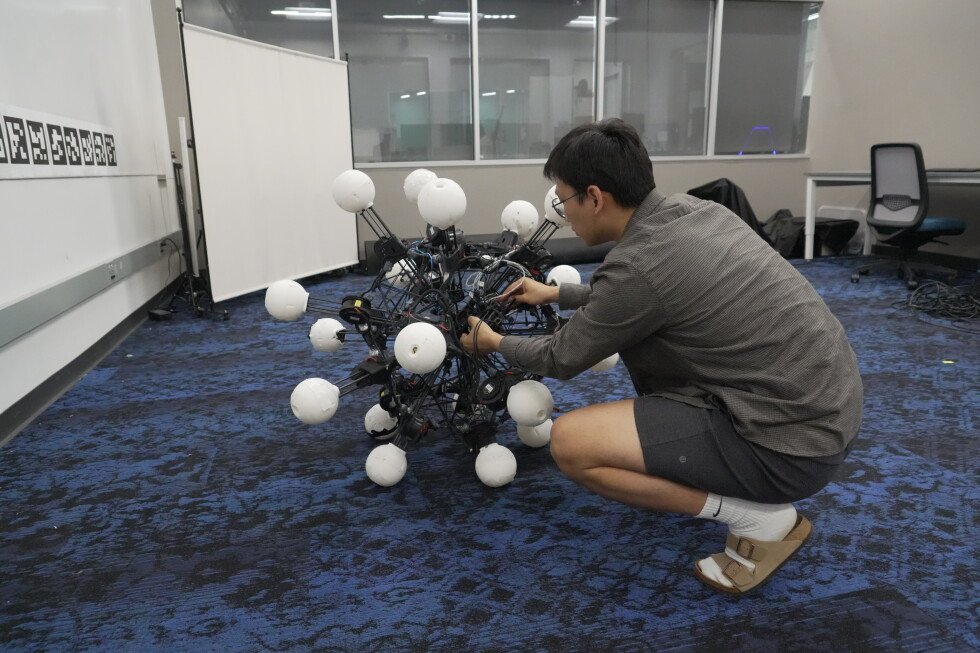
The result was Argus. The roly-poly robot named after a mythological many-eyed giant has depth-sensing cameras attached to 20 telescoping legs that radiate from a central core. With no front, back, top or bottom, it can see and move in any direction instantly.

“Instead of measuring how your legs are arranged around a different part of your body, we’re measuring how fast you can move in any direction,” Chen said. “Who said, you know, if you have a robot to help us in a most effective way, it has to look like us?”

In experiments, Argus has navigated sandy beaches and forest undergrowth, rolling over obstacles and stabilizing itself after being pushed. It can climb between parallel brick walls by alternating bracing and thrusting motions with its legs. If one or more motor dies or a leg breaks, it continues to function.

“Watching Argus move is unlike watching any other robot we’ve worked with,” said Jiaxun Liu, a graduate student and co-author of a study about Argus published online Wednesday in the journal Science Robotics. “The first time we saw it navigate among trees and rough terrain, even under heavy collisions, we knew this was something different.”

As part of their work, researchers developed a new design principle called dynamic isotropy that rates robots on a scale of 0 to 1 based on how uniformly they can accelerate in every direction. Most robots in use today, including humanoids and drones, score below 0.6. Argus scores 0.91.

“When a robot can accelerate equally well in every direction, it stops needing to face the world in any particular way,” said Chen, who hopes the same principle could guide the development of search and rescue robots, underwater or aerial vehicles or robots with the ability to grip objects.

“Instead of building a robot hand that looks like a human hand … one idea is to think about having Argus be the hand itself, and it can manipulate objects in any direction,” he said. “The knowledge we can transfer to the rest of the world is much more deeper than building an existing robot or copying an existing species.”

____

Ramer reported from Concord, New Hampshire.


Source link

Share. Facebook Twitter Pinterest LinkedIn Tumblr Email
IQ TIMES MEDIA
  • Website

Related Posts

Why LEGO Foundation says ‘PlayMatters’ to children in conflict zones

May 27, 2026

Venue gets mixed reviews as National Spelling Bee returns to DC

May 26, 2026

France’s parents’ groups demand justice in child abuse scandals

May 26, 2026
Add A Comment
Leave A Reply Cancel Reply

Editors Picks

Duke engineers develop robot with 20 legs and eyes

May 27, 2026

Why LEGO Foundation says ‘PlayMatters’ to children in conflict zones

May 27, 2026

Venue gets mixed reviews as National Spelling Bee returns to DC

May 26, 2026

France’s parents’ groups demand justice in child abuse scandals

May 26, 2026
Education

Duke engineers develop robot with 20 legs and eyes

By IQ TIMES MEDIAMay 27, 20260

DURHAM, N.C. (AP) — A robot being developed at Duke University is almost ready to…

Why LEGO Foundation says ‘PlayMatters’ to children in conflict zones

May 27, 2026

Venue gets mixed reviews as National Spelling Bee returns to DC

May 26, 2026

France’s parents’ groups demand justice in child abuse scandals

May 26, 2026
IQ Times Media – Smart News for a Smarter You
Facebook X (Twitter) Instagram Pinterest Vimeo YouTube
  • Home
  • About Us
  • Advertise With Us
  • Contact us
  • DMCA
  • Privacy Policy
  • Terms & Conditions
© 2026 iqtimes. Designed by iqtimes.

Type above and press Enter to search. Press Esc to cancel.