


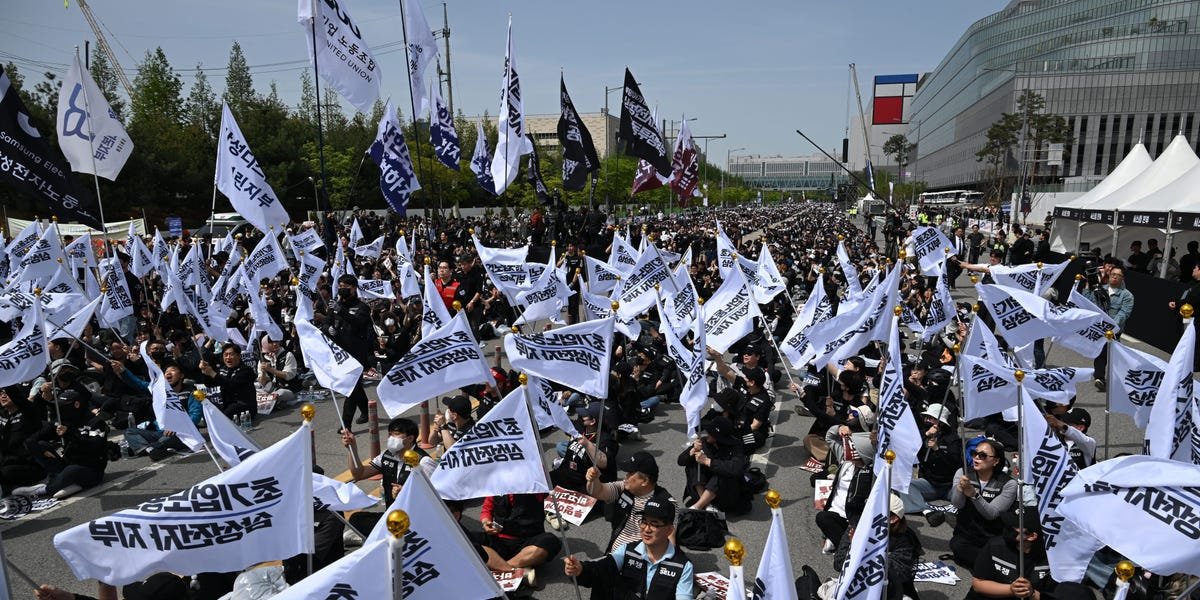
South Korea’s Samsung Electronics has become one of the biggest beneficiaries of the artificial-intelligence boom. Now the company faces a battle over who deserves a share of the gains.
Loading audio narration…
Talks between Samsung and its largest labor union broke down, according to Yonhap news agency, putting around 48,000 workers on track to begin an 18-day strike on Thursday over bonuses and profit-sharing.
Samsung shares tanked as much as 5% after reports that negotiations had collapsed.
The dispute comes at a sensitive moment for Samsung, which recently joined the trillion-dollar club as investors piled into AI-linked semiconductor stocks. The tech titan’s stock price has more than doubled this year.
Samsung sits at the center of the AI supply chain through its memory-chip business, which makes high-bandwidth memory chips used in AI servers.
The fallout from a prolonged labor dispute could stretch far beyond temporary production disruptions, wrote Jing Jie Yu, an equity analyst at Morningstar on Tuesday.
“The key obstacle is Samsung’s refusal to formalize profit-sharing in contracts,” Yu wrote in a note.
Yu warned that Samsung risks falling behind rivals if it fails to offer more competitive compensation. He pointed to rival SK Hynix, which shares 10% of operating profits with employees and scrapped bonus caps for a decade, arguing that Samsung’s weaker pay structure could hurt the company both immediately and over time.
Yu estimated that an 18-day strike could cut Samsung’s 2026 operating profit by about 5%.
The bigger concern is talent, as weaker compensation could make it harder for Samsung to retain and attract the engineers needed to stay competitive in the AI chip race, he added.
Not everyone believes the labor dispute will derail Samsung’s AI-driven rally.
Jeff Kim, the head of technology research at South Korea’s KB Securities, said concerns around strikes and bonuses have likely already been priced into the stock.
“Earnings momentum should mount further regardless of strike concerns,” Kim wrote in a Wednesday note.
Kim argued that demand for AI memory chips remains stronger than available supply as major US tech companies continue pouring money into AI infrastructure. That spending boom, he said, should continue lifting chip prices and profits even as labor tensions escalate.
Samsung’s labor dispute is feeding into a broader political debate over who should share in the gains from AI.
Last week, South Korea’s presidential policy chief, Kim Yong-beom, said some of the profits and tax revenues generated by AI should be “structurally returned to all citizens,” arguing the gains were built on decades of national industrial investment.
The official’s Facebook post on Monday night roiled South Korea’s red-hot stock market, sending the benchmark Kospi index down by as much as 5.1% the next day. Samsung and rival SK Hynix shares also dropped sharply.
The Kospi has surged about 65% this year after hitting a record high last Thursday, fueled by investor enthusiasm around AI-linked chipmakers.
The benchmark index — in which Samsung accounts for roughly a third of the weighting — was down over 2% by midday Wednesday as concerns over the labor dispute rattled investors.
