


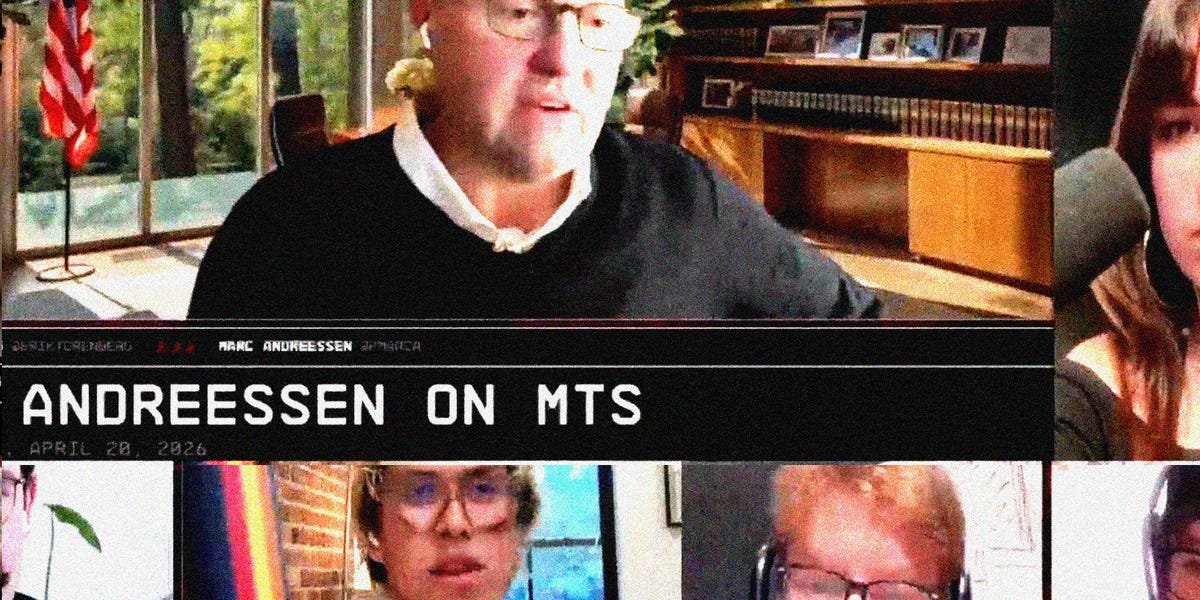
In April, Andreessen Horowitz — a venture capital firm that is also a media maverick — announced its latest investment: a news company called Monitoring the Situation, or MTS. Billed as “the first timeline-native news network that’s always on,” it promised a 24/7 firehose of “what’s happening RIGHT NOW,” broadcast live to the scrolling masses on X.
The announcement came just weeks after OpenAI acquired the popular tech podcast TBPN for a reported nine figures, and a year after Andreessen Horowitz, or a16z, acquired the tech podcast network Turpentine, both apparent efforts to shape the narrative about the tech industry. Silicon Valley has been idea-laundering through its own media for years — Airbnb, Casper, and Uber at one point all had their own magazines; Robinhood acquired a popular newsletter that offers financial news for young investors; Stripe issues a quarterly magazine for software engineers; and many founders, investors, and techno-literate have their own podcasts, Substacks, and YouTube shows to broadcast their takes. But MTS appeared to be the first of its kind to try to do this round the clock, building a full-stack media engine to compete with a news network. I decided to spend a week watching news exclusively from MTS.
My experiment got off to a bad start when I discovered that the “always on” network was, in fact, off. I had tried to tune in one morning around 7am, but there was nothing to watch. “We’re off air right now,” read a message on mts.now. “Next show TBA.” Without a broadcast schedule to go on, I was left to monitor the situation of Monitoring the Situation. Later, I discovered that the “future of news” is available only during the workday on Pacific Standard Time, exactly the opposite of “prime time.”
While I waited, I revisited the stream from the first day of programming, from April 20. The show started with a sizzle reel over a “Severance”-like score that mashed up images of computers and currency with video clips of Elon Musk shaking hands with Jensen Huang, Donald Trump shaking hands with Xi Jinping, and the moon landing. Andreessen Horowitz had promised MTS would feature “the main characters of the moment,” and it was clear that hosts Theo Jaffee and Sofia Puccini took this to mean themselves. They spent the opening 15 minutes of MTS’s debut show scrolling through posts on X about MTS — the digital equivalent of a news anchor reading his own fan mail on air.
Many parts of the show feel like Twitter for the illiterate.
The debut episode included interviews with Marc Andreessen and Balaji Srinivasan, a former partner at a16z, who each pontificated about the past and future of the media. (Andreessen: Projects like MTS could recreate the “randomonium” of early CNN. Srinivasan: The “New York Times” was as bad as the Chinese Communist Party.) It would be a stretch to call either of these segments interviews, or even conversations. Srinivasan spoke almost completely uninterrupted for two hours while the hosts sat on screen silently, interjecting only a few times with a softball question.
If this was MTS’s style, it was less like CNN and more like a Twitch stream. One of the core components of the show is the screen share, where the hosts show what they’re looking at on their laptops. At one point, Jaffee appeared onscreen to announce the news that Tim Cook would step down as the CEO of Apple. He did this by reading aloud from Apple’s press release, putting Cook’s Wikipedia page on screen, and then reading aloud from that.
There is a circular, self-dealing aspect to much of the coverage on MTS. In the week that I watched, guests included several current and former partners at Andreessen Horowitz, the founders of at least five startups that Andreessen Horowitz has invested in, and Marc Andreessen himself. One of the hosts, Puccini, is a recipient of a16z’s recently launched New Media Fellowship, an eight-week program designed to train the next generation to perform “timeline takeovers.” (It has been described as a “Thiel fellowship for the terminally online.”) The show also broadcasts on X, a platform that a16z invested $400 million in when Elon Musk acquired it in 2022, and MTS debuted on the world’s richest man’s most sacred holiday, 4/20.
In one sense, this is a masterpiece of vertical integration. Rodney Benson, a media researcher at New York University, and the author of “How Media Ownership Matters”, describes MTS as an “amenity” for Andreessen Horowitz. “You can use that media to diffuse ideas or promote your other business interests. And you don’t really care if you’re making money from it,” he says. On the other hand, if the point was to shift the narrative about the tech industry and the people in it, Benson wasn’t sure how MTS would be able to do that. “It’s mostly the industry talking to itself.”
Some of the best segments on MTS came from excellent bookings, such as a conversation between the journalist Taylor Lorenz and Srinivasan, the former a16z partner. It was an unlikely pairing (the two had a highly publicized online feud in 2020) that produced a surprisingly friendly conversation, where the two seemed to share a number of viewpoints about online privacy. Still, for a segment that had the trappings of a UFC fight — the chyron billed their debate as “Wikipedia vs. Grokipedia” — it somehow lacked the energy to sustain its rom-com length of 90 minutes.
“I feel like they haven’t really figured out how to keep the show lively,” says Eric Newcomer, who writes a popular Substack about the tech industry. Newcomer, who has written a fair bit about Andreessen Horowitz’s past forays into the media, told me he tuned into MTS to watch Lorenz duke it out with Srinivasan, and enjoyed the conversation. But overall, he noted that MTS hadn’t perfected the art of clipping the show into short, punchy bits, leaving viewers to sit through exceedingly long segments “which are often, sadly, somewhat boring.”
Media is a pretty shitty business. No offense. I think MTS is going to be great.crypto entrepreneur Jason Yanowitz, said to the MTS hosts
Some of the charm of MTS comes from a lack of polish: audio glitches, ticker tape displaying outdated information, the hosts’ constant deployment of Gen Z slang, or minutes of dead silence between segments. The hosts — there are about 5 on any given day — can be likeable in their candor, even though most are not trained journalists, and some have only just graduated college. Jaffee, who begins the show each morning, is 21, young enough to still have his SAT score displayed on his LinkedIn profile (1590, attaboy). But these very same qualities, which can make the viewer feel like they’re sitting in on a private conversation between friends, can also make MTS feel amateurish. Many parts of the show feel like Twitter for the illiterate: You are simply watching someone else scroll through their timeline and read the headlines out loud. Often, this is indeed the extent of “news” on MTS. One segment, reviewing the latest in the trial between Elon Musk and Sam Altman, involved the host screen-sharing and narrating updates from The New York Times’ liveblog of the trial (hopefully Srinivasan wasn’t watching).
Running a media outfit is hard work — something Andreessen Horowitz learned five years ago when it launched its own tech publication, Future. Margit Wennmachers, an operating partner at the firm, told Business Insider at the time: “It’s for participants rather than observers.” Future shut down after just 18 months. “They knew they wanted to own the media, and they knew they had a lot of friends that they could get, but they didn’t know the core story format or how they were going to operationalize running the thing,” says Newcomer. “It turns out, that’s actually pretty hard.”
MTS could face similar challenges. Even its own guests have pointed this out: In an interview segment last week, the crypto entrepreneur Jason Yanowitz told the hosts, “Media is a pretty shitty business. No offense. I think MTS is going to be great.” The show does arrive at a time when trust in institutional media is at an all-time low (a Gallup poll found that just 28 percent of Americans had “a fair amount” of trust in the media, the lowest number it has ever recorded), and while trust in individuals and influencers is on the rise. More than 40 percent of young adults get their news from TikTok. We are in the era of “going direct.”
More than 280,000 people tuned into MTS on its first day on air. (A network like CNN, by comparison, had about 900,000 viewers during primetime in April. TBPN’s best day had around 130,000 simultaneous viewers.) Since then, fewer people seem to be tuning in; on May 1, X shows that about 8,400 people watched the MTS livestream. It’s not an embarrassing number for a brand-new show, but it’s likely that most if not all of these people are already friends or fans of the Andreessen Horowitz worldview. If projects like MTS really are just the tech industry talking to itself, then it’s unclear what they achieve. An echo chamber of their own ideas? A place to answer their own questions? More than anything, the growing ecosystem of tech media — including MTS, TBPN, Pirate Wires, as well as podcasts like “The Marc and Ben Show,” “The Lex Fridman Podcast,” or “All In” — gives techies a place to evangelize without interruption.
A week of gorging on MTS left me feeling like AI is an infinite frontier, American dynamism is the only moral imperative, and there is no world beyond the tech world. When I finally closed the tab and opened The New York Timeson Friday evening, the rest of the world rushed back into view. It was May Day. There were protests in the streets for workers rights, a war authorization feud in Congress, a federal ruling on abortion pills. I had missed it all inside the dreamworld of MTS.
Arielle Pardes is a reporter in San Francisco covering the business and culture of technology.
Business Insider’s Discourse stories provide perspectives on the day’s most pressing issues, informed by analysis, reporting, and expertise.
