


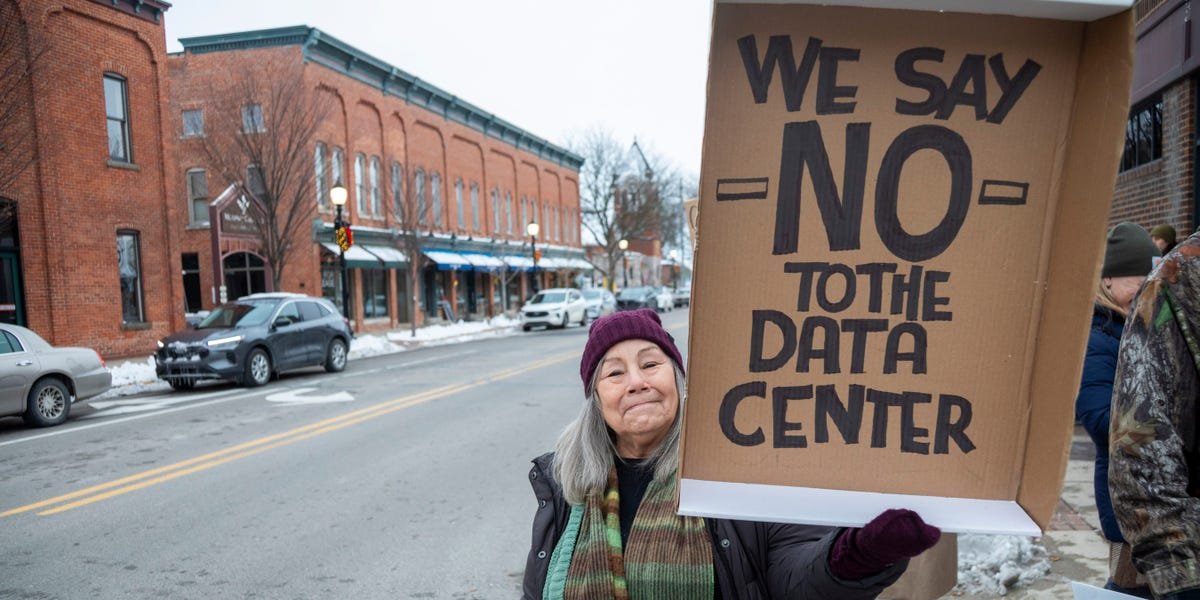
A swell of backlash against the data center development boom has left the industry struggling to reboot its image.
Loading audio narration…
The mounting opposition over issues such as rising power costs, water usage, and AI’s broader impact on the job market and environment could threaten trillions of dollars of projects backed by Big Tech, Wall Street investment giants, and a growing collection of developers.
Large and prominent projects have already become casualties of the blowback. In late March, a Virginia appeals court invalidated a rezoning for Digital Gateway, a planned 22 million square foot data center complex on a rural parcel outside Washington, D.C. — potentially scuttling the mega-project.
“The data center industry has gone too far. They’ve overpopulated certain jurisdictions, and people don’t want them,” Chap Petersen, an attorney who represented two nonprofit groups that sued to overturn the rezoning. “Communities are recognizing this is not free money, they impact the standard of living and people’s perceptions of their own neighborhood.”
Despite increasingly glaring setbacks, the disparate cast of players involved in the data center boom has struggled to unite and mount a coordinated defense.
“The worst business decision these companies can make is to invest billions in infrastructure while ceding the public debate to the loudest voices who will regulate them out of existence,” the Artificial Intelligence Infrastructure Coalition wrote in a statement to Business Insider.
The Washington DC-based advocacy group, which was cofounded late last year by former politicians Kyrsten Sinema, a US senator from Arizona, and Garret Graves, a Louisiana congressman, added that the “industry can’t outsource the sales job” — an acknowledgment that it needed to take a more active hand in public relations and politics.
Some industry leaders openly said that, as data centers proliferate around the country, they have failed to win over a public that is increasingly aware and skeptical.
“The data center industry hasn’t done a good job of explaining itself,” said Ryan Mallory, the CEO of Flexential, a data center developer and operator. “I want to be very vocal about this so people know and understand how valuable these sites are.”
The growing threat of regulation
The negative sentiment toward the industry is spilling over into politics.
In March, Vermont Sen. Bernie Sanders and New York Congresswoman Alexandria Ocasio-Cortez jointly proposed a federal ban on data center development. Several individual states, including Maine, are considering moratoriums.
Legislators in Virginia, which hosts the largest data center market in the country, are examining whether to do away with a lucrative incentive that has saved data center developers billions of dollars in sales taxes on the equipment they install at facilities.
Another data center executive who spoke to Business Insider anonymously because he has projects under public review in various locations around the country, singled out Big Tech companies because he believed the enormity of their development plans had spurred the public’s ire and the threat of regulation. He said he has seen them do little to present a rousing, unified message to the public, in part because of the intense competition among them to win the AI race.
“You’re trying to get Google and Amazon and Oracle and Meta to all say the same thing and agree,” he said. “Elon Musk and Mark Zuckerberg want to get into a cage fight.”
The result, he said, has been a fragmented response that has been insufficient “to combat the abundance of misinformation swirling around.”
In the crosshairs of controversy
Once obscure to the wider public, data centers are now in the crosshairs of several leading controversies, including a nationwide affordability crisis.
As facilities have sprawled across the country, they have necessitated costly, large-scale utility infrastructure, including transmission lines and power plants. That, in turn, has driven up electricity prices for some consumers.
“Folks are calling electricity prices like the new price of eggs,” said Christie Hicks, an attorney at Earthjustice, an environmental organization that has been critical of data center development. “I don’t think that there’s anyone who would say, yes, I would like to pay more for my electricity so that I can subsidize some of the wealthiest companies in the world.”
Because they provide the heavy computing for AI, data centers have also become emblematic of a technology whose rapid advance has stoked widespread fears about job losses across the economy. Much of the data center boom, meanwhile, has been energized by burning fossil fuels, drawing opposition from environmental groups who say the facilities will contribute significantly to the climate crisis. Some facilities deplete local water resources by consuming millions of gallons a day for cooling.
Major tech companies, along with other leading participants in the building boom, have sought to assuage the criticism. In a recent blog post, “Building Community-First AI Infrastructure,” a Microsoft executive said the company won’t siphon away water or raise energy prices, will create jobs, provide AI training, and that its facilities will contribute revenue for essential public services like schools and libraries.
“We partner closely with local and state leaders, listen to community needs, and ensure our investments benefit residents,” Oracle said in a statement provided to Business Insider. The company has partnered with OpenAI to build tens of billions of dollars of data centers across the country.
QTS, which is owned by the Wall Street investment giant Blackstone and is one of the developers behind the Digital Gateway project, said in a statement that it is “focused on being a transparent, trusted partner to responsibly deliver the infrastructure behind modern digital life.”
A matter of national security
In early March, Amazon, Google, Meta, Microsoft, xAI, OpenAI, and Oracle announced what has been seen as one of their biggest coordinated efforts at publicity, signing an agreement with President Donald Trump in which they pledged that the costs for their power infrastructure “are not passed to American households.”
The agreement “shows an awareness that these companies understand they have a public perception issue at least and they’re interested in trying to address that,” Hicks said.
The data center executive who didn’t want to be identified said the industry needed more of that kind of collaborative approach. He pointed to when US semiconductor manufacturers in the 1980s banded together to work on research and design, rally domestic support, and beat back foreign competitors.
He said the industry should launch a similar initiative oriented around the idea that the AI race is a matter of national security and that the US’s future economic vitality depends on prevailing over rivals like China.
George P. Bush, the nephew of former president George W. Bush, who operates a public affairs firm in Texas that has assisted data center industry participants navigate development in the state, said that “this overarching competition of technological supremacy” is difficult for “everyday constituents to conceptualize.”
He said that even in Texas, which has long been considered a business-friendly state, there were some signs of skepticism. The state has more planned data center development than any market in the country, but Bush said that in private conversations, pubic officials, who he declined to name, who had once championed projects, had now signaled concern to him.
“In 2024, where people would say, ‘we want these types of developments’,” Bush said. “Those same individuals that I’ve had personal conversations with now are saying ‘hey, wait a second’.”
