


An unprecedented heat wave for the month of March is continuing to hold strong across the southwestern and western United States.
Dozens of March temperature records were broken on Thursday in states including Arizona, California, Colorado, New Mexico, Nevada, Utah and Wyoming.
Several cities in Arizona and California broke 100 degrees Fahrenheit. Some places saw temperatures higher than all-time April records. In Flagstaff, Arizona, temperatures reached 84 degrees, which is 11 degrees higher than any other day in March history and 4 degrees hotter than any time in April.
How extreme heat can impact your mental health as high temperatures sweep US
Doctors told ABC News that people can suffer severe health effects in extreme heat and these effects can be worsen when high temperatures come earlier than expected.
“Heat causes your body to work harder to regulate its temperature and, when this becomes extreme, the systems that regulate temperature can fail,” Dr. Lauren Siewny, an assistant professor of emergency medicine at Duke University School of Medicine and medical director of the Duke University Emergency Department, told ABC News.

Jeff Chiu/AP – PHOTO: People visit Baker Beach in San Francisco, March 18, 2026.
How extreme heat can be dangerous for health
Typically, during extreme heat — meaning temperatures are hotter or more humid than average — the body tries to cool itself by sweating.
Not replenishing with fluids can lead to dehydration. One’s body temperature can continue to rise, which can lead to other heat-related illnesses.People may experience a sunburn, a heat rash or heat cramps, with signs including muscle pain and spasms.
More severe effects include heat exhaustion or heat stroke, a life-threatening condition when the body’s temperature rises above 104 degrees and cooling mechanisms fail.
Being exposed to extreme heat can cause even more damage to the body, Dr. Kai Chen, an associate professor of epidemiology at Yale School of Public Health, told ABC News.
Mix of extreme heat and wildfire smoke can be very dangerous, experts say
“What the research in the past two to three decades has consistently shown is that the heat impact goes beyond these kinds of injuries: heat stroke, accidental deaths,” Chen said. “It can lead to a full spectrum of diseases ranging from increased risk for heart attack events, respiratory illnesses, leading to kidney failure, kidney disease.”
A 2022 study jointly conducted by researchers in China and the U.S. found that days with extreme heat were linked to an increase in kidney disease-related ER visits.
Research has shown that extreme heat can also impact mental health, according to Chen.
A 2021 study, which Chen co-authored, found an association between short-term exposure to extreme heat and increased ER visits for mental health disorders.
Additionally, people on certain medications, including some antidepressants and antipsychotics, can have trouble regulating temperature, according to the Centers for Disease Control and Prevention.

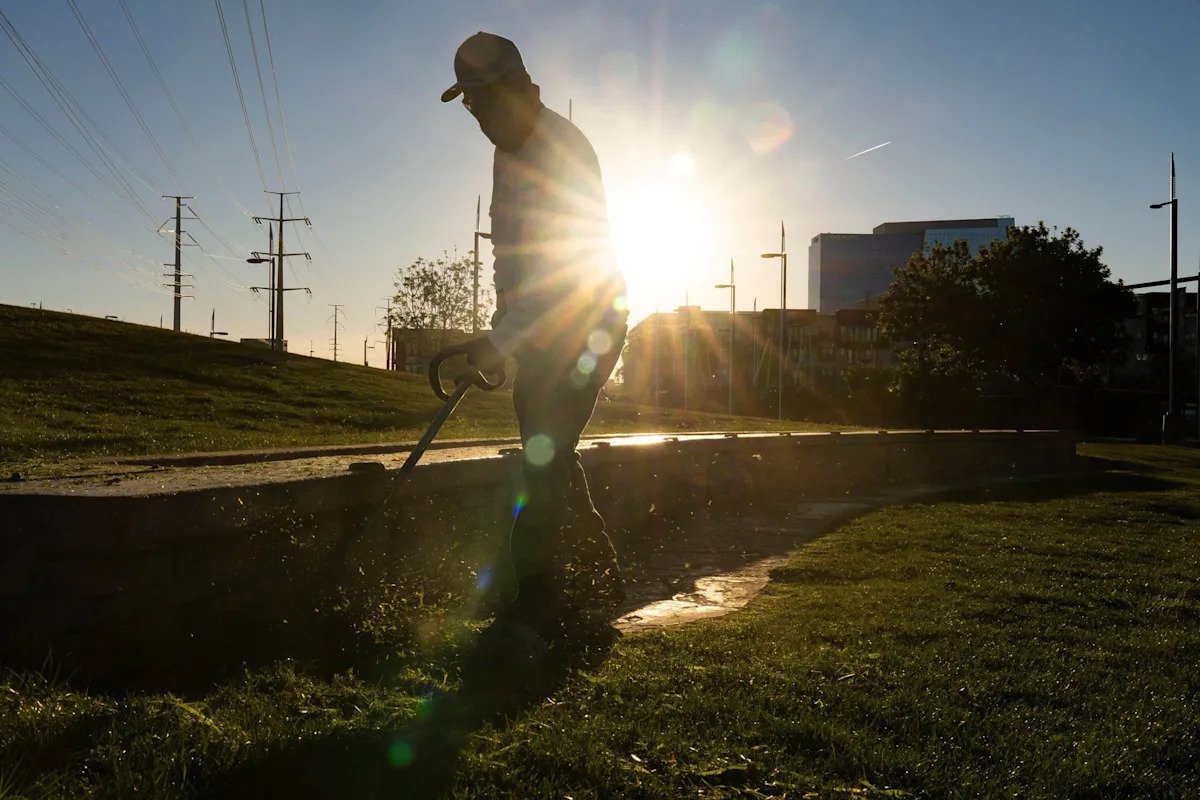
Rebecca Noble/AP – PHOTO: A City of Tempe Parks and Recreation Department groundskeeper manicures grass as the sun rises at Tempe Town Lake, March 19, 2026, in Tempe, Ariz.
Why it’s dangerous for extreme heart to come early
“From a body standpoint, it does take about two weeks to acclimatize the high heat temperatures and so, early in in the spring-summer season, when we face high temperatures, the body is less efficient at sweating,” Siewny said. “And so you’re more likely to reach those high body temperatures that can lead to organ damage.”
She added that there’s also a mismatch between the safety mechanisms usually in place to protect from heat illness and what is actually in place at the time.
Siewny said air conditioners may not be running yet, people aren’t used to hydrating and drinking more water and schools or sports teams haven’t adapted their schedules to account for high temperatures.
Extreme weather events like Texas rain are more likely to occur due to climate change, scientists warn
“All of this combines to mean that those initial heat waves are going to be more and more deadly than what we see later on in the year when we have systems in place to expect it,” Siewny said
Chen added that research has shown early-season heat waves are often more dangerous than those that occur later in the summer.
A 2010 study from the Yale Environmental Engineering Program and School of Forestry and Environmental Studies found that in early summer heat waves, the risk of death increases about 5% compared to late summer heat waves, when the risk only increases about 2.5%.
To stay safe, experts recommend using air-conditioning or finding your nearest cooling center or public space if air conditioning is not available. They also recommend people wear light, loose-fitting clothes, limit time outside and drink plenty of water.

Jeff Chiu/AP – PHOTO: Clive Lovejoy reads a book while lying on grass at Dolores Park in San Francisco, March 18, 2026.
Chen added that long-term plans need to be put in place by governmental leaders, such as cutting carbon emissions, because a warming climate will lead to more extreme weather events.
“The past decades have been the warmest decades on record and, unfortunately, we are experiencing more intense, more frequent and more early heat waves,” he said. “If we do not cut our carbon emissions, these things will happen more, and it will happen not just in the South or Southwest U.S. We have a warming climate, and there’s really no way we can stop it unless we reduce the root cause.”
ABC News’ Kenton Gewecke contributed to this report.
