


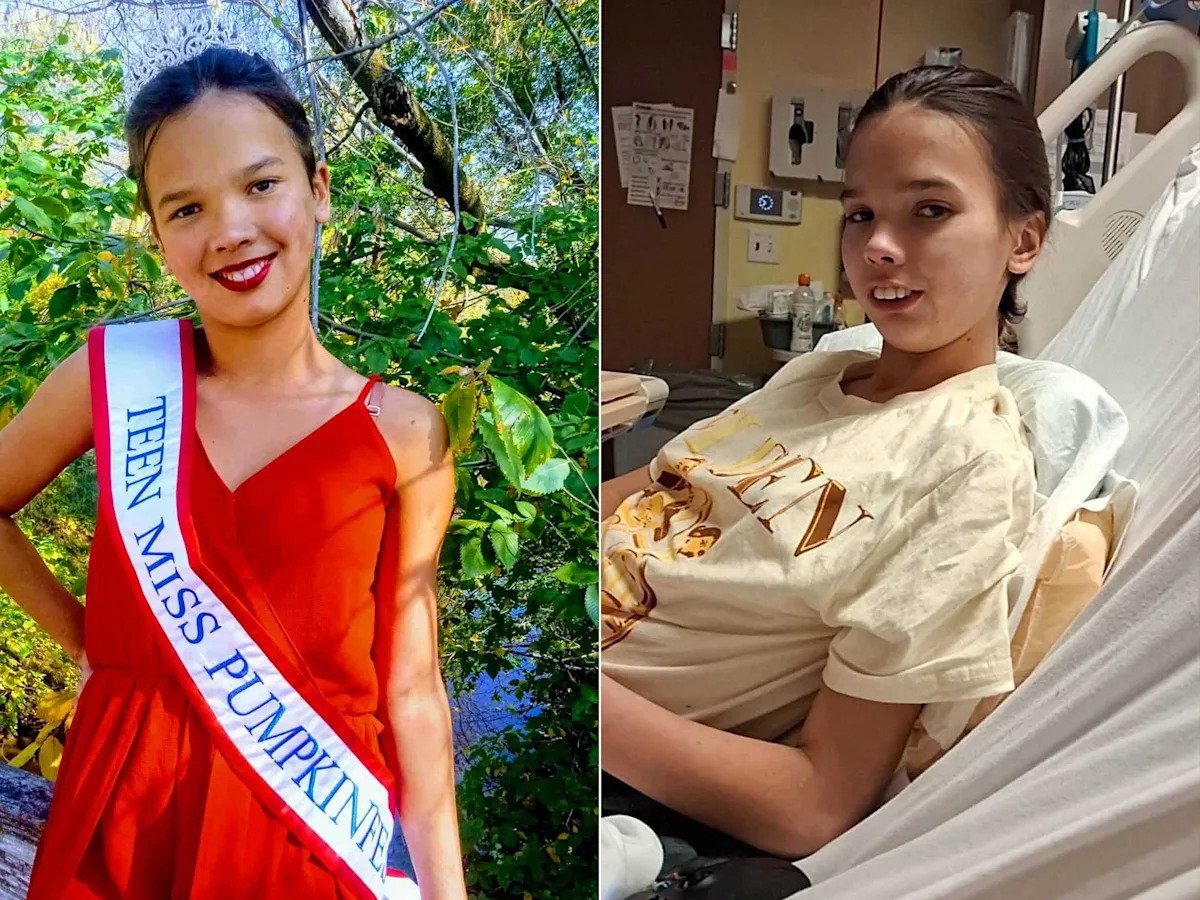
When 14-year-old Makayla Skjerva came home from school last month complaining that the side of her neck was hurting, her parents didn’t think she had much more than a mild illness.
However, that symptom soon progressed to body aches, a fever and a noticeable rash. Then came notifications from the health department and Makayla’s school that a measles exposure may have occurred at the school gym.
Soon after, Makayla, from Cavalier, North Dakota, tested positive for measles and her health rapidly declined. She was quickly hospitalized and had to be transferred to another state by air ambulance to receive care.

Courtesy of Ashley Skjerva – PHOTO: Makayla Skjerva, 14, from Cavalier, North Dakota, was exposed to measles at school in February 2026.
Her battle with measles comes amid a resurgence of the virus in the U.S. Last year, the nation saw the highest number of measles cases in 33 years with 2,283 confirmed infections. This year, measles cases surpassed 1,000 in just two months.
Her stepmother, Ashley Skjerva, told ABC News that Makayla was vaccinated against measles but, because she is immunocompromised, it left her at high risk for infection and serious complications.
“Makayla is a fighter but the fight’s not over,” Ashley said. “We’re all trying to hold ourselves together and it’s been very difficult. I’m just glad she’s here still. That’s all I keep saying to myself.”
Susceptible to illness
Ashley said Makayla was diagnosed with autoimmune encephalitis, which occurs when the immune system mistakenly attacks brain cells and causes inflammation, when she was 5 years old.
Although autoimmune encephalitis does not directly cause higher infection susceptibility, many patients often become immunocompromised due to necessary, long-term immunosuppressive treatments.
New map shows how to spot the measles risk level in your ZIP code
Ashley explained that Makayla has always been more susceptible to illness and has had trouble battling infections in the past.
Ashley said Makayla is fully vaccinated against measles. The Centers for Disease Control and Prevention (CDC) currently recommends people receive two doses of the measles, mumps, rubella (MMR) vaccine, the first at ages 12 to 15 months and the second between 4 and 6 years old. One dose is 93% effective, and two doses are 97% effective against measles, according to the CDC.
Measles was declared eliminated from the U.S. in 2000, in large part due to a highly effective vaccination campaign. However, CDC data shows vaccination rates have been lagging in recent years, leading to record levels of measles cases.
When more than 95% of people in a community are vaccinated, most are protected through herd immunity, according to the CDC. Doctors say herd immunity is important to protect everyone but especially those at high risk for severe illness, such as the immunocompromised; those who are too young to be vaccinated; or those who can’t be vaccinated for medical reasons.
“If we look at kids who are immunocompromised, they are relying on the community to protect them, not only against measles but against other infections,” Dr. Alok Patel, a pediatrician at Stanford Children’s Health and an ABC News contributor, who didn’t treat Makayla, said. “They rely on community immunity. They rely on having a 95% vaccination coverage shield so they do not catch the measles.”
He added that just because a fully vaccinated individual contracts measles, it doesn’t mean the MMR shot is ineffective.
“This is why we talk about risk reduction. Nothing is 100% effective in life. Not car seats, not helmets, not vaccines, but we’re trying to reduce the risk of a complication,” Patel said. “Now, in immunocompromised children, they have not only a higher chance of getting the measles, they have a higher risk of getting a potentially serious complication, even if they’re vaccinated.”
However, “there is a reason why the overwhelming majority of kids in this country who are getting the measles are unvaccinated, the overwhelming majority of complications we see from the measles are in unvaccinated children,” he added.

Courtesy of Ashley Skjerva – PHOTO: Makayla was fully vaccinated against measles, but her weakened immune system left her susceptible to illnesses. She was battling measles, pneumonia, COVID-19 and Haemophilus influenzae.
In North Dakota, where Makayla lives, there have been 24 measles cases so far this year, according to North Dakota Health & Human Services. Last year, North Dakota recorded 36 measles cases, which was the first time the state had seen the virus since 2011.
A recent map from ABC News — in collaboration with researchers from New York and Massachusetts that allows people to type in their ZIP code and see the measles risk in their area — found that in Cavalier, Makayla’s hometown, the measles risk is medium with 70% to 70% of young children receiving at least one MMR dose.
Makayla first started feeling ill on Tuesday, Feb. 10, Ashley said. That Friday, her parents tried to take her to the ER, but medical staff said they couldn’t see Makayla because a measles exposure had been confirmed at her school. They recommended Tylenol and ibuprofen be given for pain as well as nebulizer treatments, Ashley said.
Both Makayla and her 1-year-old sister, Armani, who had not received her first shot yet, contracted measles. While Armani had a mild illness, Makayla’s was more severe.
“Makayla has had [the vaccine], but with a [weak] immune system, it doesn’t do anything,” Ashley said. “My little one got sick, and she’s doing better. She’s got the immune system to fight it off. Makayla didn’t.”
Ashley said she brought Makayla and Armani to a clinic on Thursday, Feb. 19, by which time the teenager was having a hard time breathing. Her oxygen saturation levels fell to 62%, which is critically low.
1 year since measles cases found in Texas, US still seeing surge of infections with elimination status at risk
Clinic staff told Ashley that Makayla needed urgent medical care and to go to the hospital immediately. Makayla’s dad, Derrick, picked up their youngest daughter and brought her home while Ashley went with Makayla by ambulance about 160 miles south to Fargo.
“It went downhill from there,” Ashley said.
Hospitalization and transfer to Minneapolis
Makayla was admitted to Sanford Children’s Hospital in Fargo, during which doctors discovered she had measles, pneumonia, COVID-19 and Haemophilus influenzae, which is a bacterial infection, according to Ashley.
As many as one out of every 20 children with measles develops pneumonia, according to the CDC. It is the most common cause of death from measles in young children, the federal health agency says.
Research has shown that co-infection with other illnesses is common in patients who have measles-associated pneumonia.
Patel said about in one in five unvaccinated people who contract measles is hospitalized, but figures may be higher when looking at a subgroup, such as those who are immunocompromised.
“While many people assume or believe that measles is just an upper respiratory infection, potentially with a rash, for a lot of individuals, especially those who are susceptible — either immunocompromised or not vaccinated — the acute and long-term complications can be very serious,” he said.

Courtesy of Ashley Skjerva – PHOTO: Makayla started out experiencing a sore neck, which progressed to a rash and eventually more severe measles complications. She was hospitalized and had to be life-flighted to Minneapolis.
Because she was struggling to breathe, Makayla was given a standard nasal cannula to increase the flow of oxygen, according to Ashley. When that was no longer sufficient, medical staff placed Makayla on a CPAP machine to maintain airway pressure. By early the next morning, she was placed on a BIPAP machine, which offers multiple pressure levels, Ashley said.
Ashley said Makayla was falling in and out of responsiveness. Doctors told her they needed to sedate Makayla so she could be intubated.
“It happened really fast and then at that point, like, what do you do?” Ashley said.
Doctors told Makayla’s family she needed to be transported to Minnesota so she could receive care that she was unable to receive in North Dakota. If she stayed in North Dakota, she would have to undergo high-frequency oscillatory ventilation, which is an ICU-based ventilator method used to treat severe respiratory failure, Ashley said.
“When finally she stabilized, they literally told us that we had three hours to get people [to Fargo],” Ashley said. “They had put her in a paralytic state to transfer her, and we had people come up and say their goodbyes. … They had told us three times that ‘If she stays here, we have to put her on the oscillator, and that’s her last stage here. We cannot do any more. If we put her on it, she will die. She will not come off of it.'”
Makayla was transferred by air ambulance to M Health Fairview University of Minnesota Medical Center — West Bank in Minneapolis, according to Ashley. She said there wasn’t enough room in the air ambulance due to the number of paramedics, so she and Makayla’s mother drove three hours to meet her at the hospital.
Is the US at risk of losing its measles elimination status?
Ashley said Maykala’s condition slowly began to improve in Minneapolis. About two days later, doctors paused Makayla’s paralytic to confirm she had movement in her extremities and was able to answer questions via fingers or head movements.
“She was on pain medications,” Ashley said. “She was on steroids and a wide, wide, wide variety of antibiotics. And then she became stable enough. They finally took her off the paralytic, and it was a slow process to making sure she was able to hold her own oxygen levels.”
According to Ashley, the main reason for the urgency in transfer from Fargo to Minneapolis was because doctors were planning to place Makayla on an Extracorporeal Membrane Oxygenation (ECMO) machine.
The machine pumps a patient’s blood outside the body, oxygenates it and then sends it back into the bloodstream, which allows the heart and lungs to rest.

Courtesy of Ashley Skjerva – PHOTO: After her condition improved in Minnesota, Makayla was transferred back to North Dakota and released over the weekend of March 7.
However, the medical team in Minneapolis was able to leave Makayla on the ventilator and gradually decrease her dependence on it, Ashley said.
She added that doctors also prophylactically treated Makayla for meningitis, which can be a serious — but less common — complication of measles.
The vaccine ‘can save lives’
Makayla slowly came off ventilation and her condition improved enough so she could be transferred to Sanford Medical Center in Fargo on Saturday, Feb. 28, Ashley said. By the beginning of March, doctors were able to remove all lines and begin weaning Makayla off of her medications.
Ashley said Makayla was taken off her feeding tube and was able to eat real food as of March 3, in addition to walking slowly.

Courtesy of Ashley Skjerva – PHOTO: Makayla’s family says she has a long road to recovery at home and are spreading the importance of being vaccinated to protect those who are immunocompromised.
“She had to use a walker, and she can take slow bites,” Ashley said. “She has to chew for a very long time because with the tube [her throat] was very, very, very sore.”
On Friday, March 6, Makayla was discharged from the hospital. Ashley said Makayla is having a hard time walking due to being very weak and weight loss from her illness but that she is glad to be home.
Ashley said Makayla has “a long road ahead” and that she and her husband are currently in the process of getting virtual school set up for Makayla. She has plenty of doctors’ appointments in Fargo ahead, as well as a scheduled visit once every four months in Minneapolis.
Ashley said she and other family members felt a lot of anger and sadness that Makayla was exposed to measles in the first place, but said she believes it’s nobody’s fault.
She said she wants people to understand that getting the measles vaccine could help not only protect themselves but those who are at risk of severe illnesses such immunocompromised people or those who have autoimmune disorders, like Makayla.
“I understand that people have the right to vaccinate or choose not to but please think about the fact that there are millions with autoimmune compromises,” Ashley said. “That one poke can save their lives and can protect not only yourself and your children but others and their children as well.”
