


Tinder held its inaugural product keynote on Thursday, unveiling an ambitious slate of updates designed to reinvigorate its product, bolster safety, and harness AI. This comes on the heels of Match Group’s $50 million investment in product development, announced last August, as the parent company looks to re-engage its user base and win over younger Gen Z daters.
Among the updates are innovative features for discovering in-person events and meeting people in real life, alongside a new virtual speed dating experience being tested in Los Angeles. Additionally, a series of AI enhancements were introduced to improve the matching algorithm and enhance user safety.
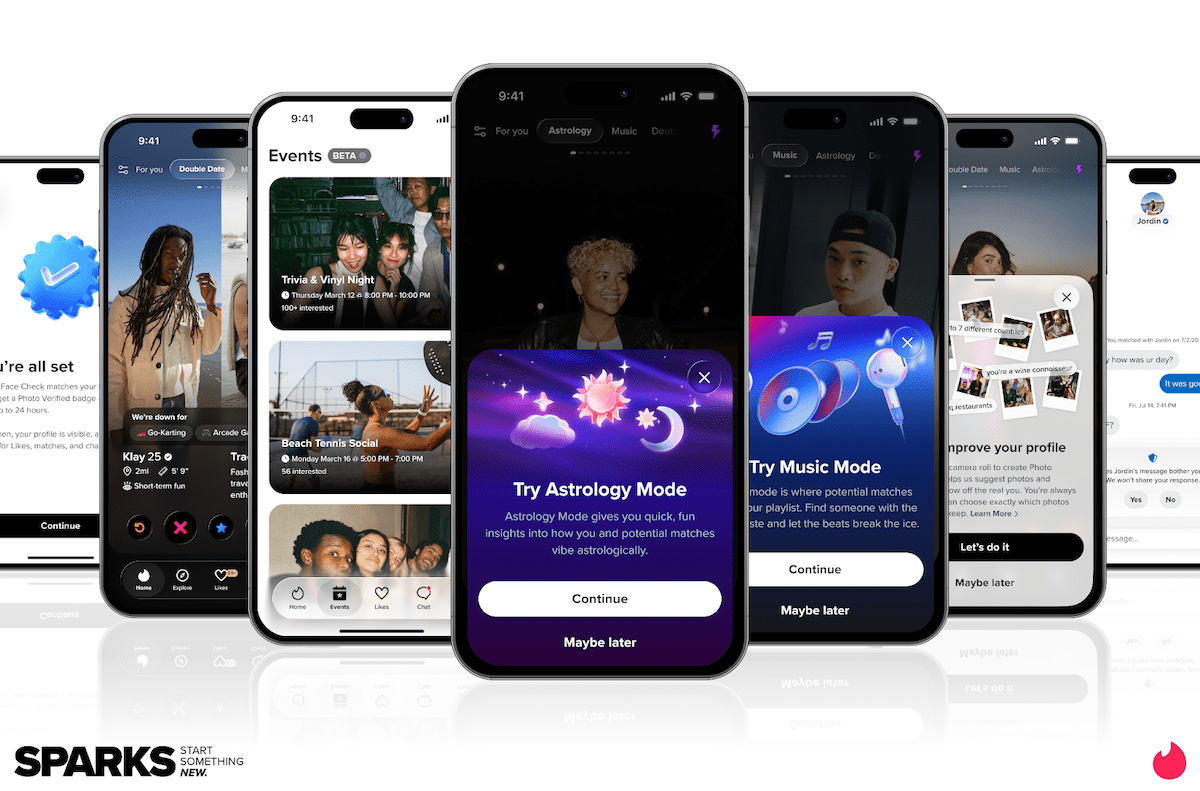
One of the most notable features is the new Events tab, which will be in beta for users in Los Angeles starting in late May or early June. This feature lets users discover curated local events— such as speakeasies, bowling, raves, and pottery classes — where they can connect with matches in person.
This is a nod to Gen Z’s growing appetite for real-world encounters over endless swiping. There has been a shift away from traditional dating apps, as young people seek authentic offline experiences or unconventional ways to meet potential partners. Other apps, like Breeze, 222, Timeleft, and Thursday, have also tapped into this in-real-life (IRL) trend.
“We’re really trying to tap into meeting younger users at the places where they’re already hanging out,” Hillary Paine, senior vice president of product at Tinder, told TechCrunch. “You can go to an event with your friend and have a good time, or you could meet somebody new. Instead of asking users to choose between their dating life and their social life, we’re trying to blend these things together and create a more social community first experience.”
Profiles of event attendees will be available on the app after the event for users to like and swipe through, a concept reminiscent of “Missed Connections” ads, allowing users who may have lacked the courage to approach someone or simply missed the opportunity to reconnect.

Speed dating is also experiencing a resurgence. To hop on the bandwagon, Tinder revealed it’s now piloting a video speed dating experience in LA, where users can join scheduled three-minute video chats with potential matches. This serves as a “vibe check,” designed to help people break the ice and gauge chemistry before committing to an in-person meeting.
The company noted that users will have the option to extend promising conversations beyond three minutes. Your profile photo has to be verified to join the experience.
Many daters appear to have become fatigued by video chats, making it intriguing to see if this experiment, introduced late in the game, will achieve success. During the COVID-19 pandemic, Tinder launched a Face-to-Face feature that was later discontinued, indicating a decline in interest.
AI was also a major theme at the keynote.
Tinder is continuing to invest in the technology, starting with its “Chemistry” feature, which utilizes AI to learn about users through questions and, with their permission, their camera rolls. This feature curates daily matches to help reduce swipe fatigue and is now rolling out in the U.S. and Canada after initial testing in Australia and New Zealand.
In the future, aspects of Chemistry will grow from being just one feature into something that shapes the entire Tinder experience, making it more personalized, the company said.

Additionally, Tinder introduced a new “Learning Mode” that presents more relevant matches earlier on. The system is designed to quickly gain insights into what users are seeking in potential matches, adapting recommendations to better suit personal preferences. Previously, Tinder needed multiple swiping sessions to gather enough signals to personalize well.
With Learning Mode, Paine notes, it can start to understand a user from the very first session. She said, “We’re hoping that this is something that makes Tinder really feel like it understands you from the very first time you use it, or if you’re returning to Tinder after some time away, it feels like it gets me, and I don’t have to spend a lot of time telling Tinder what I’m looking for again.”
Tinder is also enhancing safety features like “Does This Bother You?,” which now uses large language models to better detect harmful messages and auto-blurs disrespectful content, while “Are You Sure?” prompts are being fine-tuned to more accurately identify potentially harmful interactions.

Visually, Tinder is getting a sleek redesign: edge-to-edge profile photos, a subtle blur effect, and a Liquid Glass aesthetic for the Like and Nope bar. New modes are also on the horizon: “Music Mode” will allow up to 20 Spotify songs to auto-populate a user’s profile, and “Astrology Mode” will let users add birth details to unlock their Sun, Moon, and Rising signs and check compatibility. This follows the recent launch of Double Date Mode and College Mode.
Overall, the slew of announcements signals a pivotal shift in Tinder’s approach. While Match reported a positive earnings result in Q4 2025, with $878 million in revenue, the company has faced consecutive quarters of declining paying subscribers. Consequently, it’s under pressure to retain users and restore investor confidence, even as its outlook remains cautious, acknowledging changing user preferences and heightened competition.
It remains to be seen whether these changes will help maintain daters’ interest in the app. However, one thing is clear: Tinder is making a significant commitment to the future of dating, shifting away from solely relying on swiping and adapting to what it believes its young users want.
