


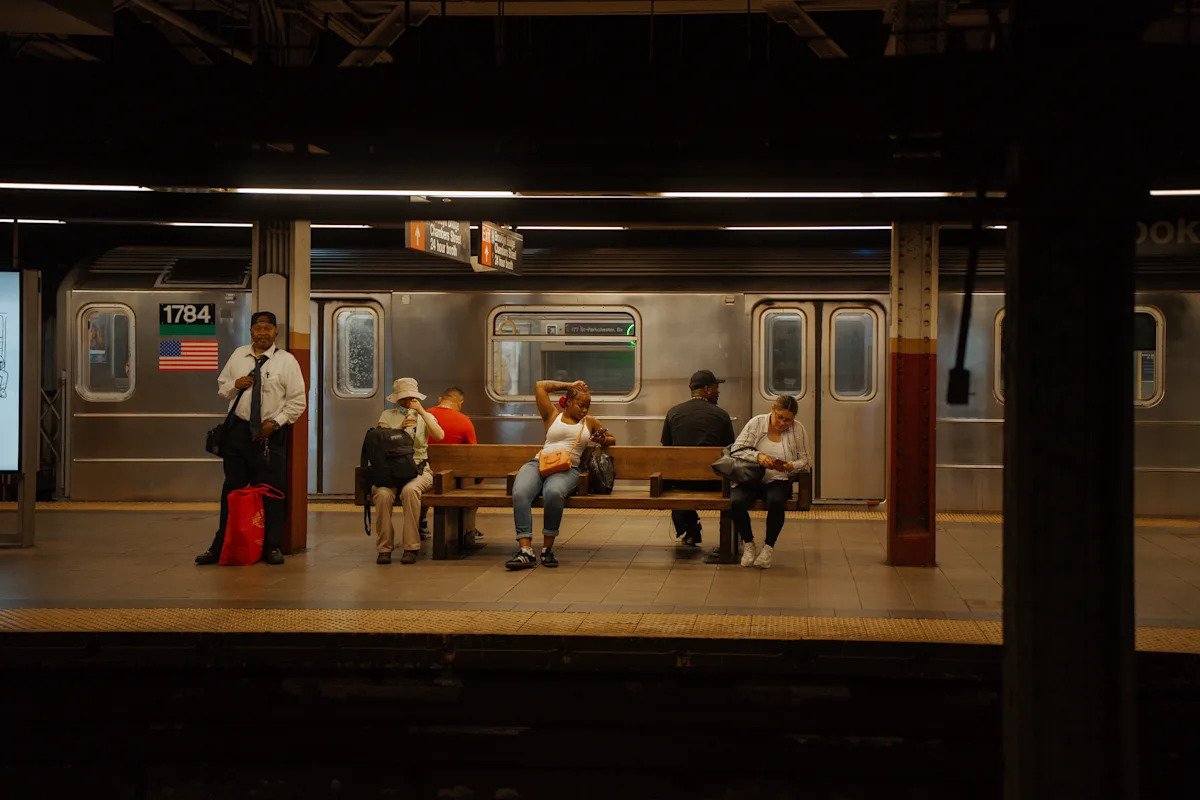
Commuters, residents and tourists who take to social media during warm months to complain about sweltering subway systems in New York, Boston and London should feel vindicated — new research says they aren’t alone.
As temperatures rise aboveground, the number of subway riders reporting uncomfortable heat belowground increases, according to a new study in the journal Nature Cities on Tuesday. This could worsen as climate change, driven by the burning of fossil fuels, makes for a hotter planet.
Northwestern University researchers analyzed more than 85,000 crowdsourced social posts on the social platform X and Google Maps reviews from 2008 to 2024 in those three major cities’ subway systems. They searched for keywords related to being too hot — or what they called “thermal discomfort” — in those metropolises, which are some of the world’s oldest and busiest. The experts looked for terms such as “hot” and “warm” while filtering out results that did not seem to relate to temperature, such as “hot dog.”
The study’s authors said subway riders may expect temperatures to be naturally cooler underground. They found that a 1-degree Fahrenheit (0.56-degree Celsius) increase in outdoor temperature led to a 10% increase in complaints in Boston, 12% in New York and 27% in London. Earth’s average temperature warmed 1 degree F (0.56 degrees C) from 2008 to 2024, according to the National Oceanic and Atmospheric Administration.
The researchers analyzed posts across seasons, time of day and day of week.
“Interestingly, over the weekend, people complained less,” said Giorgia Chinazzo, assistant professor in Northwestern’s Department of Civil and Environmental Engineering, who co-authored the study with associate professor Alessandro Rotta Loria. Chinazzo speculated that one reason may be that people were dressing differently than on workdays.
Some limitations
Flavio Lehner, an assistant professor of Earth and atmospheric sciences at Cornell University who was not involved in the work, said the research “follows the template of previous studies that link environmental conditions to human behavior using social media data.” He has also studied how warm conditions trigger a stronger online reaction.
Lehner said limitations of the research include only monitoring three city transit systems, and it being difficult to control for other factors influencing social media behavior.
University of Washington public health and climate professor Kris Ebi, who was also not involved in the study, said the actual impact of subway heat is likely to be greater than researchers found because vulnerable groups are underrepresented on social media.
Ebi said the size of the study “provides compelling evidence that cities should be planning for measures to keep people safe during hot weather.”
The potential for energy savings
Work such as this could certainly play a role in influencing how policymakers and subway operators adjust to heat extremes.
“We’re all experiencing rising temperatures. So those above will be reflected underground, and this will be reflected in people complaining more and more,” Chinazzo said. “Mitigation and adaptation strategies are things that will be much more implemented in the future.”
This could mean installing fans or operating cooling at more specific times of day. It could also mean offering drinking water at certain times.
“We need new technologies and tools, new methodologies that people can use to face these changes in temperatures that everyone is aware of and experiencing nowadays,” she added. “And it will be worse in the future.”
___
Alexa St. John is an Associated Press climate reporter. Follow her on X: @alexa_stjohn. Reach her at ast.john@ap.org.
___
Read more of AP’s climate coverage.
___
The Associated Press’ climate and environmental coverage receives financial support from multiple private foundations. AP is solely responsible for all content. Find AP’s standards for working with philanthropies, a list of supporters and funded coverage areas at AP.org.
