


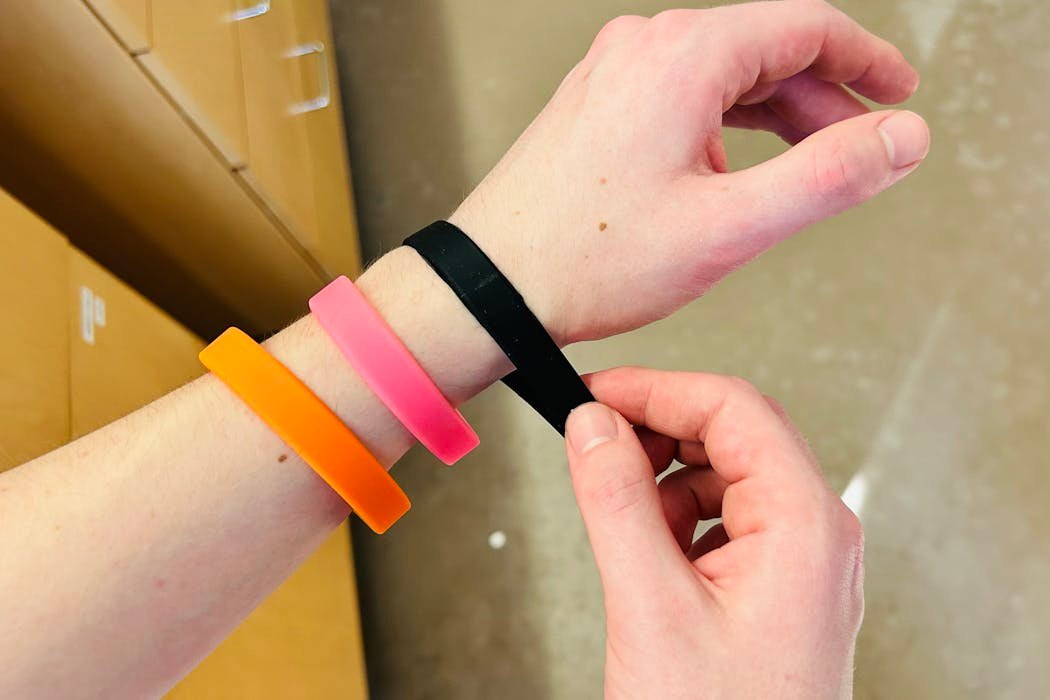
Every morning, people fasten their watch, slip on a bracelet and head out the door without thinking much about what they might encounter along the way. The air they breathe, the dust on their hands and the surfaces they touch all feel ordinary. Yet many chemical exposures happen quietly, without smell, taste or warning.
What if something as simple as a silicone band around your wrist could help track those invisible exposures?
Environmental monitoring has traditionally relied on snapshots of exposure from a water sample collected on a single day, a blood sample drawn at one point in time, or soil tested from a specific location. But exposure unfolds gradually as people move through different environments and come into contact with air, dust and surfaces throughout the day.
New noninvasive monitoring tools aim to capture that longer-term picture.
As synthetic chemicals such as “forever chemicals,” known as perfluoroalkyl and polyfluoroalkyl substances (PFAS), become more widespread in everyday environments, scientists are increasingly focused on understanding how exposure to these substances occurs in daily life.
Traditional monitoring misses everyday reality
Traditional monitoring methods are essential for identifying contamination, but they capture exposure as a moment rather than something that unfolds over time.
In studies involving people, measuring exposure often requires invasive procedures such as blood draws, which can be expensive, logistically challenging and, for some participants, uncomfortable enough to discourage involvement.
Early in my environmental chemistry research, I noticed something that didn’t quite add up. People living in the same agricultural community, or animals sharing the same landscape, often showed very different chemical profiles even when environmental measurements looked similar. The surroundings hadn’t changed much; daily behavior had.
Movement through different spaces, time spent indoors or outdoors, contact with treated surfaces and interactions with consumer products all shape exposure in ways a single sample can’t fully capture. That realization raised a larger question: If exposure unfolds gradually, how can scientists measure it using tools designed for specific moments? Answering that question requires a shift away from isolated measurements and toward approaches that reflect lived experience.
What noninvasive tools change
That question led me to work with passive, noninvasive monitoring tools, including silicone wristbands. Rather than actively collecting samples, these tools absorb chemicals from the surrounding environment over time, similar to how skin or fur interacts with air, dust and surfaces.
Silicone wristbands work because they are made of a silicone polymer called polydimethylsiloxane, or PDMS, that can absorb many organic chemicals from the surrounding environment. As the band is worn, compounds from air, dust and surfaces gradually diffuse into the silicone over time.
The material acts somewhat like a sponge, passively collecting traces of chemicals the wearer encounters during daily activities. After the wristband is worn for several days or weeks, researchers can extract those compounds in the laboratory and analyze them to better understand patterns of exposure.
Silicone wristbands are one example of a broader group of passive, noninvasive monitoring tools designed to observe how chemicals accumulate over time. Other approaches, including passive air samplers placed in homes or small wearable devices, follow similar principles by absorbing compounds from the surrounding environment.

Researchers have used noninvasive tools in community studies to track exposure without medical procedures, lowering barriers to participation and reducing the burden on volunteers. For example, scientists have applied these approaches to study exposure among adolescent girls in agricultural communities, firefighters and occupants in office buildings.
Researchers have also adapted similar ideas for animal and wildlife studies. Instead of drawing blood, scientists may use wearable tags, collars or passive samplers placed in an animal’s environment, such as nesting areas or habitats, to understand how chemicals accumulate over time. These approaches can offer insight into exposure across different ecosystems while minimizing stress on animals.
Like any method, passive monitoring has limitations. Some chemicals are more difficult to capture than others, and environmental conditions such as temperature, sunlight or airflow can influence how efficiently samplers absorb pollutants. Wearable devices also reflect exposure over a specific period, meaning they cannot provide a complete lifetime record.
These approaches do not replace traditional monitoring. Instead, they add context, showing how exposure accumulates across time and space rather than appearing suddenly at a single sampling point.

Air samplers are placed in an area of interest so scientists can use them to check chemical exposure. This method can help in animal studies to understand what chemicals wildlife is exposed to. Venier Lab
Why this matters now
In the United States, PFAS contamination has become a growing public concern, from drinking water advisories to product restrictions and cleanup efforts. Federal agencies, including the Environmental Protection Agency, have highlighted the persistence of these chemicals and their widespread presence in the environment.
Much of the public conversation focuses on where PFAS are found in water systems, soils or consumer products. Understanding exposure, however, also requires attention to how people and ecosystems encounter these chemicals in everyday settings.
Noninvasive monitoring tools may help fill that gap. They offer ways to better understand cumulative exposure, identify overlooked pathways and inform environmental health and conservation decisions. For wildlife, these methods may allow researchers to detect emerging risks earlier without adding pressure to species already facing habitat loss and climate stress.
Although these approaches are becoming more common in environmental health research, they are still emerging compared with traditional sampling methods. Costs, the need for standardized protocols and differences in how various chemicals interact with passive materials can slow wider adoption. As researchers continue refining these tools, they can complement rather than replace established monitoring strategies.
This article is republished from The Conversation, a nonprofit, independent news organization bringing you facts and trustworthy analysis to help you make sense of our complex world. It was written by: Yaw Edu Essandoh, Indiana University
Read more:
Yaw Edu Essandoh does not work for, consult, own shares in or receive funding from any company or organization that would benefit from this article, and has disclosed no relevant affiliations beyond their academic appointment.
