


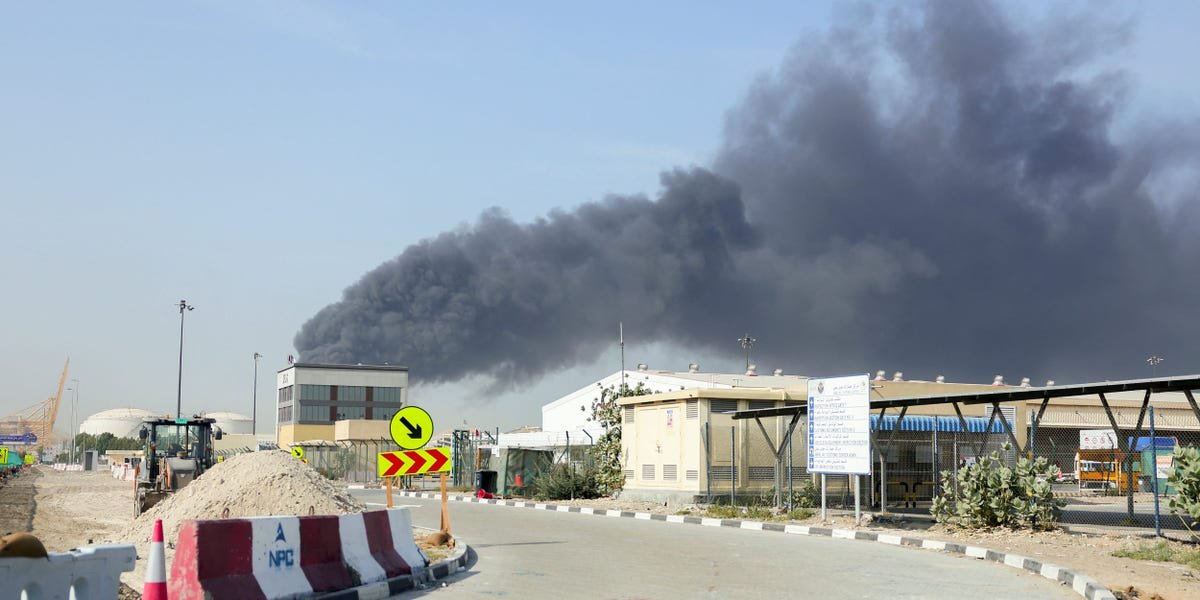
As Anthropic and the Pentagon clashed over how the military should use AI, another new reality of warfare emerged several thousand miles away: data centers are now targets.
Loading audio narration…
This week, Amazon said that three of its data centers in the Middle East — two in the United Arab Emirates and one in Bahrain — had been damaged by drone strikes during the US-Iran war.
Amazon Web Services, its cloud division, evacuated staff and closed access to at least one data center due to “structural damage” and flooding caused by the Sunday attacks, according to an internal document reviewed by Business Insider.
The two UAE data centers were “directly struck,” while the Bahrain site was damaged by a drone strike “in close proximity,” Amazon said Monday.
On Wednesday, Iran’s Islamic Revolutionary Guard Corps took responsibility for strategically targeting one of the Amazon sites due to the company’s support for the US military activities, Iran’s state media said. Business Insider could not independently verify this information.
It is the first time that Big Tech data centers have been directly targeted by military strikes, and it brings a new threat to the doorstep of companies that have invested heavily in the region to keep pace with the AI boom.
The Middle East has around 4.5 gigawatts of data center capacity, with an additional 1.7 GW in the pipeline, DC Byte, a data center intelligence company, told Business Insider. Most of the planned capacity right now is for Saudi Arabia and the UAE, the firm added. 1 GW is roughly equivalent to the power needed to run the homes of a midsize city like San Francisco.
The IRGC also claimed responsibility for targeting a Microsoft site in the Middle East.
A Microsoft spokesperson said the company had no indication of any attack and that its data centers in the region were operating as normal.
Neither Google nor Microsoft’s data centers have shown any outages in the region this week, according to their service pages.
As of Friday, service at the damaged Amazon data centers remains offline or heavily disrupted. The company has recommended that customers “enact their disaster recovery plans.”
The outages underscored how dependent much of the world’s technology is on data centers. Mudassir Sheikha, CEO of the Dubai-based ride-hailing and food delivery app Careem, said earlier this week that some of its services were “impacted by an external AWS UAE outage” and had since been restored. Various banking apps also saw disruptions throughout the week.
An Amazon spokesperson pointed to the AWS Service Health Dashboard for the latest updates. A Google spokesperson did not respond to a request for comment.
Defending data centers
Data centers are typically designed to be resilient, with workloads often distributed across different regions to limit the impact of a single location being knocked offline.
However, as the AI boom clashes against turmoil in the Middle East, the billions of dollars being poured into data centers come with more risk as a new warfare strategy emerges.
“Data centers have become the new infrastructure for economies,” said James Lewis, senior advisor at the Center for Strategic and International Studies. “If you think about how people are going to build infrastructure, before it was railroads and steam engines. Now it’s data centers and fiber optics.”
The outages experienced by some services this week further highlighted how data centers could be considered a key infrastructure target in warfare.
Lewis cited the Russia-Ukraine war as another recent example in which data became central to the conflict, as Ukraine took steps to prevent Russia from accessing data stored on the country’s servers.
“The thing that has changed now in the Gulf is that people need to think about ‘how do we defend them?'” said Lewis.
Data centers emit a big heat signature that makes them difficult to hide, Lewis said.
“You’re not going to be able to hide them. The question is, can you harden them? Can you defend them? That’s what people haven’t thought about because we didn’t have to before,” he added.
Saudi Arabia is moving quickly to expand its data center capacity and position itself as a major global player in AI. The country last year launched Humain, a new company designed to build a full-stack AI ecosystem from data centers up to the models. Humain has also struck partnerships with Nvidia and AMD to build out data centers with their chips.
Meanwhile, tech giants are pledging to invest more in the region. In November, Microsoft said it plans to have invested $7.9 billion in the UAE by 2029, while Amazon pledged more than $5 billion as part of a strategic partnership with Humain last year.
