


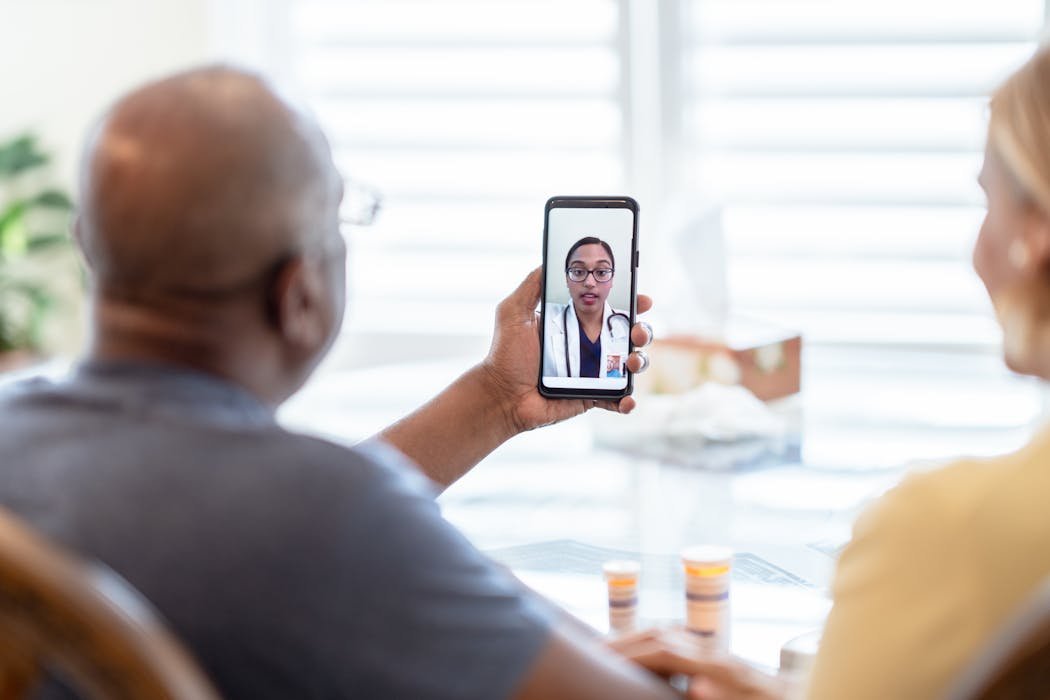
Americans age 65 and older who are insured by Medicare logged about 60 million telehealth visits annually between 2021 and 2023 – about 31 million for mental health and 29 million for other health issues. That’s the key finding in a new study I co-authored in the journal Annals of Internal Medicine.
We also found that people with Medicare coverage who used telehealth services were generally in poorer health and faced more physical and functional limitations in their daily life, compared with their counterparts who only had medical appointments in person.
To get at these numbers, we analyzed a national survey called the Medical Expenditures Panel Survey, which provides a nationally representative snapshot of how different groups of Americans use and receive health care. Based on our analysis, we generated national estimates of telehealth visits that reflect care patterns for everyone insured through Medicare, a federal health insurance program primarily for people age 65 and older as well as some younger people with disabilities.
Why it matters
In just a few years, telehealth has become a central part of how health care is delivered in the United States – and it is likely to continue to play an important role in the health care system.
Before 2020, patients rarely got their health care virtually. About 1.7% of Medicare patients – 910,490 people – used telehealth for medical appointments in 2019. These were mostly patients in rural areas, and only certain clinics were authorized to offer it.
But during the COVID-19 pandemic, the federal government expanded telehealth coverage for people insured by Medicare to make it easier for patients to maintain access to health care. Many insurance companies did, too. The number of Medicare patients using telehealth services jumped to 53% in 2021, corresponding to nearly 28.3 million telehealth users at the peak of the pandemic.
While telehealth appointments overall – not just for people with Medicare coverage – have dropped since the height of the pandemic, they remain much higher than pre-pandemic levels, according to data from Epic, the largest electronic medical record company in the U.S.
Legislation passed in 2021 made Medicare’s coverage of telehealth permanent for mental health services. But coverage for accessing care via telehealth for other types of health conditions, such as respiratory infections or diabetes, is set to expire in 2027 – and policymakers are still deciding whether to continue it.
Our findings underscore the important role that telehealth has come to serve in enabling older adults to access health care for all types of acute and chronic medical conditions. Emerging research suggests it can help them see their providers more consistently without compromising the quality of care compared to in-person visits.
Limiting access to telehealth services could reverse recent gains in access for older adults – particularly for patients who have geographical or health limitations that can make getting to in-person appointments challenging.
What still isn’t known
While our study sheds light on who used telehealth and for what medical conditions, several important questions remain.
First, we did not explicitly examine quality of care. More research is needed to pin down whether telehealth visits are comparable to in-person visits for treating different conditions. My colleagues and I plan to explore this issue for specific conditions, such as diabetes.
Second, our analysis focused on people who have Medicare coverage. Patterns may differ for younger patients or those with other kinds of health insurance.
However, our study aligns with others that have examined telehealth use since the pandemic.
While no single study or report is perfect, the overall evidence suggests that telehealth can help improve access to care and appears to be a reasonable alternative – either by itself or as a complement to in-person care for certain medical conditions.
This article is republished from The Conversation, a nonprofit, independent news organization bringing you facts and trustworthy analysis to help you make sense of our complex world. It was written by: Terrence Liu, University of Utah
Read more:
Terrence Liu does not work for, consult, own shares in or receive funding from any company or organization that would benefit from this article, and has disclosed no relevant affiliations beyond their academic appointment.
