


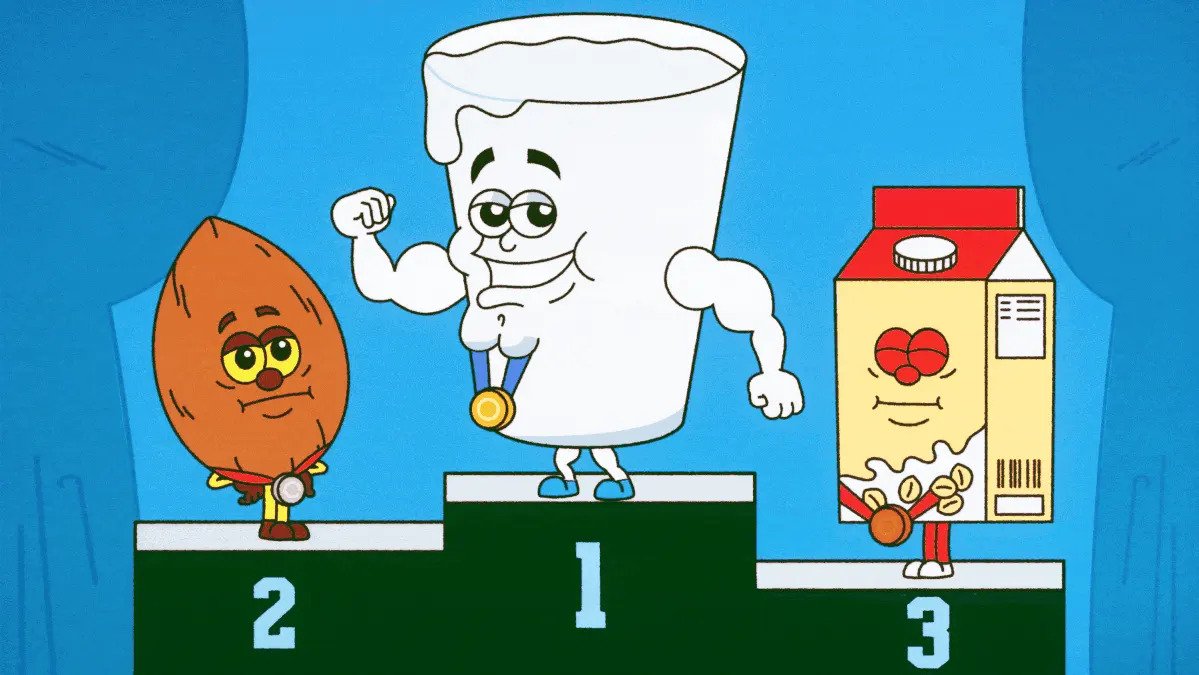
Full-fat dairy is back on top. Whole milk now dominates the dairy aisle. (Illustration: Hunter French for Yahoo News)
On the internet, you can find every kind of girlie: nap girlies, Pilates girlies, Bravo girlies, Prozac girlies, book girlies — to name a few.
Chelsea Shackel thought she was an oat milk girlie.
The 30-year-old aesthetician grew up drinking whole dairy milk. But when she moved to Los Angeles in 2018, not only did it seem trendy to order oat milk drinks, but “it seemed wrong to get whole milk all of a sudden. … I remember being fed information about whole milk, and I think I just convinced myself that it was bad for me.” She even wondered if she had a lactose intolerance.
Shackel considers herself a very “wellness and health conscious person, so doing a small shift” — to plant-based milk — “made me feel like I was doing something [good for me],” she says. So, for years, she stuck to oat-milk everything.
That is, until a Starbucks barista mistakenly put whole milk in Shackel’s coffee earlier this year. She decided to keep the coffee and give whole milk another try. It was … delicious. “It tasted so much better, and I didn’t have any stomach issues,” Shackel says. On TikTok, she found others, including the makeup influencer Jaclyn Hill, who had switched back to drinking whole milk. “OK, I’m not the only one,” Shackel thought.
And so, Shackel became a whole milk girlie, as many others define themselves on social media.
In the wake of the nut milk craze of the last several years, whole milk is back in a big way — and lots of adults are drinking it, according to recent Yahoo/YouGov polling.
The U.S. rebounds from a long dairy decline
After years of steady decline, milk sales are ticking back up.
Americans’ milk consumption has been falling since the 1970s, according to the U.S. Department of Agriculture (USDA). Part of that drop came after the American Heart Association (AHA) urged people to cut back on saturated fat amid research suggesting that it could raise levels of “bad” (LDL) cholesterol. As a result, “dairy fat has really been unfairly demonized for almost 50 years,” Dr. Dariush Mozaffarian, a cardiologist and director of the Tufts University Food Is Medicine Institute, tells Yahoo.
The stigma hit whole milk especially hard, impacting overall milk sales — although skim and low-fat varieties saw some gains. Milk sales peaked in 2009, and decreased every year afterward — until 2024. The rebound was driven by rising sales of whole milk, which climbed that year, even as Americans bought less of every other type of milk, including skim and 2% milk. Adding to the momentum, recent updates to the U.S. dietary guidelines now say that “when consuming dairy, include full-fat dairy with no added sugars” — though the guidelines still note that saturated fat should make up no more than 10% of daily calories.
However, even before the January update to the dietary guidelines, another seismic shift was working in favor of whole milk: the protein craze. In the era of proteinmaxxing, some people are even mixing their protein powder into a glass of whole milk to double their dose, Lizzy Davis, a registered dietitian-nutritionist and assistant professor at the University of Alabama at Birmingham, tells Yahoo. Plus, nut milk prices have risen more than those for dairy, and some cafes have even added a surcharge for oat lattes and almond cappuccinos.
You could say that whole milk is having a moment. Pantone’s color of the year for 2026 is “cloud dancer,” a shade of white that’s been compared to milk. Raw milk has become a cultural flash point, vaunted to fame and infamy by influencers, including Ballerina Farm. And social media’s “milk girlies” are hawking A2 milk, a version supposedly less likely to cause stomach upset. There’s even a clothing brand called Dairy Boy.
Today, about a third of American adults drink whole milk, according to our Yahoo/YouGov polling of 1,704 people between February 9 and 12, 2026. Of the 81% who said they drink some kind of milk or milk alternative, 59% said they primarily drink dairy milk, and most (32%) said they drink whole milk. Twenty-one percent of respondents said they use 2% fat milk (chosen by 21%) and plant-based alternatives (12%). While milk is most commonly used in cereal (54%), many adults will gulp down a glass, with 42% reporting drinking milk on its own.
Most respondents said they’re drinking the same amount of milk as before — or less. But sales, which are rising for whole milk, and declining for plant-based milks, suggest that some share of the population may be making the switch from oat or almond to whole milk.
Is whole milk healthy?
This is a hotly debated question in nutrition for decades. Mozaffarian started researching the link between dietary fat and cardiovascular health in part because of “the national focus on low-fat diets,” he says. Even then, he says research didn’t strongly support the idea that reducing dietary fat intake led to better health. “The evidence actually supported more fat and less starch and sugar,” Mozaffarian explains.
On the other hand, diets high in saturated and trans fats (found primarily in highly processed foods) are linked to higher levels of bad cholesterol, which can raise heart disease risks. But “what we eat as far as fat might not have as big of an impact on those blood-fat levels as we originally thought,” says Davis. The latest, large-scale review of studies on the subject had fittingly paradoxical results: For people at low risk for heart disease, the amount of saturated fats in their diets made little difference, but it did matter for those at an elevated risk of heart attack.
Fewer studies have specifically compared full to low-fat milk, however. Mozaffarian cites one that found that when whole milk drinkers switched to low-fat milk, they wound up eating more starch and sugar. Low-fat and alternative milks often also contain added sugars or a higher proportion of sodium, and Mozaffarian suspects that many of the additional calories people consumed came from unhealthy ultraprocessed foods. Whole milk, in contrast, is very filling, and that feeling of satiety may lead people to consume fewer calories from other sources than they might otherwise, Davis explains.
There also might be something special about saturated fat from dairy in particular. Some research suggests that the short chains of amino acids (cellular building blocks) in milk fat may benefit human metabolism and insulin sensitivity. Other studies indicate that consuming milk, cheese and yogurt — of any fat content — does not directly increase heart disease or stroke risks.
Overall, whole milk may offer some health benefits for many people, while low-fat milks may be better for those at risk for heart disease. Bottom line: Your milk choice alone is unlikely to make or break your health, and any kind you choose can fit into a nutritious diet.
For Shackler, the switch to whole milk wasn’t about better health — it simply tastes better to her. And that’s actually a good guiding principle, says Mozaffarian. “I don’t think the evidence is strong enough to tell people to only have whole-fat dairy, but if you prefer whole-fat dairy or it helps you switch from sugary, more processed versions [such as sweetened oat milk], that’s more real food — and that’s great,” he says.
